


 For all latest news, follow the Daily Sun's Google News channel.


The government has raised electricity tariffs at both retail and wholesale levels in a move aimed at reducing the government’s subsidy burden.
The Bangladesh Energy Regulatory Commission (BERC) on Wednesday approved an average 16.68% increase in retail electricity tariffs and a 19.85% rise in wholesale power prices, effective from June billing cycles.
The regulator also raised electricity transmission, or wheeling, charges by 23.96%, citing higher generation, procurement, import, transmission and distribution costs, alongside broader financial challenges in the power sector.
Under the revised structure, the weighted average wholesale electricity price has increased from Tk7.00 per unit to Tk8.39, while the average retail tariff has risen from Tk9.11 to Tk10.63 per unit. Transmission charges have gone up from 31.35 paisa to 38.86 paisa per unit.
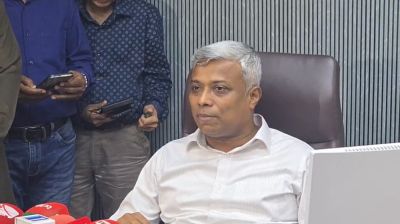
Announcing the decision at a press conference in Dhaka, BERC Chairman Jalal Ahmed said the adjustment was necessary to ease pressure on public finances.
Despite the increase, the government will still need to provide around Tk41,000 crore in annual subsidies to offset losses in the power sector, a BERC official said.
Consumers to be under pressure
Energy experts warned that the impact of the tariff hike would extend far beyond electricity bills, affecting manufacturing, agriculture, transportation and household spending at a time when consumers are already grappling with persistent inflation.
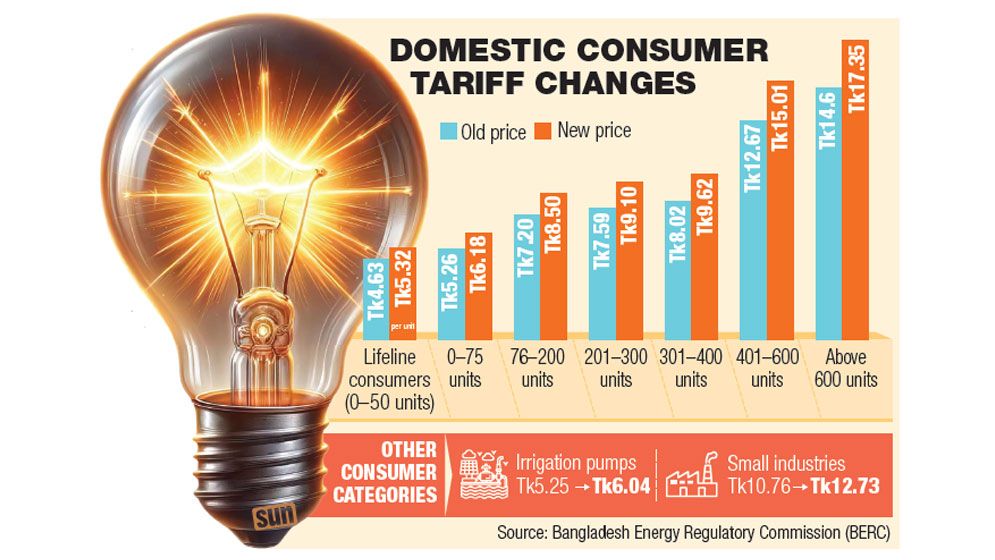
Particular concern surrounds low-income households. Tariffs for “lifeline” consumers – households using up to 50 units of electricity per month – have increased by 14.9%, from Tk4.63 to Tk5.32 per unit.
Introduced to provide subsidised electricity to lower-income users, the lifeline tariff has more than doubled over the past 16 years, rising from Tk2.50 per unit in 2010.
Other residential consumers also face significant increases. The highest rise among domestic users was recorded in the 301-400 unit consumption bracket, where tariffs increased by 19.95%.
Electricity tariffs for irrigation pumps have increased by 15%, while small industrial consumers will face an 18.3% rise. Tariffs have also been raised for commercial establishments, educational institutions, hospitals, religious organisations and electric vehicle charging facilities.
‘Inflation concerns deepen’
Energy expert Prof M Tamim said the increase would disproportionately affect low-income households and could further fuel inflation.
“The impact of higher electricity prices will not be confined to utility bills,” he said. “Production costs will rise across sectors, including food processing, edible oil, plastics and agriculture, ultimately leading to higher consumer prices.”
He warned that rising energy costs could weaken industrial competitiveness, increase operating expenses and potentially affect employment.
The agricultural sector is also likely to face higher costs as electricity-dependent irrigation systems become more expensive, potentially driving up food production and retail prices.
Tamim argued that reducing subsidies should not rely solely on tariff hikes. Instead, he called for greater operational efficiency, lower generation costs and structural reforms within the power sector.
He also advocated increased investment in renewable energy, particularly rooftop solar systems for factories, commercial buildings, educational institutions and government facilities, to reduce dependence on imported fuels and lower long-term generation costs.
Economists, consumer groups voice concern
Dr Mustafa K Mujeri, former chief economist of Bangladesh Bank, warned that repeated increases in electricity and fuel prices create ripple effects across the economy.
He said policymakers must strike a balance between reducing subsidies and protecting households whose purchasing power has been steadily eroded by inflation.
According to the Bangladesh Bureau of Statistics, inflation stood at 9.04% in April 2026, while food inflation was 8.39%.
Wage growth has remained below inflation for 51 consecutive months since February 2022, resulting in a prolonged decline in real incomes. In 2024, average inflation stood at 10.33% against wage growth of 7.94%, while food inflation peaked at 14.10% in July, its highest level in more than a decade.
Consumer rights advocates criticised the latest tariff adjustment, arguing that inefficiencies in the energy sector are being passed on to consumers.
SM Nazer Hossain, vice-president of the Consumers Association of Bangladesh (CAB), said higher electricity tariffs would increase costs across industry, agriculture, transport and household consumption.
“Electricity, gas and other energy sources are key drivers of economic activity. Any increase in energy costs ultimately translates into higher prices for goods and services,” he said.
He urged authorities to reduce system losses, corruption and operational inefficiencies rather than placing additional burdens on consumers, particularly low-income households.
Political backlash
Bangladesh Jamaat-e-Islami condemned the decision as “anti-people” and demanded an immediate withdrawal of the increased tariffs.
In a statement, Secretary General Mia Golam Porwar said the hike, announced ahead of the national budget, would place an additional burden on households already struggling with rising living costs.
Jamaat announced protest programmes across metropolitan areas on Thursday, including a demonstration at the north gate of Baitul Mukarram National Mosque in the capital.
The Bangladesher Samajtantrik Dal (Basad) described the adjustment as “anti-people” and unjustified, arguing that it came despite widespread public objections during BERC hearings.
Basad General Secretary Bazlur Rashid Firoz said repeated increases in fuel and electricity prices would raise transportation, production and living costs across the economy.
Khilafat Majlis also criticised the decision saying it would worsen the cost-of-living crisis and push up prices of essential goods.
______________________________________
The reporter can be reached at: [email protected]