



 For all latest news, follow the Daily Sun's Google News channel.


Audit exposes Tk63,243cr stress in four banks
ICB Islamic Bank’s survival questioned, while UCB, SBAC and AB Bank face large provision deficits and mounting capital stress

The persistent impact of defaulted loans, weak governance and poor risk man-agement in the banking sector became more evident in audited financial statements for 2025.
Audit reports of four banks revealed serious concerns over loan classification ir-regularities, massive provision shortfalls, capital adequacy stress, liquidity defi-ciencies and deteriorating asset quality.
Auditors appointed by the Bangladesh Securities and Exchange Commission (BSEC) disclosed the findings after reviewing the financial statements of ICB Is-lamic Bank Limited, United Commercial Bank PLC (UCB), SBAC Bank PLC and AB Bank PLC.
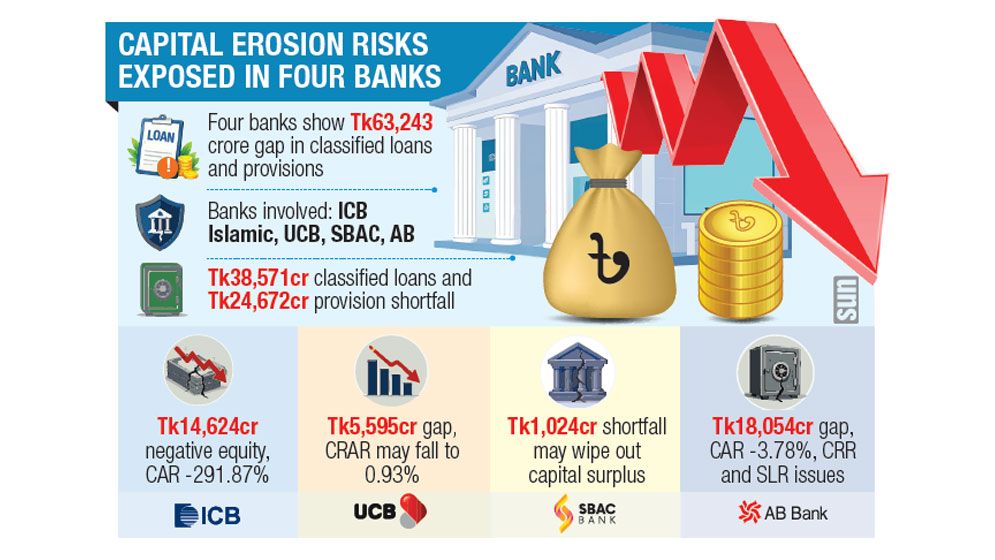
According to the audit reports, the four banks together had approximately Tk63,243 crore in classified loans, investments and provision shortfalls.
Of the total, Tk38,571 crore comprised classified loans and investments, while Tk24,672 crore represented provision deficits.
The reports showed that ICB Islamic Bank, UCB and AB Bank together had at least Tk38,572 crore in classified loans and investments.
Auditors noted that 84.29% of ICB Islamic Bank’s investment portfolio had be-come classified or non-performing, underscoring the severe deterioration in its asset quality.
Meanwhile, auditors identified combined provision shortfalls of around Tk24,672 crore in UCB, SBAC Bank and AB Bank. The deficit stood at Tk18,054 crore for AB Bank, Tk5,595 crore for UCB and Tk1,024 crore for SBAC Bank.
According to the auditors, full recognition of the required provisions would have significantly weakened the capital positions of the banks, with some failing to meet Bangladesh Bank’s minimum capital adequacy requirements.
ICB Islamic Bank faces going-concern uncertainty
Auditors raised significant doubt over ICB Islamic Bank’s ability to continue as a going concern, citing severe financial deterioration and substantial uncertainty about its capacity to sustain normal operations.
The bank’s accumulated loss stood at Tk21,806 crore as of 31 December, 2025, while shareholders’ equity turned negative at Tk14,624 crore. Its Capital Ade-quacy Ratio (CAR) fell to negative 291.87%, far below the regulatory minimum of 12.50%.
The audit report also noted that 84.29% of the bank’s total investments had be-come classified or non-performing. Profit-bearing deposits stood at Tk6,804 crore against profit-earning investments of Tk6,326 crore, indicating a mismatch between income-generating assets and liabilities.
Auditors further reported that fixed assets worth Tk154 crore could not be properly verified due to an incomplete fixed-asset register, raising concerns about the reliability of the bank’s reported asset base.
UCB’s provisioning gap widens capital pressure
At the end of 2025, UCB’s total loans and advances stood at Tk61,789 crore, of which Tk9,576 crore were classified, according to the audit report.
Against the classified loans, the required provision was Tk7,679 crore, while the bank maintained only Tk2,524 crore, resulting in a shortfall of Tk5,155 crore.
Auditors also found that the bank did not recognise impairment losses of Tk438 crore related to its investment in subsidiary UCB Fintech Company Limited, pushing the total provision shortfall to nearly Tk5,595 crore.
Had the shortfalls been fully recognised, the bank’s capital deficit would have widened to Tk5,976 crore and its Capital to Risk Weighted Assets Ratio (CRAR) would have fallen from the reported 8.42% to just 0.93%, well below the regula-tory threshold.
The auditors also noted that Tk155 crore of the Tk197 crore deposited with vari-ous non-bank financial institutions (NBFIs) had remained overdue for a pro-longed period and was considered doubtful of recovery, yet no provision was maintained against the exposure.
SBAC Bank’s reported surplus masks underlying weakness
Auditors expressed concerns about SBAC Bank’s actual capital position and provisioning adequacy.
The bank had deposits of Tk181 crore with several NBFIs, of which Tk159 crore had long matured and remained uncertain to recover. No provision was main-tained against these deposits.
Although the bank reported a capital surplus of Tk81.84 crore and a CRAR of 13.40% as of 31 December, 2025, auditors said full recognition of its Tk1,024 crore provision shortfall would erase the surplus and push the bank into a capital deficit position.
The report suggested that the bank’s financial condition could be materially weaker than reflected in its reported figures.
AB Bank records largest provisioning gap
AB Bank’s audit report revealed the most extensive irregularities among the four lenders, with major concerns relating to loan classification, provisioning, invest-ment valuation, liquidity management and capital adequacy.
After reviewing 88% of the bank’s loan portfolio, auditors concluded that classi-fied loans amounted to Tk23,664 crore, representing nearly 66% of total loans and significantly exceeding the figure reported by the bank.
Against these loans, the required provision stood at Tk20,351 crore, while only Tk2,298 crore had been maintained, leaving a provision shortfall of Tk18,054 crore.
The audit also identified a Tk136 crore provisioning gap related to investments in Pinnacle Global Fund, unrecognised mark-to-market losses of Tk397 crore on government securities, inadequate provisions against Beximco Limited’s zero-coupon bonds and unrecognised impairment losses related to subsidiary Cashlink Bangladesh Limited.
Auditors further noted that the bank failed to maintain the required Cash Reserve Ratio (CRR) and Statutory Liquidity Ratio (SLR). Its CRAR declined to nega-tive 3.78% by the end of 2025, raising serious concerns about its financial stabil-ity.
The report added that the erosion of capital into negative territory effectively placed the bank in non-compliance with Bangladesh Bank’s single-borrower ex-posure limits, raising additional regulatory and risk management concerns.
Commenting on the findings, BSEC spokesperson and Director Md Abul Kalam said the audits were part of the regulator’s routine oversight of listed companies.
Any irregularities identified by registered auditors are reviewed by the commis-sion, and necessary actions are taken in accordance with the law, he added.