


 For all latest news, follow the Daily Sun's Google News channel.



Photo: Collected
The government has already increased fuel prices twice due to the Iran war. Following those hikes, electricity tariffs have now been raised, adding further pressure to people's daily lives.
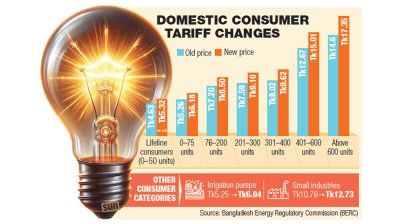
An analysis of the new electricity tariff structure shows that residential consumers will face an average increase of 16.68%. For residential lifeline customers, the tariff has risen from Tk4.63 per unit to Tk5.32 per unit. As a result, consumers using up to 50 units of electricity per month will see their bills increase by around Tk35. Those using up to 600 units monthly will face an increase of approximately Tk1,644. The amount of VAT payable will also rise proportionately.
AHM Shafiquzzaman, President of the Consumers Association of Bangladesh (CAB), said that any increase in electricity and fuel prices would undoubtedly have a direct impact on people's lives. He noted that inflation and commodity prices had already risen following the increase in fuel prices. During the public hearings on the proposed electricity tariff hike, CAB and representatives of civil society strongly opposed any increase, but their views were not taken into consideration.
He said the latest increase affects all consumption slabs from 50 units to 600 units, meaning the impact will be felt across society. Electricity costs are also linked to transport fares, particularly in Dhaka where a large number of battery-powered vehicles operate. Higher electricity tariffs are likely to push up transport costs, which in turn will affect the prices of goods and services throughout the economy. He also criticised the government for failing to address capacity payments and electricity theft, suggesting that savings from those areas could have been used to reduce the subsidy burden.
Mohammad Rezwan Selim, Vice-President of the Bangladesh Garment Manufacturers and Exporters Association (BGMEA), said that the increase would further raise production costs for manufacturers. He explained that many export orders currently being processed were secured around three months ago, when energy costs were lower. The latest tariff hike will therefore squeeze profit margins and negatively affect business operations.
Electricity Tariffs Raised
Following the increase in fuel prices, the government has now raised electricity tariffs at the wholesale, retail and transmission levels. The Bangladesh Energy Regulatory Commission (BERC) announced the new rates yesterday.
Economists and industry experts have warned that the increase will place an additional burden on consumers already struggling with inflation. They said the government had failed to adequately consider the interests of ordinary consumers and had largely ignored the concerns raised by civil society and business representatives. Higher electricity costs are expected to increase production expenses and put further strain on household budgets.
Under the new rates, wholesale electricity prices have been increased by 19.85%, while consumer-level tariffs have risen by 16.68%. Transmission charges have also been increased by 23.96%.
As a result, the average retail electricity tariff has risen by Tk1.52, from Tk9.11 to Tk10.63 per unit. The wholesale tariff has increased by Tk1.39, from Tk7 to Tk8.39 per unit. Transmission charges have been raised from Tk0.3135 per kilowatt-hour (kWh) to Tk0.3886 per kWh.
For consumers, tariff increases range from 15% for lifeline users to as much as 19.94% for certain categories. The new rates will take effect from June. Existing demand charges for different customer categories will remain unchanged.
BERC Chairman Jalal Ahmed announced the decision at a press conference held at the commission's headquarters in Ramna, Dhaka. Responding to a question, he said there had been no external pressure on the commission to increase prices. He added that the decision had been taken quickly with the national budget in mind. While acknowledging that the increase would raise people's expenses, he said no economic impact assessment had been conducted, although such an assessment could still be carried out.
New Retail Tariffs
Under the revised tariff structure:
Residential lifeline consumers (0–50 units): Tk5.32 per unit
Residential consumers (0–75 units): Tk6.18 per unit
76–200 units: Tk8.50 per unit
201–300 units: Tk9.10 per unit
301–400 units: Tk9.62 per unit
401–600 units: Tk15.01 per unit
Above 600 units: Tk17.35 per unit
For irrigation and agricultural pumps, the low-voltage tariff has been set at Tk6.04 per unit.
For commercial and office consumers at low voltage:
Flat rate: Tk15.36 per unit
Off-peak: Tk13.82 per unit
Peak hours: Tk18.43 per unit
For educational institutions, religious establishments, hospitals and charitable organisations, the tariff has been increased from Tk7.55 to Tk9.05 per unit.
For street lighting and water pumping services, the rate has risen from Tk9.71 to Tk11.46 per unit.
For small industries, the tariff has increased from Tk11.76 to Tk12.73 per unit.
For the construction sector, it has risen from Tk15.15 to Tk18.09 per unit.
For electric vehicles and battery charging stations, the tariff has been increased from Tk9.62 to Tk11.36 per unit.
Source: Bangladesh Pratidin