
 For all latest news, follow the Daily Sun's Google News channel.


Ramadan essentials see significant price surge despite ample supply
ANM Mohibub Uz Zaman, Dhaka
Published: 31 Jan 2024, 10:26 PM
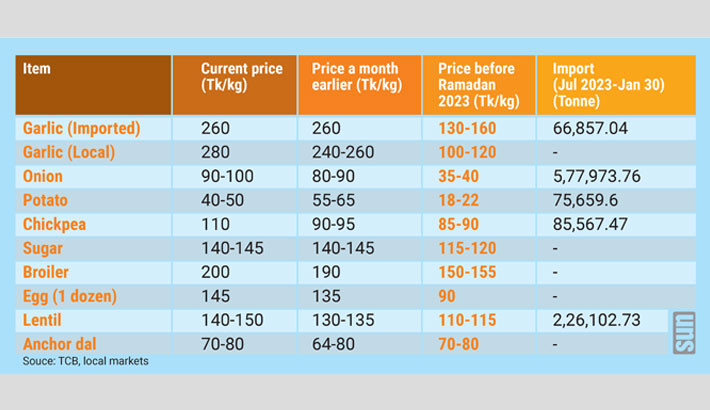
Prices of key Ramadan essentials have soared across the country, even as there has been no shortage in the supply of these commodities in recent months.
In addition to daily necessities, there has been a notable spike in demand for specific items such as edible oil, sugar, chickpeas, dried peas, onions, dates, meat, mung beans, garlic, ginger, flour, etc.
Agro-economist and researcher Dr Jahangir Alam Khan attributes the price hikes to inadequate market monitoring and surveillance by the government against wholesale market manipulation. Unscrupulous traders have taken advantage of the situation, raising prices on essential items in anticipation of Ramadan, despite sufficient supplies.
According to government sources, in the 2023-24 period, Bangladesh imported substantial quantities of lentils, chickpeas, onions, garlic, and ginger. The surge in imports is evident, with significant increases in imported sugar, crude edible oil, chickpeas, onions, and lentils compared to the previous year.
Market insiders said during Ramadan, the demand for edible oil is around 3 to 3.5 lakh tonnes, while chickpeas alone are in demand for about 1 lakh tonnes. The annual demand for onions stands at 27-28 lakh tonnes, with an estimated annual chickpea demand of Tk1.40 lakh tonnes, a figure that continues to rise annually.
Echoing Dr Jahangir Alam Khan, Consumer Association of Bangladesh Vice President SM Nazer Hossain also blamed the profit-driven practices of unscrupulous businessmen for the escalation in prices. He emphasises the need for more proactive government intervention throughout the supply chain, from import to retail, to curb price manipulation.
The Department of Agriculture Extension reports a decline in local production of garlic, lentils, chickpeas, and onions in 2022-23 compared to the previous fiscal year further exacerbating import dependency.
Jahangir Alam Khan said, “The duties of essential commodities should be removed for couple of months to keep the prices under control during Ramdan.”
He also said, “The government should fix the wholesale and retail prices of imported products after analysing the import price and other costs. Besides, the government should publicise the prices of commodities through electronic and print media.”
Apart from publicity, the authorities concerned have to monitor the markets regularly to ensure traders sell the products as per the prices fixed by the government, he added.
However, he also warns that heightened import dependency leaves the country vulnerable to price fluctuations in the international market, especially during periods of instability.
Recent price data from the Trading Corporation of Bangladesh (TCB) reveals sharp increases in the prices of essential items such as flour, lentils, mung beans, chickpeas, onions, beef, and broiler chicken.
A comparison with prices from the previous year illustrates the extent of the price surge across various commodities, with notable increases in the prices of ginger, garlic, chicken, eggs, sugar, chickpeas, and flour.
Taskin Ahmed, a private company employee, expressed concern over the continuous rise in prices, particularly as Ramadan approaches, adding to the financial strain faced by ordinary citizens.
As the cost of essentials continues to climb, many Bangladeshis are left wondering how they will cope with the economic pressures ahead.
Price hikes as per TCB data
The price of loose atta increased by 8.42% within a month while packet atta saw a 4.35% rise, fetching prices between Tk48-55 per kg and Tk55-65 per kg, respectively, according to the TCB.
Loose flour saw a 3.85% increase in price over a month, with packaged flour rising by 3.57%, reaching prices of Tk65-70 per kg and Tk70-75 per kg, respectively.
Lentil prices rose by 1.89% in a month, reaching Tk130-140 per kg. However, local lentils were sold at Tk150 per kg and chickpeas were sold at Tk110 per kg in retail shops at Mirpur-13, Mirpur-12, Mirpur-11, and Shewrapara on Wednesday.
However, according to the TCB, mung dal prices surged by 21.57% in a month, with anchor dal increasing by 4.17% and chickpeas by 5.41%, fetching prices of Tk130-180 per kg, Tk70-80 per kg, and Tk95-100 per kg, respectively. Local onion prices rose by 2.78% to Tk90-100 per kg, while beef prices increased by 11.54% to Tk700-750 per kg, and broiler chicken prices increased by 5.41% to Tk190-200 per kg.
A month ahead of Ramadan in the previous year, the price of imported ginger stood at Tk280 per kg, while local ginger was Tk180 per kg. Imported garlic was priced at Tk40 per kg, and local garlic at Tk35 per kg.
Similarly, a month before Ramadan in the previous year, broiler chicken was priced at Tk150-155 per kg, farm eggs at Tk90 per dozen, sugar at Tk78-80 per kg, chickpeas at Tk80-85 per kg, anchor dal at Tk70-80 per kg, loose sugar at Tk115-120 per kg, and potatoes at Tk20-25 per kg.
Furthermore, loose white atta was sold at Tk58-60 per kg, packet atta at Tk65-70 per kg, local onions at Tk35-40 per kg, and imported onions at Tk30-40 per kg a month before Ramadan in the previous year.