


 For all latest news, follow the Daily Sun's Google News channel.


Netrakona’s Md Rasel Mia went to Saudi Arabia two and a half years ago through a broker, after taking out a Tk4.5 lakh loan on the promise of a decent hospital job. He initially got no work, and a few months later secured a job at a camel farm in a desert near Dammam, where he worked under the scorching sun all day but was not paid regularly.
After his iqama (work permit) expired, Rasel was arrested by police and spent 41 days in prison before returning home with only the clothes he was wearing.
Rasel said, “I was about to apply for the extension of my iqama but my employer didn’t allow me to go outside. Then I was detained. On the first day I was put in prison, the jail guards shaved my head and stripped me of all my clothes and forced me to wear nothing but a pair of shorts.”
“Even in the bitter cold, they kept the large air conditioners in the cells running at high speed. Our bodies would freeze from the cold. Whenever we begged for a blanket or some clothes, the jail guards would instead come and beat us with batons,” he added.
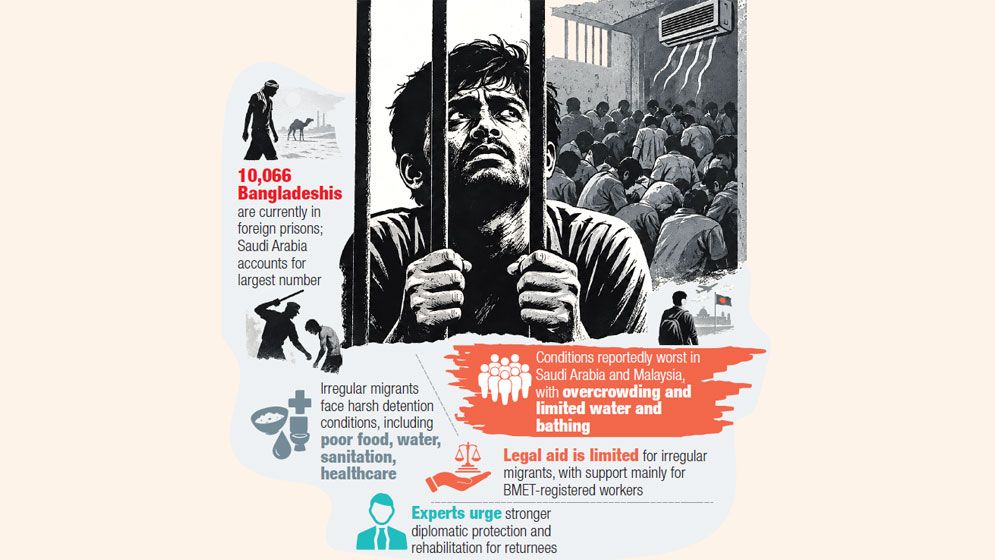
Many Bangladeshis detained after entering foreign countries without legal status report similar experiences. In detention centres, particularly in the Middle East and Malaysia, they face degrading conditions, including shortages of food, water and medical care and little support from Bangladesh embassies or high commissions.
A study, titled “Vulnerability of Irregular Bangladeshi Migrant Workers in Foreign Detention Settings,” published in the international journal “Discover Social Science & Health”, examined the experiences of irregular Bangladeshi migrant workers detained in Saudi Arabia, Iraq, Malaysia, Libya and Italy.
Many Bangladeshis who travel abroad end up in detention centres or prisons for reasons including irregular entry, lack of work permits, working outside their sponsors or kafils, and documentation problems.
Bangladeshis imprisoned in 31 countries
Foreign Minister Khalilur Rahman told the parliament on 10 September this year that around 10,066 Bangladeshi citizens are currently in prisons worldwide, according to the latest information from Bangladesh missions.
According to earlier data placed before the parliament in July 2024, Bangladeshis were being held in prisons in 31 countries. Saudi Arabia accounted for the largest number, with 5,746, followed by India with 1,579, Turkey with 508, Oman with 420, Qatar with 415, Greece with 414, the United Arab Emirates with 404, South Africa with 385, Myanmar with 358, Malaysia with 219, Iraq with 217, China with 191, Hong Kong with 122, Jordan with 100, and Italy with 81.
Allegations raised against them include irregular migration, drug-related cases and brawls.
The study paints a particularly grim picture of conditions in Saudi Arabia and Malaysia, where detainees reportedly suffered from inadequate food, extreme overcrowding, poor sanitation and a lack of basic healthcare. The researchers found conditions in Italy were comparatively less severe, while the situation in Iraq and Libya, despite allegations of abuse, was generally less critical.
In Malaysian prisons, the absence of a fixed meal schedule reportedly caused severe malnutrition, with some detainees losing as much as seven kilogrammes in weight.
Rahat Hossain, who returned home after detention in Malaysia, said: “Some days they did not give us breakfast, while on other days they brought food in the middle of the night. It was just a lump of boiled rice and a piece of foul-smelling stale fish.
“Prison guards did not consider us human beings. They gave us less food than what a cat would eat,” he added.
The study also documented allegations of physical and psychological abuse in Iraq and Libya.
A 47-year-old Bangladeshi, identified by the pseudonym Billal Hossain, said a police officer in an Iraqi prison once beat detainees with a thick stick for about 10 minutes after dawn prayers without apparent reason.
Saikat, a returnee from a Libyan detention centre, said prisoners were routinely beaten with sticks and whips for minor movements or sounds.
“The scars from the whips on my back still hurt at night sometimes.”
Hundreds of people were reportedly crammed into single rooms in Saudi Arabian and Malaysian jails, leaving little or no space to sleep, while the smell from toilets and poor sanitation filled the cells. At least 11 respondents said they received no basic healthcare while in detention in Libya, Malaysia and Saudi Arabia.
The study said detainees in parts of the Middle East were provided with only around 1.5 litres of water a day, while limited access to bathing – sometimes only once every two or three days – reportedly resulted in sores and blisters on their bodies.
Stronger diplomatic initiatives needed to protect Bangladeshis detained abroad
Many of the detainees had travelled abroad after taking high-interest loans or selling land, and were left psychologically devastated after being arrested and detained, according to the study.
Tasneem Siddiqui, founder and chair of the Refugee and Migratory Movements Research Unit (RMMRU), said diplomatic missions should strengthen legal and consular assistance for detained migrants.
“Such brutal treatment of migrants is a clear violation of the Universal Declaration of Human Rights,” she said.
She also called for greater awareness about the risks of irregular migration, rehabilitation and employment opportunities for returnees, and more active monitoring of detention centres by international human rights organisations.
Rasel Mia told the Daily Sun that officials at the Bangladesh embassy refused to provide him with legal assistance as he did not have all legal documents.
He said, “When I sent money to the country, no one asked me about my documents. Usually regular workers face no serious prison-related difficulties. If the embassy officials don’t help undocumented workers staying in prison, what do they actually do abroad?”
Dr Md Jakerul Abedin, director general of the Legal Affairs Wing at the Ministry of Foreign Affairs, was unavailable for comment.
Mohammad Asaduzzaman, director general of the Wage Earners’ Welfare Board, said that Bangladesh’s labour wings abroad monitor detained workers and arrange legal assistance through local lawyers or law firms when necessary.
Such support, however, is primarily available to workers registered with the Bureau of Manpower, Employment and Training (BMET), leaving irregular migrants with far more limited access to government assistance.
“Government assistance is relatively limited for people who travel abroad as undocumented individual, although they are also provided support in special circumstances,” he said.
He added that the Ministry of Foreign Affairs, the Ministry of Expatriates’ Welfare and Overseas Employment and other agencies also assist irregular migrants in different ways, depending on circumstances.