


 For all latest news, follow the Daily Sun's Google News channel.


Riyadh airport reopens after deadly Houthi attack
Bangladesh condemns strikes on Saudi civilian infrastructure, calls for immediate halt
Agencies, Riyadh/Dhaka/Washington/Tehran
Published: 10 Oct 2026, 12:00 AM
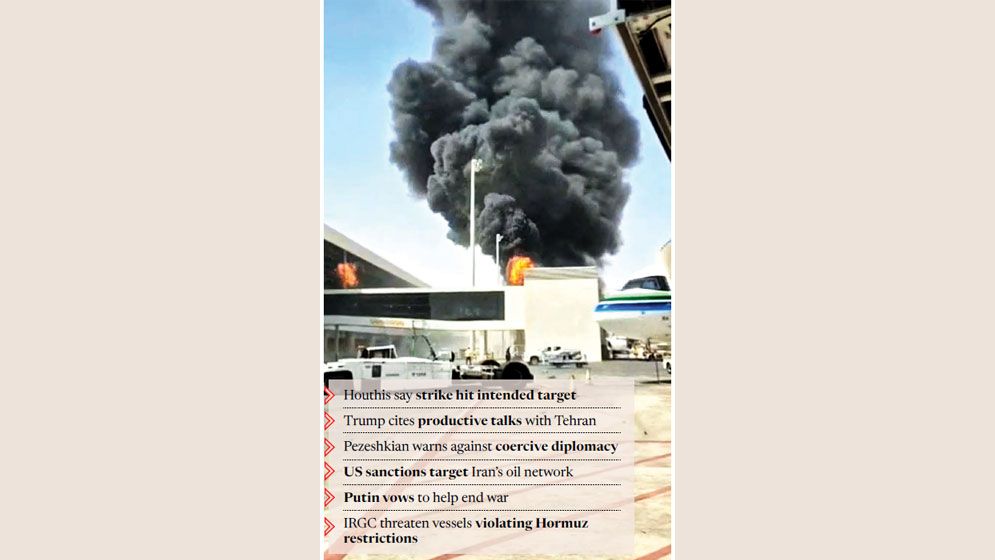
Saudi Arabia has reopened Riyadh’s King Khalid International Airport after Houthi attacks killed three people, injured several others and damaged airport facilities and an aircraft operated by national
carrier Saudia.
The General Authority of Civil Aviation (GACA) said on Friday that the attacks a day earlier had caused casualties and material damage, with injuries ranging from minor to severe. Airport operations have since resumed, and air traffic has returned to normal, Al Jazeera reported.
Saudia confirmed that one of its pilots had died in an incident at the airport.
“It is with profound sadness that Saudia announces the passing of Captain Hamoud Ali Alkalthami,” the airline said in a statement, adding that an aircraft had also been damaged.
A Houthi military spokesman said on Thursday that the group had launched a ballistic missile towards King Khalid International Airport, claiming it had struck its intended target and disrupted air traffic.
The attacks come as the Houthis face an offensive by Yemen’s internationally recognised government, which is backed by Riyadh. The armed group has targeted Saudi airports in several attacks this week.
Bangladesh on Friday strongly condemned the attacks on civilian infrastructure in Saudi Arabia, including airports, warning that they violated international law, endangered innocent lives and threatened regional stability.
In a statement, the foreign ministry expressed the country’s full solidarity with the government and people of Saudi Arabia and called for an immediate end to the attacks.
Trump rules out strikes on Iran before midterms
Meanwhile, US President Donald Trump said Washington would not attack Iran before the midterm elections, despite mounting tensions between the two countries.
“I want to make it clear to everybody that, while Iran is in very bad condition, both economically and militarily, and while the blockade will remain in full force and effect ... we will not be attacking Iran at any time prior to the Midterm Elections,” Trump wrote on Truth Social on Thursday.
He added that Washington was holding “productive discussions with the Islamic Republic of Iran”.
The announcement followed a rise in oil prices amid reports of possible fresh US strikes before the elections. The Atlantic reported on Wednesday that the White House had asked the Pentagon to prepare options for attacks on Iranian targets. The New York Times reported on Thursday that planning was continuing despite Trump’s uncertainty over the course of action.
Brent crude, the international benchmark, rose to $105.88 a barrel on Thursday before retreating to $104.28.
Iran says negotiations cannot succeed under threats
Iranian President Masoud Pezeshkian said on Friday that negotiations with the United States could succeed only if they were based on mutual respect and commitments, without pressure or threats.
“Negotiation conducted in the shadow of force is not negotiation, it is imposition and coercion,” he said during an address at a Commonwealth of Independent States summit in Turkmenistan.
Pezeshkian warned that sanctions on Iran would affect regional trade, connectivity, energy and stability. He also questioned the value of negotiations with an adversary he accused of resorting to assassinations, sanctions and threats while breaking its commitments.
Putin pledges help to end Iran war
Russian President Vladimir Putin said on Thursday that Moscow would do everything within its power to help end the war, during a meeting with Pezeshkian ahead of the summit, according to Russian media.
“We are ready to do everything that is in our power to contribute to the settlement of this situation,” Putin said.
He added that Iran had made genuine efforts to end the war since US-Israeli attacks began on 28 February. Putin also pointed to improving relations between Moscow and Tehran.
US sanctions Iran’s oil shipping network
The United States announced fresh sanctions on Thursday targeting individuals, networks and 17 vessels accused of transporting Iranian crude oil, petroleum products and petrochemicals.
A Treasury Department official described the measures as a major blow to Iran’s remaining illicit maritime infrastructure, saying they were intended to disrupt its so-called shadow fleet and restrict revenue for Tehran.
The sanctions form part of Washington’s wider campaign to intensify economic pressure on Iran.
Sri Lanka declines immediate aid to Iranian ships
Sri Lanka has no immediate plans to assist 19 Iranian vessels anchored in international waters near the island, despite reported shortages of food, water and fuel, Foreign Ministry spokesman Thushara Rodrigo said.
He said Colombo would prioritise its national interests before considering any assistance, adding that shipping companies were aware of the risk of secondary US sanctions.
The vessels are reportedly positioned about 24 nautical miles off Sri Lanka’s coast.
IRGC claims strike on tanker in Strait of Hormuz
Iran’s Islamic Revolutionary Guard Corps (IRGC) said on Friday that it had struck a tanker attempting to use what it described as an “illegal route” through the Strait of Hormuz, a critical global shipping corridor that Tehran has sought to blockade during the war.
Maritime tracking reports separately indicated that an unidentified projectile had sparked a fire aboard a vessel off the United Arab Emirates. The reports named a different ship, and it was not immediately clear whether the incidents were connected.
The IRGC also warned that vessels violating its restrictions beyond the Strait of Hormuz would face punishment, signalling a potential widening of its enforcement measures in the region.