



 For all latest news, follow the Daily Sun's Google News channel.


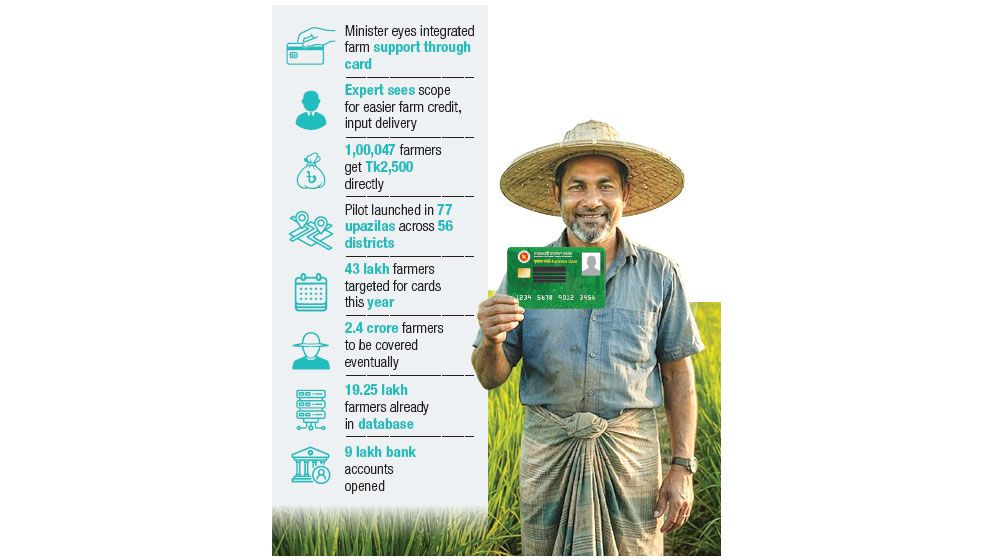
The government has taken a major step towards overhauling the way agricultural assistance is delivered, launching the nationwide pilot phase of its Farmer Card programme with 1,00,047 farmers receiving Tk2,500 each directly into their bank accounts.
The pilot, inaugurated by Prime Minister Tarique Rahman in Fulgazi upazila of Feni on Thursday, is being implemented simultaneously in 77 upazilas across 56 districts, marking a significant expansion from the programme’s pre-pilot phase involving more than 20,000 farmers.
The initiative is designed to create a formal, database-based system for identifying farmers and delivering government support directly to eligible beneficiaries. The government ultimately plans to bring around 2.4 crore farmers under the programme.
The direct transfer of agricultural assistance is expected to reduce reliance on intermediary channels and make the distribution of subsidised inputs and other government support more transparent and targeted.
Agriculture Minister Mohammad Aminur Rashid told the Daily Sun that farmers would initially receive Tk2,500 annually through the card, while the government plans to gradually add more services.
“Once one-fourth of the farmers are covered under the Farmer Card, we will expand other facilities, including estimating total production and demand, procurement, fertilisers, seeds, pesticides, weather and pest forecasts and other integrated benefits,” he said.
“With this card, we will be able to control and coordinate production, demand and distribution,” the minister added.
On Thursday, 1,00,047 farmers received Tk2,500 each as agricultural input assistance, bringing the total disbursement to Tk25,00,11,750.
In the first phase, 1,10,165 farmers are being brought under the Farmer Card programme. Of them, 1,00,047 received the cash assistance, while 7,643 farmers in Feni district received printed copies of the Farmer Card.
The pilot programme was formally launched at Fulgazi, with 13 upazilas directly connected to the main event through two-way video conferencing. The remaining 64 upazilas joined the programme virtually.
The 13 directly connected upazilas were Tetulia in Panchagarh, Thakurgaon Sadar in Thakurgaon, Gabtali in Bogura, Jashore Sadar in Jashore, Lalmohan in Bhola, Gazaria in Munshiganj, Shalla in Sunamganj, Burichang in Cumilla, Ramgati in
Lakshmipur, Ruma in Bandarban, Kaliganj in Gazipur, Durgapur in Netrakona and Hathazari in Chattogram.
From experiment to nationwide system
The government began the Farmer Card programme with a pre-pilot to test the mechanisms for identifying farmers, collecting their information, preparing records, linking them with banking services and transferring agricultural assistance directly to their accounts.
During the pre-pilot phase, more than 20,000 farmers received Farmer Cards along with one-time input assistance of Tk2,500 each on 14 April 2026.
The experience gathered from the initial phase subsequently paved the way for the larger pilot programme, which began in July.
The government is now gradually expanding the system, with a target of providing Farmer Cards to 43 lakh farmers during the current year.
According to programme information, a database of 19.25 lakh farmers has already been prepared, while around 9 lakh bank accounts have been opened.
The banking component is considered important because the programme is intended to enable farmers to receive government assistance directly rather than through multiple intermediary channels.
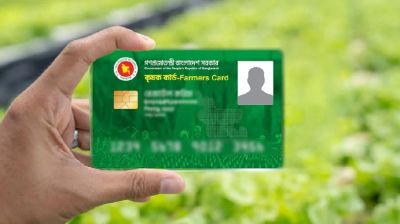
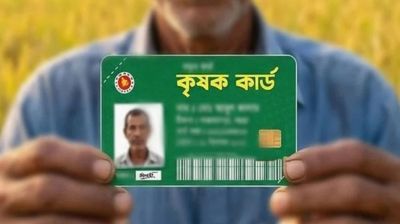
The Farmer Card system is also being developed as more than a physical or digital identification card. It is intended to serve as a platform through which farmers can access subsidised agricultural inputs, government incentives, agricultural credit, insurance, training, weather information, market information and other services.
Experts see wider potential
Agro-economist and researcher Dr Jahangir Alam Khan said the Farmer Card could bring significant changes to the agricultural sector if properly implemented and expanded.
“The card could be very effective in distributing agricultural inputs, especially those provided with subsidies. It would serve as a reliable tool to ensure that subsidised products reach the intended farmers properly,” he told the Daily Sun.
He said the card could also play an important role in agricultural credit.
“Many farmers may not need to mortgage their land. Instead, loans could be provided based on verification through the Farmer Card. All relevant information about a farmer could be accessed through the card number,” he said.
The system could also simplify government procurement of agricultural produce, he said.
“Furthermore, in government procurement drives such as the collection of paddy and wheat, the Farmer Card would eliminate the need for separate applications or complex procedures. Farmers could be selected directly through the card,” said the agro-economist.
2.4 crore farmers targeted
The government ultimately aims to bring around 2.4 crore farmers under the Farmer Card programme in phases.
The immediate target is to provide cards to 43 lakh farmers this year, while the database and banking infrastructure are being expanded to support the larger rollout.
The programme is intended to establish a unified database through which eligible farmers can be identified and linked with agricultural assistance and services.
The pre-pilot phase involving more than 20,000 farmers served as the initial step in developing the system before the government moved to the larger pilot phase.