


 For all latest news, follow the Daily Sun's Google News channel.


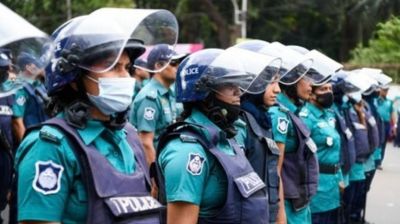
The Anti-Terrorism Unit (ATU) of Bangladesh Police has been renamed the Special Response Unit (SRU), with its organogram and activities left unchanged, according to Police Headquarters (PHQ) and the Ministry of Home Affairs.
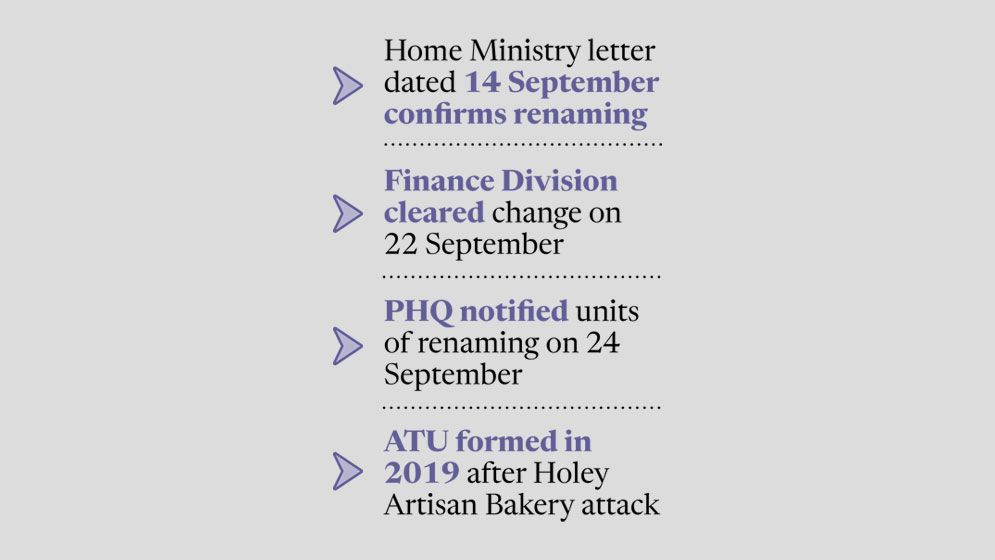
The exact date of the renaming could not be confirmed, but the home ministry published an official letter, dated 14 September, on its website on Sunday.
Signed by Deputy Secretary (Police-3) Tanvir-Al-Nasif and addressed to the ministry’s chief accounts and finance officer, the letter stated, “The Government sanction is hereby accorded that the Anti-Terrorism Unit (ATU) has been named the Special Response Unit (SRU), subject to certain conditions.”
Those conditions specify that the change takes effect from the date of the gazette notification issued by the Finance Division; that it will not alter the posts approved under the existing organisational structure; and that all conditions set by the Ministry of Public Administration, along with relevant rules and regulations, must be complied with.
The letter was forwarded to the Finance Division on 17 September.
The division completed its procedures on 22 September and wrote to the home ministry’s senior secretary, the inspector general of police (IGP) and others.
On 24 September, Additional DIG (Organisation and Management) Mahbubul Kabir at PHQ notified various police units and sections: “The ATU has been changed to the SRU.”
An SP-ranked officer, speaking on condition of anonymity, told the Daily Sun that the renaming was already official, though the unit’s website still carries the ATU name.
The ATU was approved for formation in September 2017 after the then Awami League government approved its creation following the militant attack on Holey Artisan Bakery in Gulshan on 1 July 2016. It was formally launched on 19 November 2019.
Though conceived to combat terrorism, the unit was not fully equipped for the task, according to some ATU officers, who said the Counter Terrorism and Transnational Crime (CTTC) unit of Dhaka Metropolitan Police – backed by modern weaponry, a SWAT team and a Bomb Disposal Unit – carried out most anti-militancy operations instead.
Under its citizen’s charter, the unit’s mandate covers combating cybercrime and assisting victims, de-radicalisation, defusing bombs and explosives, cyber patrolling and related work.
While authorised to make arrests across various crimes, it could investigate only cases falling under the Anti-Terrorism Act 2009 – later amended in 2026 – or other cases when directed by the courts or PHQ.
Following the fall of the Awami League government, anti-militancy operations were halted and the unit’s activities came to a standstill, said another SP-ranked officer.
It was subsequently tasked with executing arrest warrants in other criminal cases, tracking inmates who escaped from jails during the July-August mass uprising, and investigating a number of separate criminal cases.
Officers said the unit’s authority and functions remain unchanged following the renaming.
The organogram, also unaltered, is headed by an additional inspector general of police, followed by four deputy inspectors general, nine additional DIGs, 10 SPs and other ranks, with a total workforce of around 600.
Its units cover operations, investigation, research, logistics and development, media and awareness, ICT, intelligence, cybercrime, organised crime, training, and planning and research, alongside divisional units for Chattogram, Rajshahi, Dhaka, Mymensingh, Rangpur, Khulna, Sylhet and Barishal.
The unit’s headquarters remains in the capital, with offices in Chattogram, Khulna, Rajshahi, Rangpur and Mymensingh.