


 For all latest news, follow the Daily Sun's Google News channel.


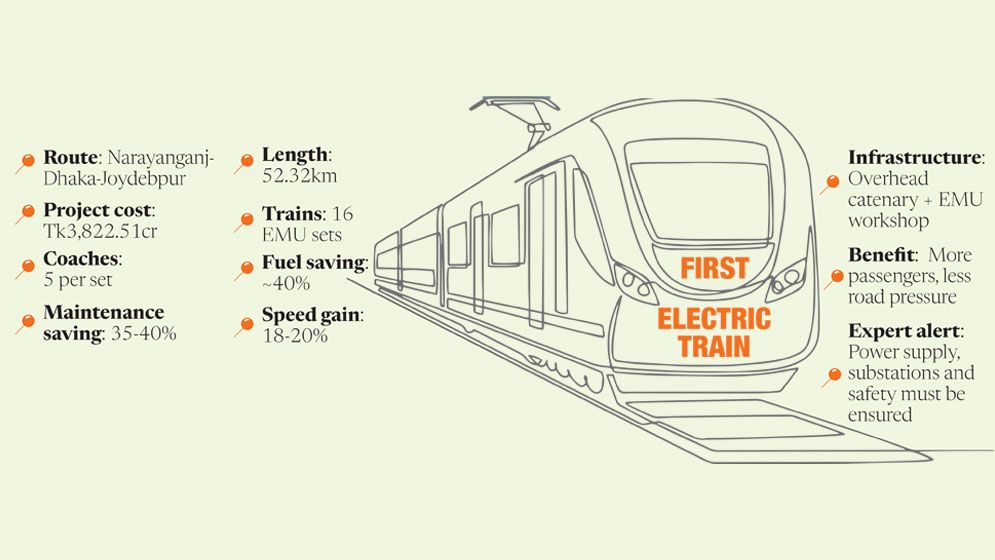
The government is set to introduce Bangladesh’s first electric train on the busy Narayanganj-Dhaka-Joydebpur corridor under a Tk3,822.51-crore project aimed at boosting rail capacity, cutting travel time and reducing carbon emissions.
The project will be placed before the Executive Committee of the National Economic Council (ECNEC) today for approval, with Bangladesh Railway planning to implement it from July 2026 to June 2030, a Planning Commission official told the Daily Sun.
The government will provide Tk942 crore of the total cost, while Tk2,880.42 crore will come as foreign loans from the European Investment Bank (EIB) and the Asian Development Bank (ADB).
Titled “Implication of Electric Traction along Narayanganj-Dhaka-Joydebpur”, the project will electrify 52.32 kilometres of railway, procure 16 sets of electric multiple units (EMUs), each with five coaches, and build an EMU maintenance workshop.
Bangladesh Railway Additional Director General (Infrastructure) Md Shuboktagin said the project was being taken up because of the large number of people travelling daily between Dhaka, Gazipur and Narayanganj.
“The aim is to develop electric rail transport as an important public transport system to reduce traffic congestion and pressure on roads in these areas,” he said.
The railway authority expects electrification to increase train speeds, lower operating and maintenance costs, raise revenue and improve operational efficiency. It also expects the move to reduce pressure on roads by increasing the railway’s share of passenger and freight transport.
The corridor is among the country’s busiest, with several lakh passengers travelling along it every day. High passenger demand, industrial concentration in Narayanganj and Gazipur, and heavy motor-vehicle traffic were among the reasons for selecting the route.
An overhead catenary system will be installed along the corridor. Bangladesh Railway estimates that electric traction can save around 40% in fuel compared with the existing diesel-electric system, while
maintenance and repair costs of electric rolling stock could be 35-40% lower.
Electric trains are also expected to have better acceleration and deceleration, increasing average train speeds by around 18-20%.
However, experts have called for a thorough technical assessment before the system is introduced.
Prof Dr Sharif Mohammad Mominuzzaman, head of the Department of Electrical and Electronic Engineering at Bangladesh University of Engineering and Technology (BUET), said Bangladesh had both the need and potential for electric trains, but stressed the importance of proper feasibility studies by qualified technical experts.
The availability of adequate power supply and necessary substations should be examined carefully before the trains are introduced, he said.
“Decisions should be taken based on proper technical evaluation rather than rushing into implementation, as safety and quality are often overlooked when projects are undertaken in haste,” he said.
Prof Mominuzzaman also stressed the need for adequate infrastructure and skilled manpower, warning that operating electric trains on longer routes outside Dhaka would present challenges different from those of metro rail systems.
Power failures during a journey, for instance, could raise questions over where trains would stop, how passengers would reach their destinations and whether rescue and safety arrangements would be adequate, he said.
He called for a comprehensive assessment of the system’s benefits, drawbacks and safety risks, including power capacity, passenger safety and long-term sustainability.
The preliminary Development Project Proposal (DPP) received in-principle approval from former interim government Planning Adviser Dr Wahiduddin Mahmud on 30 June 2025.
According to officials, the ADB and EIB expressed interest in financing the project following a proposal from the Economic Relations Division.
The initial proposed cost was Tk4,282 crore. It was later reduced by Tk460.35 crore, or 12.04%, in the revised DPP.
Planning Commission Member (Senior Secretary) Dr Neyamat Ullah Bhuiyan said the project would reduce travel time and transport costs while increasing the carrying capacity of trains.
“Bangladesh Railway will be able to transport more passengers faster and at lower cost, which will help reduce pressure on road transport and associated expenditure,” he said.
The project would also help cut carbon emissions and increase railway revenue, he added.
Recommended Stories