



 For all latest news, follow the Daily Sun's Google News channel.


Mounting caseload chokes justice delivery
Each judge burdened with about 2,000 of pending cases

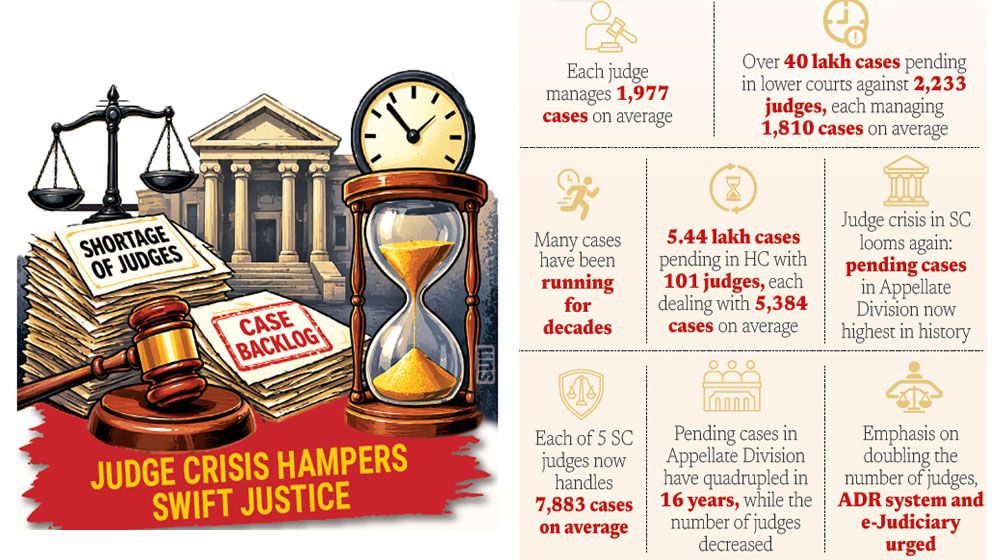
The judiciary is currently grappling with a huge volume of legal disputes, with over 46.25 lakh cases pending across all court tiers, including the Supreme Court and subordinate courts, across the country against only 2,339 judges. On average, each judge is responsible for 1,977 cases.
A severe crisis of judges is a major factor in the judicial system’s efficiency, while other factors include slow trial processes, inefficient case management, and excessive reliance on traditional court procedures.
The case backlog is severely hampering access to timely justice, eroding public confidence in the judicial system, and causing immense suffering to litigants seeking justice.
The government has already established some new courts, created new judicial posts, and initiated the “e-Judiciary” project to digitalise case management. However, the implementation of “e-Judiciary” still remains in the development phase.
Experts believe that steps needed to address the case backlog include doubling the number of judges, making the alternative dispute resolution (ADR) system mandatory for small cases, setting strict deadlines for hearings and disposing of cases, and implementing “e-Judiciary” in an effective manner.
Law Minister Md Asaduzzaman has said that the government is taking various measures to reduce the case backlog and ensure faster and more accessible justice for all citizens.
Over 40 lakh cases in lower courts against 2,233 judges
As of 31 December 2025, a total of 40,41,924 cases were pending in lower courts across the country against 2,233 judges. Each judge of the subordinate court, which is the primary gateway for justice-seekers, deals with 1,810 cases on average. Many of the cases have been going on for decades.
Revealing the number of pending cases, the law minister told parliament on Thursday that the government had taken various plans to reduce case backlogs. The Code of Criminal Procedure (Amendment) Bill, 2026 was passed in parliament as part of the government’s move to expedite criminal proceedings.
The delay in the disposal of cases is particularly evident in murder cases and cases regarding land acquisition and inheritance disputes among siblings. It has been observed that murder cases take an average of 15 years to reach the High Court, and some cases take two to three decades to be disposed of, said sources.
Delays in trying murder cases are often caused by prolonged investigations, negligence in filing charge sheets, a lack of witnesses, and inefficiencies in state prosecutions. “Years are passing in such cases even before the police report is filed in the court,” said Advocate Mohammad Delawar Hosain, a lawyer of Bangladesh Supreme Court.
Law Minister Md Asaduzzaman acknowledged the structural challenges in the judiciary, noting that judicial work is delayed due to responsibilities such as overseeing police investigations, conducting bail and remand hearings, and processing affidavits.
He said that the government has already established 871 courts and created 232 judicial posts, with a further 304 judgeships currently in the pipeline, to reduce the backlog.
Asaduzzaman also highlighted the expansion of legal aid services through the Legal Aid (Amendment) Bill, 2026. Under the revised framework, disputes arising under seven of the nine scheduled laws must undergo mandatory mediation at district legal aid offices before cases can be filed in the court, he said.
Sk Sabbir Sumu, who was a justice-seeker in Khulna, said that land-related cases in Bangladesh last for 8 to 15 years, and can even last a lifetime if someone wants. “We have not yet achieved independence from the courtroom through British law. There is a need for major changes in the law and system,” he said.
The implementation of “e-Judiciary” has been slow in all tiers of courts, particularly in the lower courts. The e-family courts had been launched in two districts, allowing the filing, hearing, and management of family cases entirely online.
Many subordinate courts lack the necessary digital tools and administrative support needed to expedite case management. Advocate Khayrul Alom Bokul, a lawyer in Sylhet court, raised the issue of the lack of necessary digital tools in the Sylhet court with this correspondent.
The lawyer said, “Unless immediate steps are taken, the gap between the number of judges and the volume of cases will continue to widen.”
101 HC judges deal with 543,847 cases
The pressure is also most acute in the High Court Division of the Supreme Court, where a judge is burdened with 5,384 cases on average.
As of 31 December 2025, the number of cases pending in the High Court is more than 543,847. However, there are currently 101 judges in the High Court.
Advocate Muzahedul Islam Shahin, a Supreme Court lawyer, told the Daily Sun that the number of pending cases would be much higher if interim applications were also considered. HC judges usually spend one day each week hearing interim applications, he added.
Echoing the same, Advocate Ishrat Hasan, another Supreme Court lawyer, said that the relentless efforts and honesty of all the bench officers and staff of the court are essential to ensure justice.
Afzal Chowdhury, a justice-seeker in Brahmanbaria, said that if a High Court bench is established in every division and three courts are established in every upazila, all cases will be resolved within two years.
Judge crisis in SC looms again
The Appellate Division of the Supreme Court is also facing the brunt of the crisis, where the number of unresolved cases is now 39,417, leaving justice-seekers waiting decades for verdicts.
The apex court is now operating with only five judges, each handling 7,883 cases on average. Although the pace of case disposal in the Appellate Division is currently accelerating, this number of pending cases is the highest in history.
An acute shortage of judges is cited as one of the primary reasons for the case backlog in the Appellate Division, which has seen the number of judges dwindle despite a surge in cases.
Advocate Delawar Hosain of the Supreme Court described the situation as dire, saying that justice-seekers are also suffering financially.
The Appellate Division currently has only five judges, including Chief Justice Zubayer Rahman Chowdhury, but 16 years ago, there were eight judges, handling 9,141 cases in total. The number of pending cases in the Appellate Division has more than quadrupled in that time, while the number of judges has decreased.
Historical comparisons reveal the gravity of the issue. In 1974, the Appellate Division had five judges managing just over 4,000 cases.
By 2009, the number of judges had been increased to 11, but that precedent has not been maintained. The crisis deepened further in 2025, when the-then chief justice Dr Syed Refaat Ahmed retired, leaving the Appellate Division with only one functional bench.
Even including Chief Justice Zubayer Rahman Chowdhury it has been unable to constitute more than one full bench, which requires at least three judges, due to the shortage.
Legal experts stress that forming two or three full benches could significantly speed up case disposal. “Appointing new judges in the apex court is important to get rid of pending cases,” said Advocate Muzahedul Islam Shahin.
Delays in the appellate process further complicate matters
When the Supreme Court upholds a death penalty, for instance, the convict often files a review petition, which can take six months to two years to resolve.
The delays have taken a toll on both litigants and defenders, with some victims of serious crimes waiting up to 20 years for justice.
This protracted process not only prolongs the suffering of victims but also raises questions about its impact on crime prevention.
Legal experts argue that systemic changes are essential to address the backlog and ensure timely justice.
A lawyer said that the settlement rate is very low compared to the number of cases filed in the court every day. The long process of trial increases immorality. Thousands of cases are pending in the High Court and Supreme Court for years. Unnecessary cases are being filed and left for a long time. There is no provision for settlement. The High Court can quickly settle the land acquisition cases and inheritance disputes among siblings. In this way, the weaker party would get justice easily. And siblings can live together.
__________________________________ Recommended Stories
The reporter can be reached at: [email protected]