



 For all latest news, follow the Daily Sun's Google News channel.


Foreign banks’ profits fall despite strong capital in H1
Experts cite macroeconomic challenges, structural weaknesses

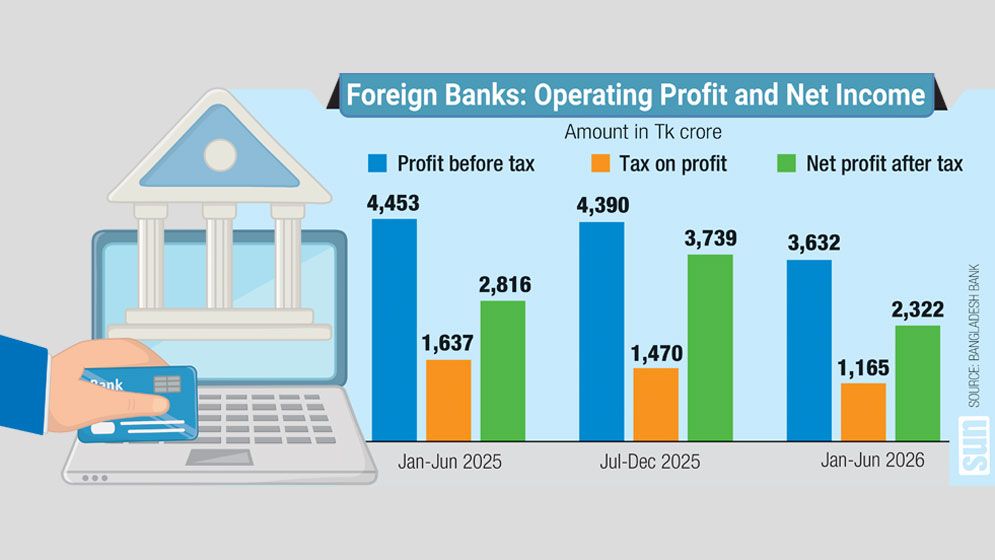
Foreign banks operating in Bangladesh recorded an over 18% year-on-year decline in pre-tax profits in the first half of 2026, while profits and income remitted abroad rose by more than 25%, reflecting mounting pressure on their business performance.
Their non-performing loan (NPL) ratio also climbed to 6.5% in June, although they maintained strong capital adequacy and liquidity positions, according to the latest Bangladesh Bank report.
As of June 2026, nine foreign commercial banks operated in Bangladesh through 70 branches and five sub-branches. Their deposits stood at around Tk87,378 crore, while loans and advances totalled approximately Tk48,704 crore.
The banks are Standard Chartered, HSBC, State Bank of India, Woori Bank, Citibank N.A., Commercial Bank of Ceylon, Bank Alfalah, Habib Bank and National Bank of Pakistan.
Former Bangladesh Bank chief economist Mustafa K Mujeri attributed the pressure on foreign banks to macroeconomic challenges, structural weaknesses in the banking sector and rising credit risks.
Weak governance and the banking sector’s record-high NPL ratio of 33.2% in June 2026 were major concerns, he said. Elevated bad loans had made foreign banks more cautious about financing large new projects, limiting opportunities to expand their portfolios.
Foreign banks were adopting conservative lending strategies to contain risks and avoid losses, Mujeri said. International banking groups also tend to limit exposure in markets facing pressure on sovereign creditworthiness, including countries with negative credit-rating outlooks from agencies such as Fitch and S&P.
Bangladesh Bank spokesperson and Executive Director Arief Hussain Khan said foreign banks played an important role in foreign trade, international transactions and export financing. Their strong capital and liquidity positions supported financial stability, he added.
However, profitability and loan quality required close monitoring. The central bank was continuing regular supervision to strengthen risk management, maintain financial stability and ensure credit flowed to productive sectors.
Regarding Standard Chartered’s plans to close or transfer its retail banking business, Arief said the bank could make strategic decisions within the applicable regulatory framework. The central bank expected the process to comply with all rules and employment procedures and would monitor developments to protect customers and employees and prevent disruption.
Profits fall, remittances abroad rise
Foreign banks recorded pre-tax profits of around Tk3,632 crore in January-June 2026, down more than 18% year-on-year and around 17% from the second half of 2025.
Net profit after tax fell 17.5% year-on-year to approximately Tk2,322 crore. Tax payments declined by around 29%, reducing the tax-to-profit ratio to 32.1% from 36.8%.
Profits reinvested during the six-month period fell by more than 22%, while profits and income remitted abroad increased by over 25%.
No dividends were remitted abroad during the period, although provisions of around Tk133 crore were made for dividends. In the preceding six months, more than Tk560 crore was remitted abroad as dividends.
Deposit trends and lending risks
Foreign banks’ deposits stood at around Tk87,378 crore at the end of June. Term deposits fell by around 13% year-on-year, while special notice deposits dropped by approximately one-third. Deposits under the “other” category rose to account for around one-fourth of the total.
Loans and advances grew by around 5.5% between December 2025 and June 2026, although year-on-year growth remained below 1%.
Industry accounted for more than half of sector-wise lending, while trade received around one-fifth. Together, the sectors accounted for more than 70% of total loans.
Lending to agriculture, fisheries and forestry rose by more than 24% year-on-year. However, asset quality deteriorated, with the NPL ratio increasing to 6.5% in June from 5.9% in December 2025. The loan-loss provision coverage ratio improved to 71% from 65% over the same period.
Import growth outpaces export growth
Foreign banks remained significant channels for Bangladesh’s international trade. Export proceeds received through them totalled around US$3.95 billion in the first half of 2026, up more than 3.5% year-on-year. Their share of the country’s total export earnings rose to 18.6% from 17.3%.
The ready-made garment (RMG) sector accounted for around four-fifths of export proceeds received through these banks, with woven garments contributing around 46% and knitwear slightly more than 34%.
Knitwear export proceeds grew by more than 6% year-on-year, compared with around 3% growth for woven garments.
On the import side, spending on crude oil and petroleum products rose by around 40%, while imports of other machinery increased by approximately 44%. Imports of chemicals, plastic and rubber products also grew by 16% to 17%. However, imports of capital machinery declined by around 9%.
Capital and liquidity remain strong
Despite weaker profitability, foreign banks maintained strong capital and liquidity positions.
Their capital adequacy ratio exceeded 41% at the end of June, while common equity and Tier 1 capital ratios stood at around 39%. Some capital indicators, however, declined slightly from a year earlier.
Liquid assets accounted for around 47.5% of total assets. The liquidity coverage ratio (LCR) fell to around 350% from more than 450%, but remained about three-and-a-half times the regulatory minimum.
The net stable funding ratio (NSFR) rose to 133%, indicating continued strength in stable funding.