




 For all latest news, follow the Daily Sun's Google News channel.


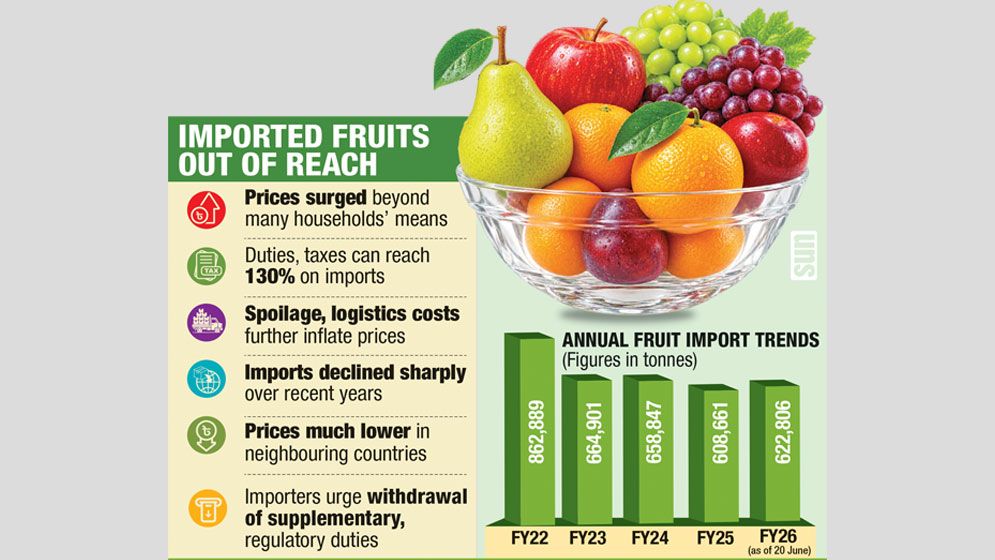
Imported apples, oranges, grapes and pomegranates – often bought when people fall ill – are increasingly becoming unaffordable for low-income and working-class families as high import duties, taxes and supply constraints drive up prices.
At Karwan Bazar on Tuesday, apples were selling for Tk380 a kilogramme, with lower-quality varieties available at Tk360. Oranges, which crossed Tk500 a kilogramme a few days ago, were selling at Tk400-450. Ashraful Islam, a Panthapath resident shopping for apples, said he had been unable to afford apples or oranges since last month.
“One kilogramme of apples contains four to six pieces. Even if there are six, each apple costs more than Tk60. For oranges, the price is more than Tk80 each,” he said.
“Inflation is already at an alarming level. These fruits are bought only when necessary, but when they are needed, there is no way to avoid buying them. I came to Karwan Bazar hoping prices would be lower, but even here they are extremely high,” he added.
Importers blame high duties for much of the price pressure. A 50% supplementary duty has been imposed on imported fruits in the current fiscal year, while the combined import duty and tax burden on several varieties reaches 130%.
Yet importers also question whether some fruits are being sold at excessive prices after entering the domestic market.
At Badamtoli, the country’s largest wholesale fruit market, importers said oranges from South Africa and Egypt are currently being imported at about 75 US cents a kilogramme, equivalent to roughly Tk90. Under the relevant HS code, the duty burden is 121.78%, adding about Tk107 and taking the import cost to Tk197.
Transportation adds around 10%, handling 8% and demurrage another 5%. Importers therefore estimate that oranges reach the market at roughly Tk250-255 a kilogramme before retailers add their margins. They argue that selling them for Tk500 a kilogramme is abnormal.
Apples from South Africa are also being imported at about 70 US cents a kilogramme, while pears and grapes are arriving at similar prices. With a 121.78% duty burden, importers at Badamtoli estimate that these fruits should generally retail for no more than Tk280-300 a kilogramme.
National Board of Revenue data show that the combined duty and tax burden on oranges, mandarins, watermelons, papayas, lemons, apricots, strawberries and other fresh fruits is 121.78%. For kiwis, durians and persimmons, it is 129.38%.
Bangladesh Trade and Tariff Commission data show that the country is heavily dependent on imports for apples, oranges, mandarins, grapes and dates, with combined duties and taxes ranging from 96.10% to 121.78%.
Mohammad Nazim Uddin, a Bangladesh Fresh Fruits Importer Association member and proprietor of Oishi Fruits Agency, said oranges currently have an LC price of about Tk90 a kilogramme.
“On top of that, we have to pay 122% duty, adding about Tk107 per kilogramme, along with transportation and handling costs,” he told the Daily Sun.
He said shipments from South Africa take 30-35 days to reach Bangladesh, during which a significant quantity can spoil. About 40 cartons may be damaged in a single container, with each carton holding roughly 15kg. The cost of the damaged fruit must then be spread across the rest of the shipment, further increasing prices.
Nazim said imported fruits also face a 30% supplementary duty and 20% regulatory duty. His association has urged the government to withdraw the additional charges.
Former National Board of Revenue chairman Badiur Rahman said the link between import costs, supply and prices was straightforward. High taxes raise traders’ costs, while transport, storage, spoilage and wholesale and retail expenses add further pressure.
Declining imports have also tightened supply. Bangladesh imported 862,889 tonnes of fruit in FY22, which stood at 622,806 tonnes up to 20 June in FY26.
Of that volume, 154,674 tonnes were apples, 138,282 tonnes oranges and 87,338 tonnes grapes.
The BTTC estimates annual demand for imported fresh fruit at five to six lakh tonnes, with apples and oranges together accounting for about 77% of demand.
The price gap with neighbouring countries is also stark. BTTC data show apples cost Tk350-380 a kilogramme in Bangladesh, compared with Tk150-220 in India, Tk110-170 in Pakistan and Tk160-240 in Nepal. Oranges cost Tk250-350 in Bangladesh, against Tk90-150 in India and Tk70-120 in Pakistan.
Grapes sell for up to Tk450 a kilogramme in Bangladesh, compared with Tk130-200 in India and Tk100-160 in Pakistan. Dates cost Tk250-450 in Bangladesh, against Tk160-260 in India and Tk120-200 in Pakistan.