



 For all latest news, follow the Daily Sun's Google News channel.


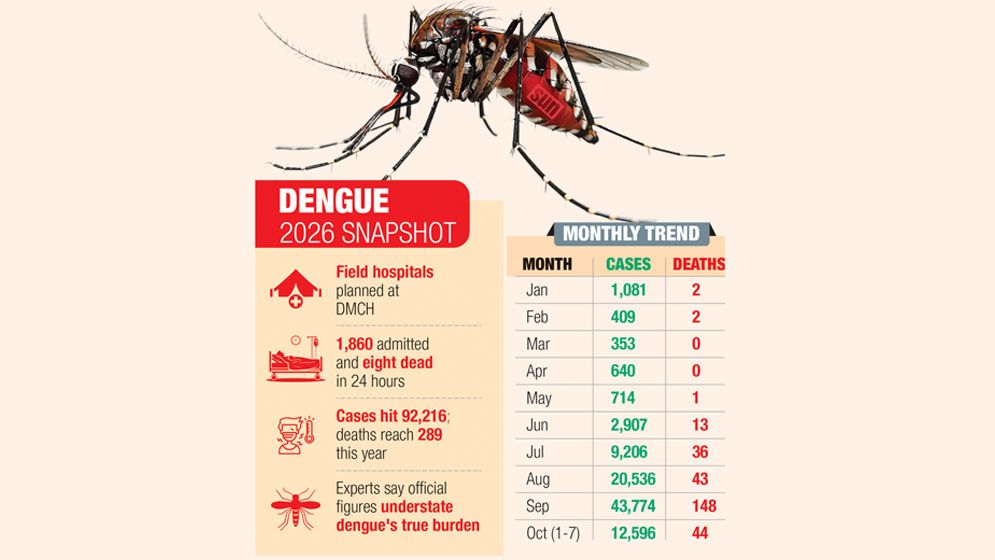
The government has ordered public hospitals in Dhaka to add about 1,000 beds as dengue admissions reached 1,860 in 24 hours and eight more people died, taking this year's death toll to 289.
Hospitals outside the capital have also been told to expand capacity as local needs require.
Dr Md Nurul Islam, director (hospital) at the Directorate General of Health Services (DGHS), said the directive followed instructions from the health minister at a recent Secretariat meeting.
"We hope that if we arrange around 1,000 more beds in the public hospitals in Dhaka city, we can tackle the situation," he told the Daily Sun, adding, "We have adequate logistical support, including saline, to operate additional beds." Dhaka Medical College Hospital (DMCH) will set up field hospitals if necessary.
Patients in the DMCH burn unit will be moved to the National Institute of Burn and Plastic Surgery to free 50-100 beds for dengue cases.
Medical college and district hospitals outside Dhaka have also been asked to add beds as required; Khulna Medical College Hospital has already set aside 100.
Brig Gen Md Saydur Rahman, director of Kurmitola, said 450-500 patients with fever visit its outpatient department daily, around 40 per cent of whom are diagnosed with dengue. The medicine ward of the 1,200-bed hospital has 400 beds, and a further 100 have been added for dengue patients, who are being given admission priority.
"A number of patients are being released every day after receiving necessary treatment," he said.
According to the DGHS bulletin covering the 24 hours to 8am on Wednesday, Khulna division reported the most admissions (376), followed by Dhaka division outside the city corporations (347), Chattogram (216), Dhaka North City Corporation (DNCC) (212), Barishal (200), Rajshahi (176), Dhaka South City Corporation (DSCC) (171), Mymensingh (110), Rangpur (38) and Sylhet (14).
The eight deaths, of three men and five women, included two each in DSCC, Khulna and Rajshahi, and one each in Barishal and Sylhet.
Cases this year have reached 92,216, with 5,776 patients currently in hospital. Dhaka division outside the city corporations has recorded the most cases (16,331), followed by Khulna (14,782), Chattogram (13,872), Barishal (11,977), DSCC (10,509) and DNCC (10,015). DSCC has the highest death toll at 77, ahead of Khulna division (57) and DNCC (35).
Cases rose from 2,907 in June to 43,774 in September; deaths rose from 13 to 148 over the same months. In the first seven days of October, 12,596 cases and 44 deaths were recorded.
October is averaging about 1,800 cases and six deaths a day, against about 1,460 cases and five deaths a day in September, an analysis of DGHS data shows.
Health experts say the true picture is worse because many patients are never diagnosed. "They do not come to any doctor or hospital to take treatment. After feeling fever, they only take over-the-counter drugs," public health expert Mushtuq Husain told the Daily Sun.
DGHS data cover 18 government and autonomous hospitals and 59 private hospitals in the capital. Outside Dhaka, it collects figures from government hospitals and very few private ones, so many patients treated or dying in private facilities are not counted.