


 For all latest news, follow the Daily Sun's Google News channel.


Bangladesh observes World Suicide Prevention Day today amid a rise in suicide attempts and deaths, with experts warning that stigma, untreated mental health conditions and the criminalisation of suicide attempts are discouraging people from seeking timely help.
Under the theme “Changing the Narrative on Suicide”, the observance will focus on prevention, support and early intervention.
The concern has come into sharp focus following the suicide attempt by former Bangladesh Rifles (BDR) member Abdul Barek at his business premises in Gaibandha on 6 September. Family members rescued him and took him to hospital.
Barek had been out on bail in a BDR tragedy case after spending 17 years in jail. His family said he had become increasingly frustrated by monthly court appearances in Dhaka, legal expenses and his inability to reclaim his lost job.
According to the Aachol Foundation, a non-governmental organisation, suicide is linked to a range of factors, including mental disorders, emotional distress, relationship and family problems, cyberbullying, academic pressure, exam failure, unemployment, financial stress, bullying or ragging, substance use,loneliness, gender-based violence and social stigma.
Thousands of calls
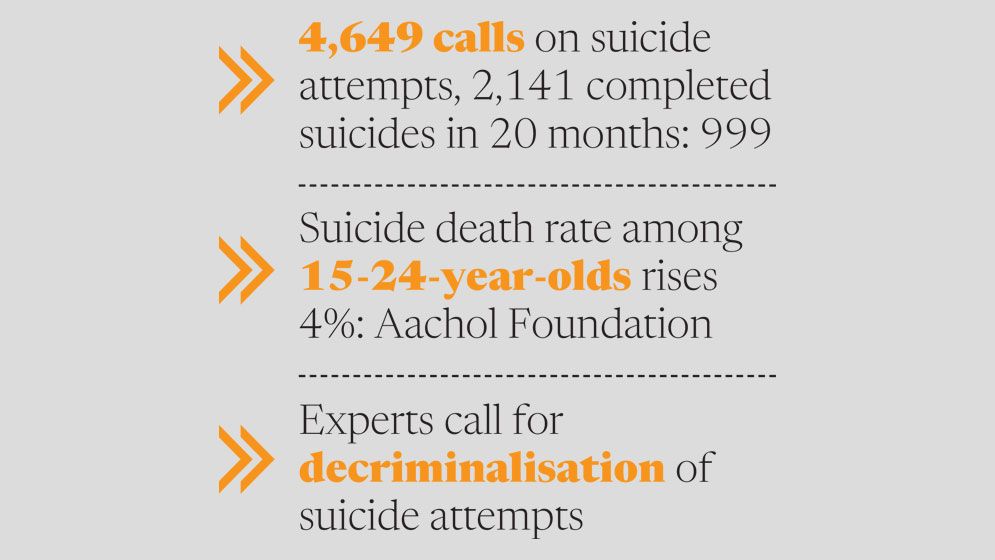
National Emergency Services 999 logged 4,649 calls reporting suicide attempts and 2,141 reports of completed suicides between January 2025 and August 2026.
Of these, 2,083 attempts and 427 deaths were reported in the first eight months of 2026 alone.
Anwar Sattar, a spokesperson for the 999 service, told the Daily Sun that such calls were referred to local police stations and the Fire Service and Civil Defence for rescue operations and other assistance.
Separate police data shows 73,597 people died by suicide between 2020 and 2024, while another 12,335 suicide cases were recorded between January and October 2025.
The Aachol Foundation said the suicide death rate among people aged 15 to 24 rose from around 18 per 100,000 in 2024 to 19 per 100,000 in 2025, an increase of roughly 4%.
It recorded at least 403 student suicide deaths in 2025, up from 310 in 2024. School pupils accounted for 47.4% of the cases, college students 22.8%, university students 19.1% and madrasah students 10.9%.
Treatment gap
The World Health Organisation estimates that more than 700,000 people die by suicide globally each year. Its latest comparable estimate put Bangladesh’s suicide mortality rate at 2.8 per 100,000 in 2021.
A pooled analysis published in “Health Science Reports”, based on 34 studies involving nearly 28,000 respondents between 2015 and 2024, found that one in every 14 respondents reported having attempted suicide.
Bangladesh’s National Mental Health Survey 2018–19 found diagnosable mental disorders among 18.7% of adults and 12.6% of children aged seven to 17. Depressive disorders affected 6.7% of adults and anxiety disorders 4.7%.
Yet the WHO mental health profile shows that 92.3% of adults and 94.5% of children with mental health disorders receive no treatment.
The country has several mental health policies and laws, including the National Health Policy 2011, Mental Health Act 2018, National Mental Health Strategic Plan 2020-2030 and National Mental Health Policy 2022.
The National Education Policy 2010 also calls for stronger student counselling services. However, the Aachol Foundation said implementation remains inadequate.
Call to decriminalise attempts
Prof Kamal Uddin Ahmed Chowdhury of Dhaka University’s Department of Clinical Psychology said criminalising suicide attempts remained a major barrier to seeking help.
“We consider those who attempt suicide to be criminals. This is a major barrier. The time has come to think about changing the current law regarding suicide or attempted suicide,” he said.
Barrister Nawfal Zamir, founder and chairman of the Insight for Change Foundation, said Section 309 of the Penal Code 1860 makes attempted suicide punishable by up to one year in prison, a fine, or both.
He called for the provision to be repealed or reformed.
Prof Mohsin Ali Shah, former chairman of the Department of Psychiatry at Bangladesh Medical University, said many people considering suicide “actually want to live” but see suicide as their only option amid severe distress.
Untreated depression can lead to repeated attempts, he warned, urging people at risk to seek prompt professional help.
Prof Dr Saifun Nahar, director of the National Institute of Mental Health, called for potentially dangerous materials to be kept away from at-risk people and urged society to support rather than isolate them.
Hasina Momtaz, a national professional officer for mental health at the WHO, said previous suicide attempts increase the risk of another attempt, making early warning signs and swift support crucial.
Clinical psychologist Zianur Kabir, director of the HRDC, called for an end to silence and stigma and urged coordinated action by the legal system, healthcare services and society.
Psychiatrist Dr Sayedul Islam Sayed said suicide was rarely caused by a single factor but was usually the cumulative effect of multiple problems and crises.
Police spokesperson AHM Shahdat Hossain, also an assistant inspector general, said investigators reassessed deaths initially recorded as suicide when evidence raised doubts.
“Post-mortem findings, forensic evidence, the crime scene, witness statements and digital records are all examined and a murder case is opened where evidence points to foul play,” he told the Daily Sun.
State Minister for Health and Family Welfare Dr MA Muhit acknowledged that criminalising attempted suicide was compounding mental health stigma and said the legal framework needed reconsideration.
He said the government was working to modernise Pabna Mental Hospital, strengthen mental health institutions in Dhaka, develop community-based mental healthcare and expand services at district and upazila levels.