


 For all latest news, follow the Daily Sun's Google News channel.


President moved to tears at July Memorial Museum
Daily Sun Report, Dhaka
Published: 10 Sep 2026, 12:00 AM
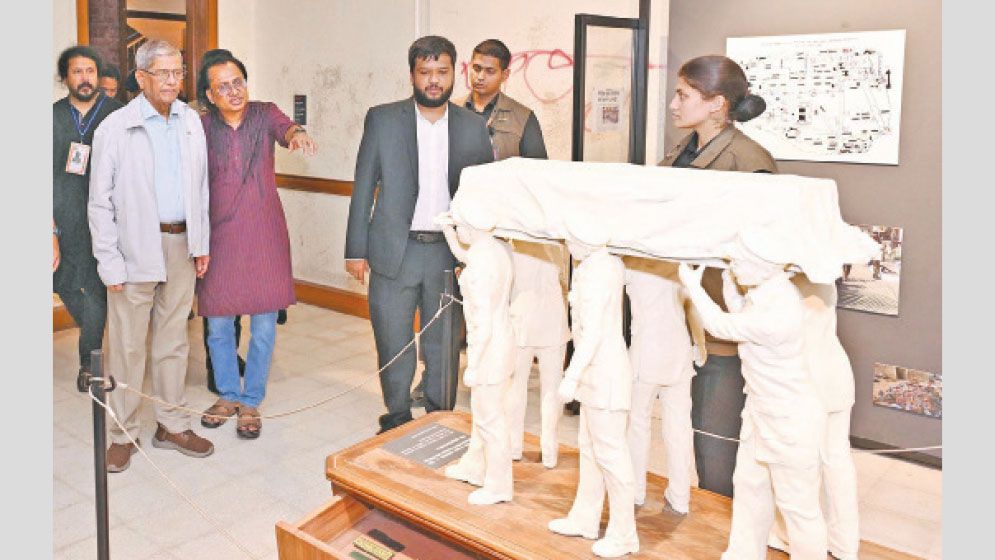
President Mirza Fakhrul Islam Alamgir looks at a sculpture depicting soldiers carrying the coffin of their colleague killed in the 2009 BDR massacre during his visit to the July Uprising Memorial Museum in Dhaka on Wednesday, as Prime Minister’s Policy and Strategy Adviser Dr Zahed Ur Rahman explains the exhibit. PID Photo
President Mirza Fakhrul Islam Alamgir broke down in tears while visiting the July Uprising Memorial Museum in Dhaka on Wednesday, saying Bangladesh had regained freedom from “fascist rule” and democracy but had paid a very high price for it.
“We have been freed from the hands of the fascists and regained democracy, but we have paid a very high price,” the President said after watching a documentary on the July mass uprising.
He said the state would never be able to repay its debt to those killed and injured during the July uprising and urged that such “tragic and brutal massacres” never take place in Bangladesh again.
Accompanied by his wife Rahat Ara Begum, the President reached the museum around 11am, where Culture Minister Nitai Roy Chowdhury, State Minister for Culture Ali Nawaz Mahmud Khaiyam, Prime Minister’s Policy and Strategy Adviser Dr Zahed Ur Rahman, the culture secretary, the museum’s director general and senior officials welcomed them.
After collecting a visitor ticket, the President walked through the “Long Walk to Democracy” walkway, viewing historical images depicting the Liberation War and different stages of Bangladesh’s democratic journey.
He visited the memorial dedicated to those killed during 16 years of what the museum describes as fascist rule, as well as a replica of the “Aynaghar” detention facility.
He also toured sections documenting the BDR massacre, Shapla massacre, torture equipment and enforced disappearances. He became visibly emotional while viewing letters, memorabilia and personal belongings of victims.
The President later visited exhibits documenting key events of the July uprising and the struggle of students and ordinary people. At the museum’s Monsoon Theatre, he watched a documentary on the uprising and again became emotional.
He paid tribute to those killed and injured during the uprising and planted a tree on the museum premises in their memory.
He said building a democratic, just, non-discriminatory and humane state by upholding the spirit of the July uprising was the responsibility of all.
Preserving the history of the uprising and presenting it accurately to future generations is crucial, he said, stressing the museum’s important role in preserving collective memory.
The President prayed for the eternal peace of those killed and wished speedy recovery and wellbeing for the injured and affected people. He also expressed condolences to the families of the victims.
After the visit, he signed the museum’s visitors’ book.