




 For all latest news, follow the Daily Sun's Google News channel.


Recent rape cases involving victims such as Achia and Ramisa have once again stirred public outrage and renewed calls for swift justice. Yet inside Bangladesh’s courts, the reality remains far more complicated, as thousands of pending cases, delayed investigations and limited judicial resources continue to slow the legal process.
Over the past few years, the government has introduced several measures aimed at accelerating the trial of rape cases, particularly those involving children. Earlier this year, two special tribunals were established to deal exclusively with child rape cases. Last year, amendments were also made to the Women and Children Repression Prevention Act following the Achia rape and murder case in an effort to speed up investigations and trials.
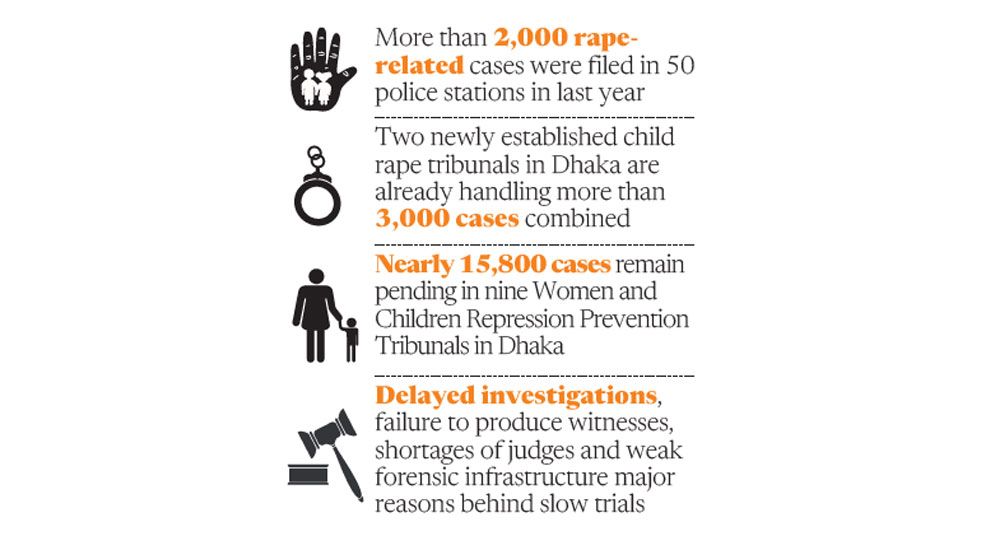
Despite those initiatives, legal experts and court officials say the justice system is still struggling to deliver verdicts within the timeframes set by law. Delays in police investigations and difficulties in producing witnesses in court are among the main reasons frequently cited. At the same time, shortages of judges, investigators and support staff, along with broader procedural bottlenecks, continue to place heavy pressure on the system.
Under Section 18 of the Women and Children Repression Prevention Act, investigators are required to complete probes within 15 days if an accused is caught red-handed during rape or attempted rape. If the accused is not apprehended at the scene, the law allows 30 days for the investigation.
Courts may grant an additional 15 days if necessary, while further extensions are permitted until DNA reports become available.
In reality, however, investigations often extend well beyond those deadlines.
According to available data, more than 2,000 rape-related cases were filed in 50 police stations between April last year and April this year. Of those, investigations into around 750 cases remain incomplete.
The law also stipulates that trials under Section 9 of the Act, covering rape and rape-murder cases, should be completed within 90 days. To minimise delays, courts are allowed to proceed on the basis of medical certificates and circumstantial evidence.
Even so, many cases continue for years.
A review of several randomly selected tribunal cases showed that many were filed four to five years ago, while some date back nearly a decade.
The pressure on the judiciary is particularly visible in Dhaka, where the two newly established child tribunals have already accumulated more than 3,000 cases since beginning operations in January.
As per the court sources, the Child Violation Prevention Tribunal responsible for Dhaka Metropolitan cases currently has more than 1,400 registered child rape cases, with another 600 awaiting registration.
The second tribunal, which handles cases from outside the metropolitan area, is dealing with more than 850 cases, while over 100 additional cases are still awaiting registration.
Court officials noted that these tribunals also hear other categories of cases within their jurisdiction, adding to the workload.
Meanwhile, rape cases involving victims above the age of 16 are being tried in nine Women and Children Repression Prevention Tribunals in Dhaka, where nearly 15,800 cases remain pending. On average, each judge is responsible for handling more than 1,700 cases.
Even after verdicts are delivered, legal proceedings may continue through appeals. Under existing law, convicted individuals are allowed to challenge tribunal verdicts before the High Court within 30 days.
Dhaka Metropolitan Sessions Court state prosecutor Shamsuddoha Sumon said timely justice depends largely on the smooth completion of legal procedures, including prompt police reports and the presence of witnesses during hearings.
He added that confessional statements recorded under Section 164 of the Code of Criminal Procedure could help shorten trial proceedings.
Quazi Mahfujul Hoque Supan, associate professor of law at the University of Dhaka and former member of the Judiciary Reform Commission, said the increasing number of rape cases reflected broader social concerns, including drug abuse, declining social values and inadequate attention to mental health.
He also pointed to weaknesses in the country’s investigative infrastructure. According to him, police do not maintain a proper database of offenders, limiting opportunities to monitor repeat offenders or conduct research that could support preventive measures.
Supan stressed the need for specialised female personnel in police stations and hospitals to assist survivors more effectively. He also emphasised the importance of awareness programmes in schools to help children understand personal safety and evidence preservation in emergency situations.
To reduce delays, he proposed forming a specialised investigative unit dedicated solely to rape cases and staffed by trained personnel.
He further noted that Bangladesh currently has only one forensic laboratory, despite the need for dedicated facilities in each of the country’s eight divisions. The shortage often delays DNA testing and slows investigations.
Discussing delays in court proceedings, Supan said weak infrastructure and the lack of skilled legal professionals remain major challenges. He noted that many public prosecutors work without adequate office facilities or proper remuneration.
He suggested introducing a competitive recruitment system for state prosecutors, similar to the process used in judicial appointments, to strengthen professionalism within prosecutions.
“If police can collect evidence properly and prosecutors can present cases effectively, the judicial process can move much faster,” he said. “Courts ultimately rely on evidence to proceed.”
Recommended Stories