



 For all latest news, follow the Daily Sun's Google News channel.


Green energy push sparks Tk2,000cr linkage market
Rising industrial demand for solar, batteries and energy storage systems drives export prospects, job creation

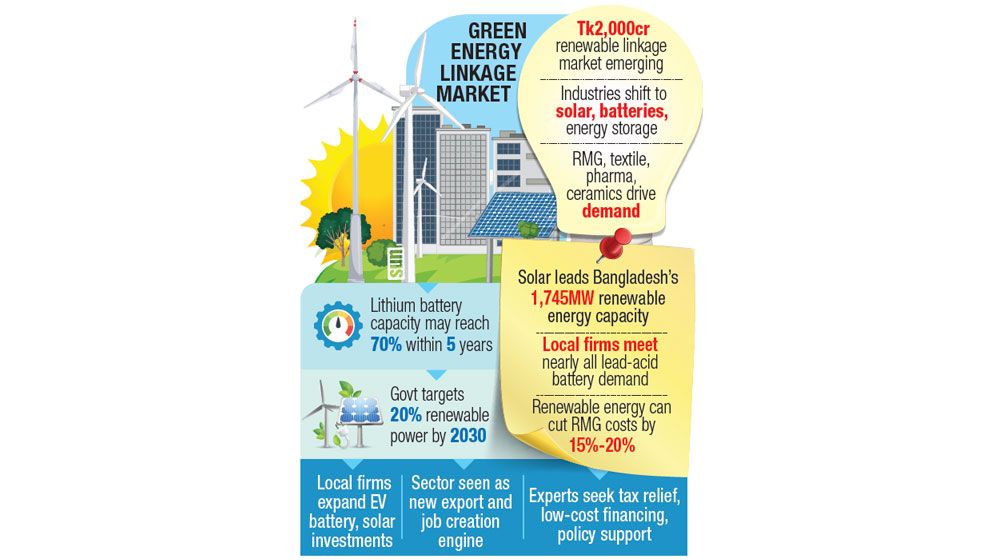
Transition toward renewable energy is creating significant opportunities for Bangladesh’s green linkage industry, as industries increasingly adopt solar and energy storage solutions to reduce production costs, ensure uninterrupted power supply and remain globally competitive.
Industry experts said the expanding use of renewable energy across the ready-made garment (RMG), textile, pharmaceutical and ceramic sectors is driving strong demand for locally manufactured batteries, solar panels, inverters and energy storage systems.
However, the availability of critical minerals remains a major challenge for the industry’s long-term growth.
They believe that with proper policy support, investment and technological advancement, the sector could emerge as a major pillar of industrial diversification, export expansion, employment generation and sustainable economic growth.
According to the Sustainable and Renewable Energy Development Authority (SREDA), Bangladesh’s installed renewable energy capacity currently stands at 1,745.31 MW, of which solar power accounts for 1,452.22 MW through both on-grid and off-grid systems. The remaining capacity comes from wind, hydro, biogas and biomass-based power generation.
A recent report by the Institute for Energy Economics and Financial Analysis (IEEFA) found that renewable energy accounts for only 2.3% of the country’s grid-based power generation, far below the global average of around 33.8% in the fiscal 2024-25.
The report also showed that industrial grid-based power consumption increased by around 1,125.5 GWh, or 4.8%, in FY25.
Data from the Bangladesh Investment Development Authority (BIDA) shows the country’s electricity demand is growing by nearly 7% annually, with peak demand projected to exceed 25,000 MW by 2030.
To address rising energy demand, the government’s draft renewable energy policy aims to generate 20% of total electricity from renewable sources by 2030 and 30% by 2040.
Huge untapped market
Industry insiders estimate that Bangladesh’s renewable energy linkage sector already represents an annual market worth around Tk2,000 crore, driven by growing demand from both industrial and residential consumers.
Local manufacturers are now producing or assembling a wide range of renewable energy products, including solar batteries, IPS batteries, lithium batteries, inverters, LED lighting products, EV batteries and small-scale solar accessories.
They said domestic firms currently meet nearly all demand for lead-acid batteries and around 30% of lithium battery demand, with production capacity expected to rise to 70% within the next five years.
However, advanced raw materials, lithium cells and high-tech components still need to be imported.
President of the Bangladesh Sustainable and Renewable Energy Association (BSREA) Mostafa Al Mahmud said the sector’s growth has been slowed by financing constraints, infrastructure limitations, technology gaps and long-standing dependence on imported fuel.
“Bangladesh is moving toward a serious energy crisis unless timely measures are taken. Renewable energy and its backward linkage industries must now become a national priority,” he said.
Export potential gaining momentum
Industry stakeholders also see strong export prospects for Bangladesh’s battery and energy storage sector as global demand for electric vehicles (EVs) and affordable energy solutions continues to rise.
Several Bangladeshi companies are already exporting batteries and related products to India, Nepal, the European Union and Middle Eastern countries.
Chief Operating Officer of Panna Group SM Muzibul Alam said the company exports battery products to more than 40 countries under brands including Volvo, Krank and Adixin.
He said rising global demand for clean energy technologies is creating new opportunities for the manufacturers.
“Green energy not only saves foreign currency but also helps reduce carbon emissions and environmental pollution,” he added.
Local firms expand investments
At least eight major local companies are now actively involved in renewable energy-related manufacturing and assembly operations.
They include Panna Group, Rahimafrooz Batteries Ltd, Hamko Industries Ltd, Super Star Group, Rimso Battery & Co Ltd, Navana Group, Rangs Group Energy Solutions and Walton Group.
Panna Group said it is expanding operations in solar energy, EV batteries, energy storage systems and lithium battery technologies to support the country’s transition toward clean energy.
Meanwhile, Walton has invested more than Tk113 crore in a lithium-ion battery manufacturing project in Gazipur.
Walton’s Chief Business Officer (Battery & Fastener) Mahfuzur Rahman Russel said commercial production is expected to begin by July this year.
“The market for renewable energy linkage products is expanding rapidly. Alongside meeting local demand, we are also preparing for exports,” he said.
He also urged the government to ensure strict monitoring of substandard imported products and maintain a level playing field for local industries.
RMG sector can cut costs
Research Director at the Centre for Policy Dialogue (CPD) Dr Khondaker Golam Moazzem said renewable energy adoption could significantly reduce industrial production costs despite Bangladesh’s land constraints.
“The RMG sector alone can reduce production costs by 15% to 20% through renewable energy use,” he said.
He added that Bangladesh spends a huge amount on LNG imports every year, while part of that expenditure could instead be directed toward renewable energy development.
“Export-oriented industries will increasingly need renewable energy to meet international buyers’ compliance requirements,” he added.
Job creation opportunities
Industry insiders said the sector also has strong potential for employment generation, particularly in battery manufacturing, lithium technology, EV servicing, solar installation, technical maintenance, recycling, and research and development.
Thousands of workers, engineers, technicians and service providers are already engaged in the industry, with demand for skilled manpower expected to grow rapidly in the coming years.
Calls for stronger policy support
As the national budget for FY27 approaches, experts and industrialists have called for comprehensive policy support to strengthen the domestic renewable energy linkage industry.
Their recommendations include reducing import duties and VAT on raw materials and machinery, offering tax incentives for lithium battery and EV industries, expanding low-interest financing facilities and supporting research and development initiatives.
They also stressed the need to restrict substandard imports, develop skilled manpower through technical training and promote “Made in Bangladesh” renewable energy products in global markets.
Chairman and CEO of Policy Exchange Bangladesh M Masrur Reaz said Bangladesh should leverage the global “China Plus One” investment strategy to attract foreign direct investment (FDI) into the sector.
“Strong policy support is essential to develop a competitive local supply chain and unlock the sector’s full potential,” he said.
Distinguished Fellow at CPD Prof Mustafizur Rahman said Bangladesh has considerable scope to gradually develop local manufacturing and value addition in solar panel production.
“Even if raw materials are initially imported, assembling and producing components locally will reduce dependency on imports and lower costs over time,” he observed.