


 For all latest news, follow the Daily Sun's Google News channel.


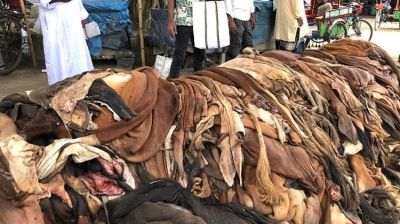
Experts call for action plan to boost tannery byproducts export
BUILD Chairperson Abul Kashem Khan highlighted the vast potential of tannery solid waste management
Daily Sun Report, Dhaka
Published: 05 Oct 2026, 07:41 PM
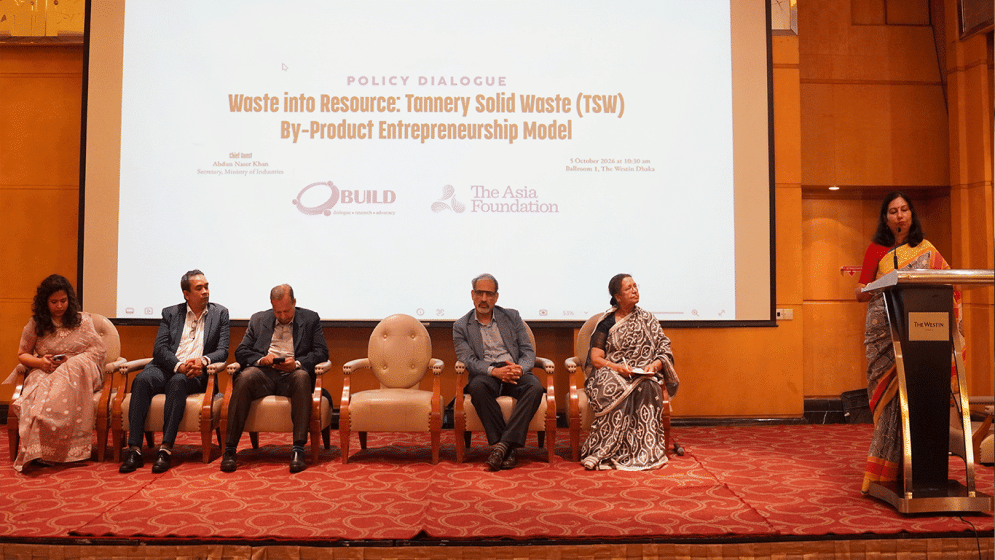
Photo: Daily Sun
Experts on Monday underscored the need for a time-bound pragmatic action plan to enhance the exports of tannery solid waste byproducts.
They said the country has a scope to increase
exports of leather and leather goods including its byproducts valued more than USD$5
billion by next five years.
They made the remarks at a policy dialogue titled “Waste
into Resource: Tannery Solid Waste (TSW) Byproduct Entrepreneurship Model,”
jointly hosted by Business Initiative Leading Development (BUILD) and The Asia
Foundation at The Westin Dhaka.
According to EPB data, the country exported leather
and leather goods valued $1.23 billion in fiscal year 2025-26. In
July-September quarter of FY27, leather and leather goods exports increased by
14.74% to $367 million from $320 million.
The dialogue explored new entrepreneurship models
utilising waste as a resource through TSW management in a compliant manner,
controlling pollution and being friendly to the environment.
Addressing the programme as the chief guest,
Ministry of Industries Additional Secretary Smriti Karmakar emphasised that
tannery solid waste should not be viewed merely as an environmental or river
pollution concern, but as a valuable economic resource that can drive new
businesses, investment, and green entrepreneurship through proper technology.
She highlighted the potential of the leather and
leather-goods sector, while stressing the importance of addressing
environmental management, resource efficiency, product diversification,
compliance, and value addition.
She assured that the Ministry of Industries is ready
to work with BUILD and other stakeholders to review the study’s recommendations
and identify practical policy measures.
Dr. Mohammed Abu Eusuf, executive director of RAPID,
emphasised the 3Cs–comprehensive approach, coordination, and compliance.
He highlighted existing financial bottlenecks and
stressed that a dedicated, separate policy is urgently needed for tannery solid
waste Management because it functions as an entirely distinct sector.
Furthermore, he underlined the critical necessity of
activating slaughterhouses to improve raw material quality at the source.
Md Golam Shahnewaz, managing director of Dhaka
Tannery Industrial Estate Wastage Treatment Plant Company Limited, pointed out
the massive domestic market for capsules (reaching 500 to 700 crore pieces),
highlighting the immense requirement for gelatin.
He advocated for extended solid waste management
frameworks reaching down to grassroots levels and emphasised the importance of
proper chrome-shaving management and collecting raw hides efficiently during
peak seasonal periods like Eid.
Presenting the keynote paper at the dialogue, CEO of
BUILD Ferdaus Ara Begum highlighted that the Savar Tannery Industrial Estate
(STIE) alone generates approximately 84,000 tonnes of tannery solid waste
annually and underscored that roughly 60% to 70% of this waste consists of
chrome-free beamhouse trimmings and fleshings possessing high near-term valorisation
potential for gelatin, collagen, protein meal, and tallow.
“However, due to a fragmented policy framework,
ambiguous waste-code classifications, and a lack of source-level segregation
protocols, a vast majority of these valuable industrial inputs remain
underutilised or improperly dumped,” she noted.
Ferdaus stressed that transforming TSW management
requires treating recovered waste as secondary industrial raw material rather
than hazardous refuse.
Her data-driven presentation outlined actionable
business models–ranging from large-scale commercial biorefineries to SME-level
tallow extraction units–that could capture millions in domestic value and
substitute around $100 million in annual imports of gelatin, glue, shoe soles,
and poultry feed additives.
Alamgir Hossain, country representative of UNIDO,
stressed that as Bangladesh targets becoming a trillion-dollar economy, it must
move away from single-sector dependency, identifying the leather industry as a
vital alternative growth engine.
Addressing imminent LDC graduation challenges and
the request for a three-year extension, he emphasised that the country must
prepare itself actively regardless.
BUILD Chairperson Abul Kashem Khan highlighted the
vast potential of tannery solid waste management in driving export
diversification, attracting foreign direct investment, and generating revenue.
BSCIC Director (Promotion and Development) Kazi
Nazrul Islam said effective waste management requires a coordinated approach
involving households, offices, industries, and government agencies.
He observed that in many Western countries, waste
segregation begins at the household level, whereas Bangladesh continues to face
challenges due to gaps in policy, public awareness, institutional systems, and
implementation.
Ainee Islam, program director at The Asia
Foundation, said during the transition from Hazaribagh to Savar, parts of the
leather-sector ecosystem and related activities continue to remain connected to
Hazaribagh.
Sharifa Khan, former alternate director of the World
Bank and Senior Secretary of ERD, moderated the panel session and highlighted
the need for a coordinated action for handling tannery solid waste management
(TSW) as a compliant sector.
Mizanur Rahaman, general secretary of BTA, said
Bangladesh could establish dedicated processing factories similar to JW Animal
Protein, which would eliminate the classification of waste entirely, and noted
that currently, no factories inside the Savar Tannery Industrial Estate (STIE)
are Leather Working Group (LWG) certified, as individual ETPs within the estate
were prohibited in the past.
Ishrat Shabnam, country director of Practical
Action, stressed that digital tracking and thorough cost-benefit analyses are
crucial for the sector as recommended by the BUILD study.
Tipu Sultan, president of BFFLEA, urged the government to resolve infrastructural and land problems, support individual ETP setups for factories desiring them, and provide targeted policy backing to arrest the current fall in exports.