


 For all latest news, follow the Daily Sun's Google News channel.


IMF projects 3.2% growth, 10.9% inflation in FY27
Daily Sun Report, Dhaka
Published: 14 Oct 2026, 12:00 AM
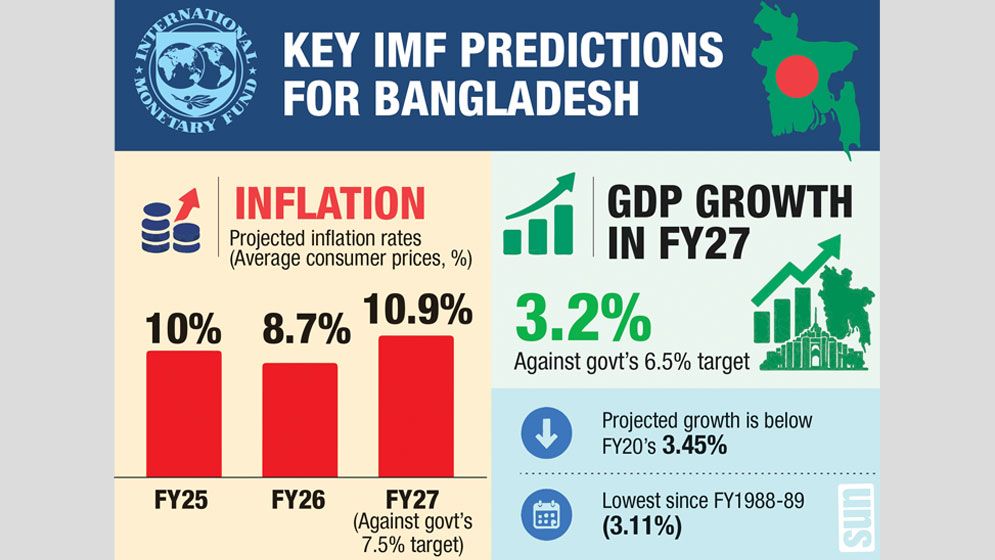
The International Monetary Fund (IMF) has projected that Bangladesh’s economy will grow by 3.2% in the current 2026-27 fiscal year (FY27) while average inflation will rise to 10.9%, well short of the government’s targets of 6.5% growth and 7.5% inflation.
The forecasts appear in the October edition of the IMF’s World Economic Outlook, released on Tuesday during the annual meetings of the World Bank and the IMF in Bangkok.
If realised, the growth rate would be lower than the 3.45% recorded in FY20, during the COVID-19 pandemic.
According to the Bangladesh Bureau of Statistics (BBS), growth was 3.11% in FY1988-89. That would make 3.2% the lowest in nearly four decades.
The IMF expects average inflation to ease to 8.7% in FY26 from 10% in FY25, before climbing again in FY27. The BBS put FY26 average inflation at 8.68%, against the interim government’s budget target of 6.5%.
Point-to-point inflation was 8.34% in September, up from 8.26% in August and 8.32% in July. Inflation peaked at 11.66% in July 2024, when food inflation reached 14.10% and non-food inflation 9.68%. After the fall of the Awami League government, it fluctuated between 9% and 10% for several months.
Other lenders’ forecasts
The IMF is not alone in expecting Bangladesh to fall short of the government’s 6.5% growth target for FY27, as the World Bank and the Asian Development Bank (ADB) have also projected weaker expansion.
The World Bank, in its Bangladesh Development Update published on 6 October, forecast growth of 3.4% for the current fiscal year. It warned of the risk of rising inflation but did not provide a specific projection. In its Global Economic Prospects report in June, the lender had projected 4.6% growth for FY27, citing the impact of the conflict involving the United States, Israel and Iran.
The ADB, in its Asian Development Outlook published on 23 September, projected growth of 4% in FY27, with inflation expected to rise to 9%.
The IMF report does not explain all of its Bangladesh-specific projections.
The World Bank’s assessment says growth is slowing as private investment and employment weaken. It also cites gas and electricity shortages disrupting industrial output, and rising default loans and capital shortfalls in the banking sector.
The World Bank said much spending on electricity, fuel and fertiliser subsidies does not reach the poorest households, while many vulnerable families remain outside social protection programmes.
It named banking stability, energy security, governance and higher tax revenue as reform priorities, and recommended gradually cutting general subsidies while expanding targeted support.
The ADB called for macroeconomic stability, a better investment climate, stronger financial sector governance and energy and infrastructure reforms.
It warned that escalation of the conflict in West Asia could raise fuel and transport costs, adding to inflation and straining external payments. It also cited new tariffs or trade restrictions, slower growth in major export markets, tighter access to foreign financing and climate-related risks.