




 For all latest news, follow the Daily Sun's Google News channel.


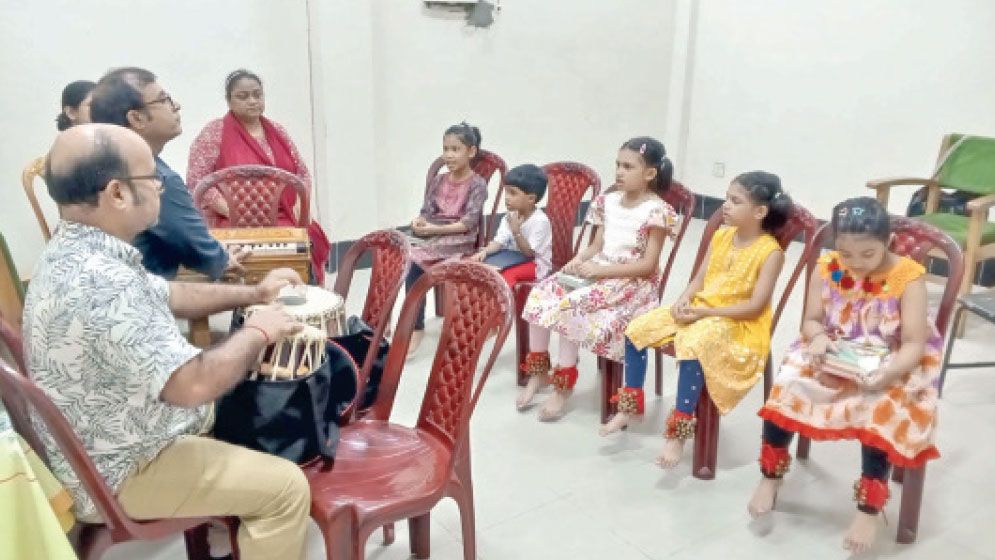
Children receive singing lessons at a music centre at Mohammadpur Suchona Community Centre on Tuesday. -Daily sun Photo
For just Tk250 for a three-year course and Tk100 a month, Dhaka’s city corporation-run music schools promise affordable arts education, but outdated information, irregular classes, poor facilities and delayed certificates are letting students down.
At least two centres have stopped operating at their listed locations, while others struggle with low enrolment and poor learning conditions.
Teachers and guardians say frequent changes of venue, a lack of publicity, and the absence of a consistent academic calendar and syllabus have further weakened the schools.
The programme was introduced in 2004 by Sadeque Hossain Khoka, then mayor of undivided Dhaka City Corporation, to expand learning opportunities for children from low-income households.
According to the corporations’ websites, Dhaka South City Corporation (DSCC) has 12 music schools and Dhaka North City Corporation (DNCC) has five.
Schools difficult to find
Children aged four to 18 are eligible. Each school is supposed to have six teachers – two each for music, dance and tabla. DSCC employs 57 teachers and DNCC 27, each receiving Tk12,000 a month.
Classes are scheduled twice a week, but published information is inconsistent. DSCC classes are currently held on Mondays and Wednesdays from 3pm to 5pm, while DNCC classes take place on Thursdays from 3pm to 5pm and Fridays from 9.30am to 11.30am.
Finding the schools can be difficult: many venues have no signboards, and online listings do not always reflect reality.
The DSCC website lists Paltan Community Centre and Jahir Rayhan Cultural Centre as teaching venues.
During visits on 5 and 12 October, however, no instructors or students were found. At Paltan, there was no sign of a music school. The Ward 13 secretary, whose office is inside the building, said he knew nothing about it.
Teacher Mujibur Rahman said Paltan Music School had stopped operating after 5 August 2024, when the community centre was damaged during the mass uprising.
Mujibur and other teachers now sign their attendance at the social welfare department and spend their duty hours in Social Welfare Officer Moshiur Rahman’s room.
At Sutrapur Community Centre, caretaker Shohid Ullah said no music school operated there and suggested visiting Jahir Rayhan Cultural Centre. Officials at that centre, however, said no music classes were held there either.
The website names assistant social welfare officer Saidur Rahman as the person in charge of the Bakshibazar centre. Saidur said the centre no longer operated at that location and that he had relinquished responsibility in 2021.
Other centres face similar visibility problems. Although the website lists Gendaria Community Centre as a venue, no teachers were seen there at 3.30pm on 12 October.
Staff confirmed that a music centre was based there. No signboard was visible at Mohammadpur Suchona Community Centre either.
Teacher Sultana Rajia said a signboard displaying the school’s details could help attract students.
When asked for the locations and contact details of school in-charges, DSCC Social Welfare Officer Moshiur Rahman declined to provide them, saying the information was sensitive and would require an application under the Right to Information Act.
Chief Social Welfare and Slum Development Officer of Dhaka South Mohammad Mobasher Hassan acknowledged that the website carried outdated information, saying updated details had long been sent to the ICT department.
He said a high-level committee had been formed to assess the schools and teachers, and to revive the programme.
He also questioned whether some teachers were giving the schools sufficient attention.
Inadequate facilities, discouraged students
At Dholpur community centres, teachers and students complain of a lack of support staff to clean classrooms and maintain instruments.
“When there is a programme in the community centre, the classrooms get unclean,” said music teacher Mazhrul Islam. Students need drinking water during singing and dance classes, he said, while washrooms sometimes remain locked.
Aritra Saha, a student at DNCC’s Ward 2 Community Centre Music School, said rainwater enters the classroom because the roof is damp. The school has only one harmonium, which teachers also use.
At Dhaka Mohangar Mohila College centre, teacher Chanchala said students and guardians were losing heart because the school could not provide certificates after the three-year course.
A visit to Abdul Halim Community Centre on 8 October found three students practising dance on the third floor under teachers Afroja Sultana Boby and Zamil Hossain Khan. The classroom was poorly maintained, with damaged chairs, and other community activities sometimes ended just before lessons began.
On the fourth floor, Subra Debnath was conducting a music class with six students in a room also used as the ward secretary’s office. With no support staff, one trainer had to take on additional duties without extra pay.
Lutfor Rahman, who is also in charge of the school, said teachers often had to arrange seating across different floors and had no separate waiting area for guardians. Parents sometimes left without enrolling their children because the school did not offer alternatives such as art and recitation. Basabo Community Centre presents a more encouraging picture. Its music school has around 100 students and five teachers, and the classrooms and practice area are clean. Yet teachers still lack instruments and proper storage for documents; damaged tables, chairs, mats and carpets are not replaced.
Student Mohona Zannat Meem, who has attended music classes since 2023 and recently began dance lessons, said both classes were scheduled at the same time. By the time she finishes one, she misses the first half of the other.
Centre in-charge Chowdhury Mostak Hossen said students had taken examinations and results were available, but printed certificates had not arrived from the central authority. The delay had lasted nearly a year, discouraging students. Issuing certificates promptly, he said, could help sustain interest and attendance.
Munmun Dey, whose daughter attends the Mohanagar Mohila College music centre, said only six or seven students attended, although they were consistent. With no academic calendar, students could enrol at any time of the year, she said, and were frequently on the move.
Guidelines without consistent implementation
Both corporations have guidelines for their music schools, but classroom practice does not always match the rules.
DNCC’s Academy of Music and Fine Arts guideline, issued in 2018, provides for music, dance, arts, recitation and painting, with classes on Thursdays and Saturdays from 3pm to 6pm.
DSCC’s 2024 guideline sets out a three-year music and dance course and provides for certificates. It also specifies Friday and Saturday morning classes, although schools have been holding classes on other days. Teachers say they have received inadequate support to print certificates.
Chief Social Welfare and Slum Development Officer of Dhaka North Mohammad Mamun-Ul-Hassan said the corporations needed updated guidelines and budgets.
He said work was under way and that certificates had begun to be printed with support from zonal offices.
Dr Priyanka Gope, chair of the University of Dhaka’s Department of Music, said the schools needed better publicity through signboards, social media and websites.
Enrolment should take place annually through proper announcements, she said, and qualified teachers should make music, dance and poetry enjoyable for children.
Although fees are low, the institutions need greater attention to ensure regular operations, she said. A clear policy for government-run programmes of this kind, backed by a monitoring team or cell, would help ensure that the schools fulfil their original purpose.