




 For all latest news, follow the Daily Sun's Google News channel.


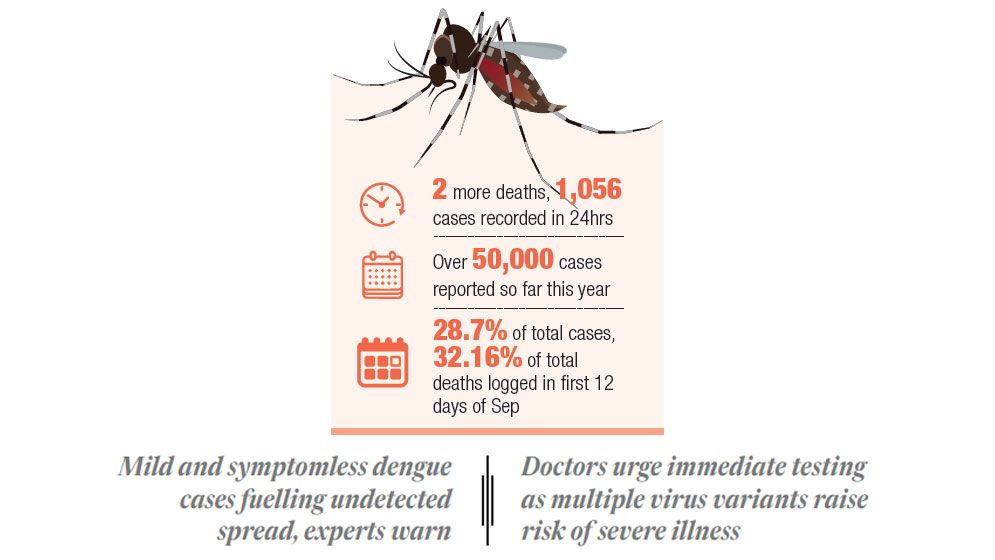
Dengue has emerged as one of the season’s gravest public health concerns in the country, with health experts warning that a rising share of mild and symptomless infections is allowing the disease to spread undetected, even as case numbers and deaths climb sharply in September.
Officials say the danger is compounded by the co-circulation of multiple dengue virus variants, which doctors warn significantly raises the risk of severe illness and fatality when patients are infected more than once.
According to the Directorate General of Health Services (DGHS), at least two more patients died and 1,056 were hospitalised in the 24 hours to 8am on Saturday. Both deaths were reported from the Dhaka South City Corporation area.
The fresh figures take the year’s death toll to 143 and total cases to 50,276, with 3,577 patients currently under treatment nationwide.
DGHS data show the outbreak has accelerated markedly this month: 46 deaths, or 32.16% of the annual total, were recorded in the first 12 days of September alone, compared with 43 in the whole of August. Similarly, 14,430 cases, or 28.7% of the yearly count, were logged in the same 12-day period, against 20,536 for all of August.
"The number of dengue cases is increasing in the country. We are prepared to ensure treatment, but people have to remain alert to prevent the disease," said Prof Dr Md Halimur Rashid, director (disease control) at DGHS.
Hidden infections, rising risk
Physicians say the danger this year lies partly in what cannot be seen.
Prof Dr Saif Ullah Munshi, director of the Super Specialised Hospital at Bangladesh Medical University, said mild or asymptomatic dengue can occur in any patient, making prompt testing essential.
"Every patient, after feeling any fever, has to go for a dengue test immediately to prevent severe illness or death," he said.
Brig Gen Md Saydur Rahman, director of the hospital, said around 500 patients with fever were attending its outpatient department daily, of whom 70–80% tested positive for dengue.
The World Health Organisation notes that most dengue infections are mild or symptomless and resolve within one to two weeks, but the disease can still turn severe and fatal.
Where symptoms appear, they typically begin four to ten days after infection, lasting two to seven days, and may include high fever, severe headache, pain behind the eyes, muscle and joint pain, nausea, vomiting and swollen glands.
Crucially, the WHO says mosquitoes can pick up the virus from anyone who is viraemic, whether symptomatic, pre-symptomatic or entirely asymptomatic, meaning transmission can continue undetected. Human-to-mosquito transmission can occur up to two days before symptoms appear and up to two days after fever subsides.
Multiple variants heighten danger
Public health expert Mushtuq Husain, a former principal scientific officer at the Institute of Epidemiology, Disease Control and Research (IEDCR), said many patients go undetected because they avoid hospitals and rely on over-the-counter medicine instead.
He urged the government to expand testing capacity, including mobile facilities, to identify cases early and bring the outbreak under control.
All government hospitals are currently offering free NS1 antigen tests for dengue, with the facility available until 31 December.
According to the US CDC, dengue is caused by four related but distinct virus serotypes: DENV-1, DENV-2, DENV-3 and DENV-4. Roughly one in twenty patients progresses to severe, life-threatening disease, and because multiple serotypes exist, people can be infected repeatedly through their lives.
Experts note that while infection confers lifelong immunity to that particular serotype, protection against the other three can last as little as two months, leaving people vulnerable to reinfection during active outbreaks.
"Definitely, infection with a different serotype of dengue virus in the same patient can be bad, as it may develop severe dengue. So, infection with more than one variant is bad," said Prof Dr Zakir Hossain Habib, chief scientific officer at IEDCR.
An IEDCR report shows DENV-3 has overtaken DENV-2 as the dominant strain this year. Last year’s surveillance found DENV-2 in 49.2% of samples, followed by DENV-3 (35.8%), DENV-1 (8.8%) and DENV-4 (6.3%).
The WHO classifies symptomatic dengue into three categories by severity: classic dengue fever, dengue haemorrhagic fever and dengue shock syndrome.
Experts say a prior dengue infection remains among the strongest risk factors for severe disease, with second infections carrying a markedly higher risk of complications, including shock syndrome.
State Minister for Health MA Muhit said on Wednesday that the outbreak is expected to peak between the end of this month and the first week of next.