


 For all latest news, follow the Daily Sun's Google News channel.


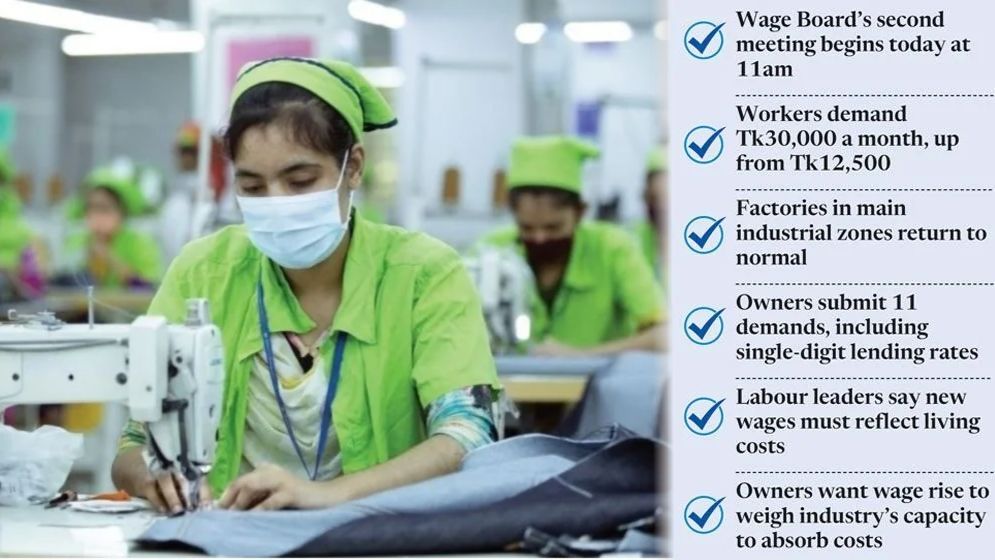
Employers and workers will submit written proposals on a new garment-sector minimum wage at the Wage Board’s second meeting in Dhaka today, as factories in Savar, Ashulia, Gazipur and Narayanganj returned to normal after days of unrest over workers’ demand to raise the monthly minimum from Tk12,500 to Tk30,000.
Owners, meanwhile, have set out an 11-point list of demands, including single-digit bank lending rates, urging the government to protect the sector’s competitiveness alongside any pay rise.
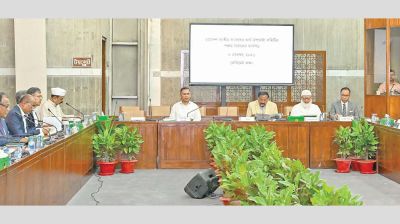
The meeting will begin at 11am at the Wage Board office in Segunbagicha, Dhaka, chaired by Syed Azad Subhani, the board’s chairman and a district and sessions judge. It will also discuss new minimum wages for workers and employees across all garment grades.
At the first meeting, on 4 November, both sides agreed to bring their proposals to the next. today’s session is expected to move the talks into a more formal and substantive stage.
The government formed the six-member board for readymade garment (RMG) workers on 1 November under the Ministry of Labour and Employment, amid widespread protests. Workers have been demonstrating since 31 October.
They say their pay no longer covers food, rent, transport, healthcare and education amid persistently high inflation.
They also say it trails competitors: Bangladesh’s minimum monthly garment wage is $102, against $124 in India, $294 in China, $208 in Cambodia, $172 in Indonesia, $163 in Vietnam and $135 in Pakistan.
Md Towhidur Rahman, chairman of the Bangladesh Garment Workers Unity Council, told Daily Sun that revising wages in line with the actual cost of living was essential.
He said five labour alliances, representing around 54 federations and 450 active trade unions, would submit a joint proposal at 10am today.
Different organisations have proposed monthly wages of between Tk27,500 and Tk37,000, he said, and these would be consolidated into a unified demand.
Return to work
Workers returned to factories in Savar, Ashulia, Gazipur and Narayanganj on Sunday, with attendance reported in most units. Sources said they went back of their own accord after outstanding wages were paid, attendance bonuses were increased and various other demands were accepted.
Md Israil Howlader, additional inspector general of Industrial Police, said the situation in the industrial zones was returning to normal. He said the owners of one or two Ashulia factories had temporarily suspended operations following problems, after which workers left the premises peacefully. No protests, clashes or road blockades were reported on Sunday, he added.
Md Mostafizur Rahman, DIG of the Dhaka Range, said about 15 cases had been filed in Ashulia and Savar and more than 100 people arrested. None of those arrested were workers, he said, but people who had instigated the crisis.
Towhidur said workers at Apex Holdings on Tangail Road had reportedly walked out, while 10 to 11 factories in the Jamgora, Envoy, Ha-Meem and Nischintapur areas of Ashulia were temporarily closed. The BGB and other law enforcement agencies intervened, he said. He expressed hope that production would resume fully and that October wages would be paid in full by today.
Employers’ 11 demands
Garment entrepreneurs have presented an 11-point list of demands to the government, urging it to protect the sector’s competitiveness, productivity and financial viability alongside any wage increase.
They said the wage board should consider the industry’s capacity to absorb higher costs as well as workers’ demands.
On pricing and labour rules, they want minimum buying prices fixed by product on the basis of production costs, wages and compliance expenses.
They also seek piece-rate wages and enforcement of the “no work, no pay” principle under existing labour laws.
On finance, they called for bank lending rates in single digits and a joint monitoring cell of Bangladesh Bank and the Bangladesh Garment Manufacturers and Exporters Association (BGMEA) to address difficulties in accessing loans and banking services.
They also want the Master L/C transfer facility through MT720 scrapped.
In its place, bank guarantees or acceptable security deposits would be mandatory for contracts mediated by buying houses, to protect factories from payment defaults by original buyers. They also seek transparency in buying-house commissions.
On regulation, they asked for one integrated compliance system to replace separate inspections and audits by different agencies, with certificates valid for at least three years. They want government licences and approvals extended to five years, subject to annual inspections, and an end to harassment and delays in customs, VAT and port operations.
They also demanded greater transparency and accountability in workers’ organisations, including disclosure of local offices and updated membership lists. Their other proposals include a separate ministry for the garment sector, ration cards to supply essential commodities to workers, and state recognition for entrepreneurs.
They further urged uninterrupted supplies of electricity, gas and other fuels to export-oriented factories, with compensation for losses from shortages, load-shedding or system failures.
Mohammad Masud Kabir, chairman of BGMEA’s standing committee on press, publications and publicity, told Daily Sun the points were drawn up on the basis of members’ views.
The RMG industry accounts for around 80% of the country’s $48 billion in exports and directly employs about four million people.
Recommended Stories