


 For all latest news, follow the Daily Sun's Google News channel.


St Martin’s needs management over visitor caps
Experts call for improved infrastructure, environmental safeguards and technology-based monitoring
Daily Sun Report, Dhaka
Published: 01 Nov 2026, 12:00 AM
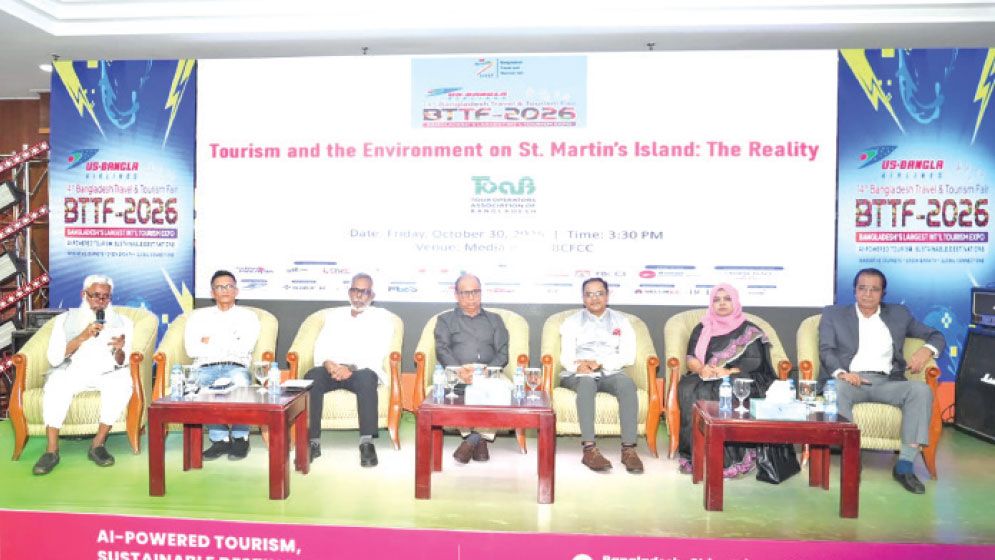
Tourism experts share views on balancing tourism growth with environmental protection on St Martin’s Island at a seminar during the Bangladesh Travel and Tourism Fair 2026 in Dhaka on Friday. PHOTO: COURTESY
Tourism experts have called for upgraded environmental management, improved infrastructure, and technology-based monitoring to tap into St Martin’s Island’s tourism potential without endangering its fragile ecosystem.
Rather than relying strictly on visitor caps, industry leaders argued that the government should focus on boosting the island’s capacity to handle tourists.
Sustainable tourism practices, they emphasised, can safeguard local biodiversity while protecting coastal livelihoods and businesses.
The recommendations were highlighted on Friday during a seminar titled "Tourism and the Environment on St Martin’s Island: The Reality," held on the second day of the Bangladesh Travel and Tourism Fair (BTTF) 2026, organised by the Tour Operators Association of Bangladesh (TOAB) in Dhaka.
The government has set a limit of 3,500 daily tourists to the country's only coral island during the peak season from November to March.
However, seminar speakers stressed that any increase in visitor volume must be paired with strict environmental safeguards and modern infrastructure.
Delivering the keynote address, tourism researcher and development consultant Faruque Hasan noted that blanket arrival restrictions have heavily disrupted local businesses dependent on tourism.
He pointed out that while St Martin’s holds vast eco-tourism potential, inadequate environmental oversight continues to hamper its growth, noting that live coral colonies now cover only about 8% to 9% of the island’s coastline.
Drawing on successful international island models, Hasan argued that technology-based monitoring, enforced regulations, environmental infrastructure, and community participation can strike a balance between tourism growth and conservation.
He called out widespread littering – specifically plastic bags and food packaging – and alleged that several hotels and motels are operating in direct violation of environmental laws.
To curb damage, Hasan proposed requiring tourists to sign a pledge committing to environmental guidelines prior to entry, enforced by fines for non-compliance.
Ultimately, he stressed, long-term protection relies on raising public awareness and fostering responsible tourist behavior.
Other speakers called for a proper sewage network, improved waste collection and disposal systems, and effective operation of the island’s waste-to-energy power plant.
They also urged authorities to stop ships from dumping burnt engine oil into the sea and strengthen recycling initiatives.
The experts recommended using artificial intelligence (AI) and the Internet of Things (IoT) to monitor tourist arrivals, enforce visitor limits and provide real-time information on environmental rules and travel guidelines.
They also observed that many Bangladeshis follow environmental regulations when travelling abroad but often disregard similar rules at home.
Speaking as chief guest, Mohammed Solaiman Haider, additional director general (current charge) of the Department of Environment, warned that environmental degradation could undermine the island’s tourism industry.
“Without biodiversity, tourism in St Martin’s will not survive,” he said.
Haider said protecting the island’s ecosystem was the government’s responsibility, while tourism operators must ensure their activities remained within environmental limits.
Citing research suggesting that the island could accommodate no more than 1,000 visitors, he said the government had nevertheless allowed up to 3,500 tourists daily this season.
Any further increase would depend on stakeholders’ ability to manage tourism without damaging the ecosystem, he added.
The seminar was chaired by TOAB Vice-President (1) Md Moinul Islam and moderated by former TOAB President Shiblul Azam Qureshi. Panel discussants included Dr Kazi Matin Ahmed, professor of geology at the University of Dhaka; Dr Santus Kumar Deb, professor of tourism and hospitality management at the same university; and Dr Mahfuza Parveen, associate professor and head of the Department of Environmental Science and Disaster Management at Daffodil International University.