



 For all latest news, follow the Daily Sun's Google News channel.


Foreign debt repayment more than doubles fresh financing
Debt servicing reaches $699m in Jul-Aug as foreign assistance disbursements plunge 61% to $295m

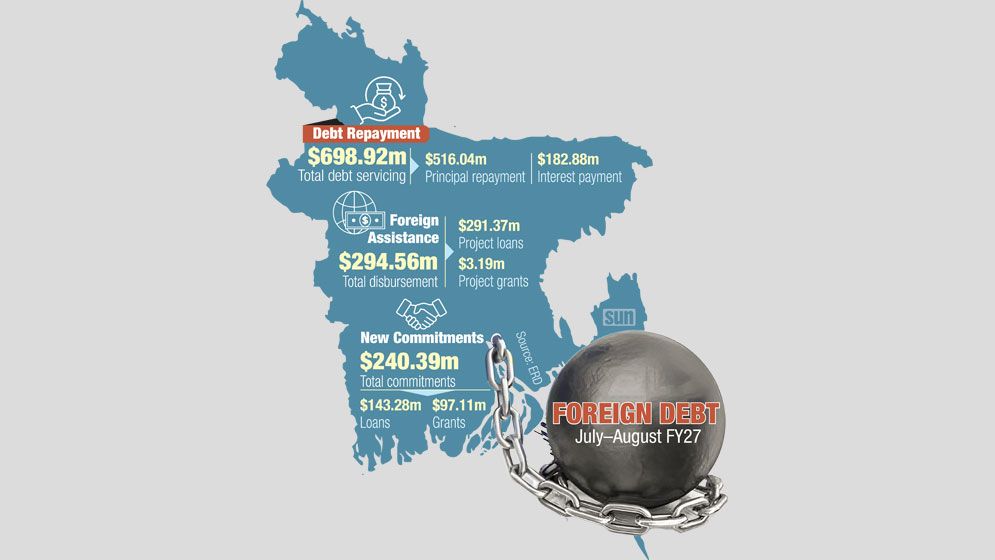
Bangladesh paid nearly US$699 million to service its external debt in the first two months of the 2026-27 fiscal year, more than double the $294.56 million it received in foreign aid and grants, highlighting a widening gap between debt obligations and fresh funding.
Provisional data from the Economic Relations Division (ERD) shows that debt repayments rose to $698.92 million in July-August, up from $667.11 million during the same period last fiscal year.
Of this total, $516.04 million went toward principal repayments (up from $488.79 million) and $182.88 million covered interest (up from $178.32 million).
Meanwhile, foreign assistance disbursements plunged 61% year-on-year to $294.56 million, down from $750.07 million in July-August FY26.
The sharp decline was driven almost entirely by lower project loan disbursements. Project assistance loans fell to $291.37 million from $746.16 million, while project assistance grants declined marginally to $3.19 million from $3.91 million.
No food assistance was disbursed during the period in either fiscal year.
The contrasting trends mean Bangladesh paid about $404 million more in external debt servicing than it received in foreign assistance during the first two months of FY27.
Repayment burden rises
The debt-servicing burden also increased in taka terms.
Total external debt servicing rose to Tk8,626.25 crore in July-August FY27 from Tk8,130.87 crore in the corresponding period of FY26.
Of the latest amount, principal repayments accounted for Tk6,368.85 crore, while interest payments stood at Tk2,257.40 crore.
The increase comes as a growing number of foreign-funded projects contracted in earlier years move beyond their grace periods and enter the repayment phase.
Former Bangladesh Bank chief economist Dr Mustafa K Mujeri said the repayment figures should primarily be viewed in the context of obligations arising from loans contracted in previous years rather than as evidence of a fresh financing crisis.
“The loans have to be repaid, including both principal and interest,” Mujeri told the Daily Sun, noting that the government must service such obligations according to the agreed terms, regardless of the level of new financing coming in.
He said the repayment burden could increase further in the coming years as more foreign-funded projects move into active repayment, requiring the government to maintain sufficient foreign exchange to meet its external obligations.
New commitments remain relatively stable
The weakness in actual disbursements was not fully reflected in new foreign assistance commitments.
Bangladesh secured commitments worth $240.39 million during July-August FY27, compared with $243.81 million in the same period of FY26.
However, the composition of the commitments changed.
Grant commitments increased to $97.11 million from $70.93 million, while loan commitments declined to $143.28 million from $172.88 million.
All commitments during the two-month period were classified as project assistance. There were no food assistance commitments in either year.
Development partner-wise figures show that the Asian Development Bank (ADB) was the largest source of disbursements, providing $128.72 million, followed by the World Bank’s International Development Association (IDA) with $73.96 million.
Japan disbursed $39.04 million and recorded $3.51 million in new commitments. India disbursed $30.30 million, while Russia provided $20.65 million.
There were no disbursements or new commitments from China or the Asian Infrastructure Investment Bank (AIIB) during the period.
The bulk of new commitments, $236.88 million out of $240.39 million, came from other multilateral and bilateral development partners, according to the ERD report.
Caution urged over new borrowing
Mujeri said Bangladesh needs to take a cautious approach to new external borrowing and ensure that loans are directed towards projects capable of generating economic returns, foreign exchange earnings or savings.
He also attributed the weak commitment figures at the beginning of the fiscal year partly to ongoing negotiations between the new government and development partners and international financial institutions.
Incoming administrations generally require time to negotiate project financing and budget support with lenders, while differences over financing terms and conditions can delay new agreements, he said.
Mujeri expects new commitments to increase as those negotiations progress.
At the same time, he stressed the need for stronger project appraisal and implementation to ensure that borrowed funds generate sufficient economic benefits.
He also called for tighter control over project costs and more efficient use of external financing to ensure that future borrowing does not create an excessive repayment burden.