



 For all latest news, follow the Daily Sun's Google News channel.


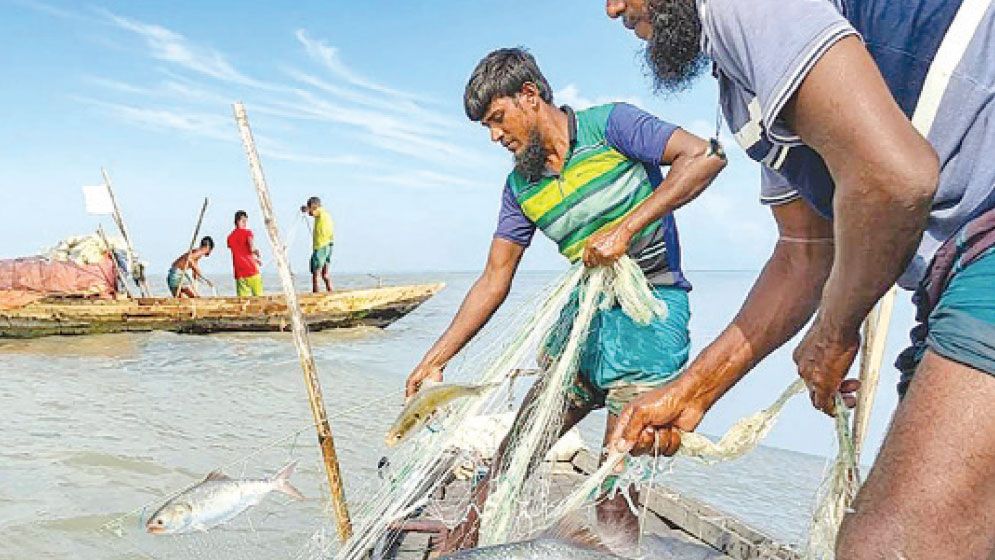
The government has taken the initiative to dredge the river estuaries to restore navigability and facilitate the natural migration of Hilsa, following a proposal from the Department of Fisheries.
Barisal District Fisheries Officer Dr Md Hadiuzzaman said “Dredging work will begin soon. This will help Hilsa enter the rivers naturally. Hopefully, production will increase from the next season,” he added.
The amount of Hilsa in the rivers had declined significantly this year, he said adding that “The campaign against illegal fishing with Behundi, China Duari and other harmful nets will be strengthened.” 
Fishermen and fish traders in the Barisal region said declining navigability in several rivers and estuaries has disrupted the natural movement and breeding of Hilsa. Siltation has filled several channels and created underwater shoals, narrowing the routes through which Hilsa enter rivers from the sea. They also blamed the use of illegal fishing nets, including Behundi and China Duari nets, for the declining Hilsa population. Such nets catch large quantities of fish, including juvenile Hilsa and other fry, affecting fish reproduction and production in the long run. According to Department of Fisheries data, Hilsa production in Barisal Division stood at 372,343 tonnes in fiscal 2022-23. It fell to 348,834 tonnes in 2023-24, 334,783 tonnes in 2024-25 and 266,597 tonnes in 2025-26.
According to fisheries experts, Hilsa depend on both rivers and the sea throughout their life cycle. During the breeding season, the fish migrate upstream through relatively shallow waters. Siltation and the formation of underwater shoals at river-sea estuaries are obstructing this migration, they said. Prof Dr Md Sajedul Haque, dean of the Faculty of Fisheries Science at Patuakhali Science and Technology University, said Hilsa production had declined alarmingly because of fishing with Behundi, China Duari and other illegal nets.
“Climate change, river encroachment and pollution have also contributed to the navigability crisis at river-sea estuaries. The formation of underwater shoals is disrupting the natural movement of Hilsa,” he said. “Dredging the sea and estuaries is necessary to restore navigability and ensure the normal migration of Hilsa. At the same time, fishermen should receive adequate assistance during fishing bans, and enforcement against illegal fishing must be strengthened to ensure breeding,” he added.
Fishermen struggling to catch Hilsa
Fishermen fishing in the Kirtankhola, Arial Khan, Meghna, Tentulia, Sugandha, Sandhya and Kalabadar rivers said they are catching far fewer Hilsa than in previous years. Many said they sometimes spend an entire day on the river without catching enough fish to cover the costs of fuel, ice and food.
Rafiq Majhi, a fisherman from Hijla who fishes in the Meghna River, said, “Earlier, we would catch Hilsa whenever we went to the river at this time of year. Now, we often have to cast our nets for hours without catching enough fish. We cannot even cover the costs of fuel, ice and food.”
Another fisherman, Faruk Mir, said, “We have to borrow money to support our families because we cannot catch enough Hilsa. When fish become scarce in the river, fishermen like us have no other option.”
Fish traders on Barisal’s Port Road also reported a sharp decline in Hilsa supplies. They said 1,000 to 1,200 maunds of Hilsa used to arrive at the market daily during this period, but the volume has now fallen to around 100 to 150 maunds.
Hilsa becoming unaffordable
The decline in supply has also pushed up Hilsa prices, making the fish increasingly unaffordable for lower- and middle-income families. Many consumers are now turning to cheaper fish such as pangasius and tilapia. Ariful Islam, a consumer shopping for fish on Barisal’s Port Road, said, “Hilsa has now become a luxury for the rich. It is difficult for middle-class families like us to afford it. Perhaps we will be able to buy it again if prices come down.”