



 For all latest news, follow the Daily Sun's Google News channel.


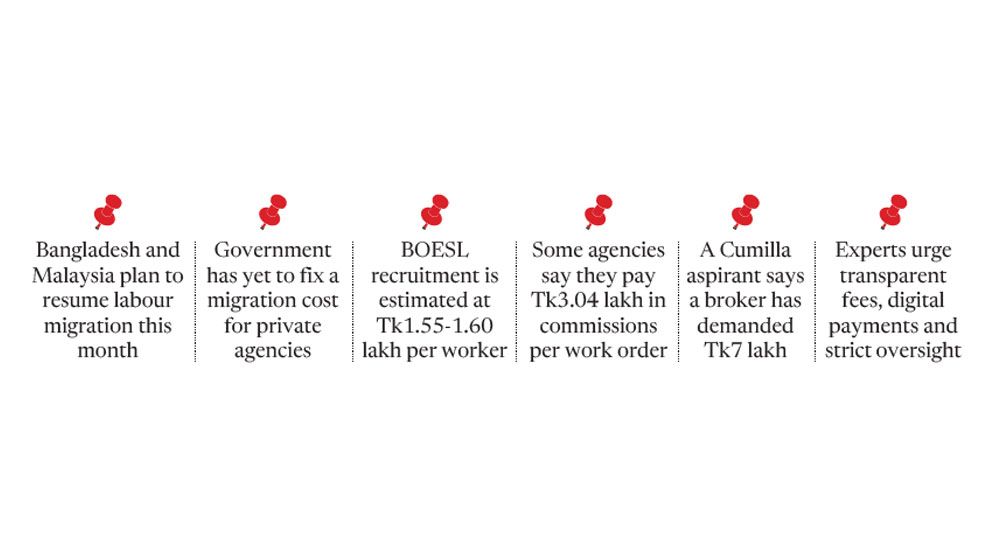
The absence of a fixed migration cost for Bangladeshis seeking jobs in Malaysia has raised concerns about a return of syndicates, excessive recruitment charges and the exploitation of workers, as the two countries prepare to resume labour migration early this month.
Labour rights activists and migration experts say the reopening offers fresh employment to thousands of Bangladeshis, but warn that workers may go unprotected unless recruitment costs, agency responsibilities and payment procedures are clearly defined.
“It is urgent to determine a realistic migration cost for workers going to Malaysia. The entire payment should also be made through the Overseas Employment Platform. The charges for each item, including the service fees of primary recruiting agencies and sub-agents, must be clearly specified. If necessary, the platform’s service charge could be fixed on a pilot basis,” migration expert Asif Munier told the Daily Sun.
He also recommended scrutinising those currently collecting passports. He said workers who have submitted their passports should be asked how much they are being charged, and a task force should conduct raids if necessary.
When the government announced the resumption of the Malaysian market in 2022, it fixed the migration cost at Tk78,990 per worker. Workers, however, reportedly spent an average of around Tk5.44 lakh. The syndicate that controlled recruitment was reportedly run by a limited number of agency owners, including lawmakers of the then ruling party.
Bangladesh and Malaysia have been working on a framework to restart recruitment since the Malaysian labour market was closed to Bangladeshi workers on 31 May 2024.
BOESL cost put at Tk1.55-1.60 lakh
Under the proposed arrangement, around 10,000 workers were initially expected to be recruited through the state-owned Bangladesh Overseas Employment and Services Limited (BOESL) without paying migration fees.
Speaking to reporters after a programme in the capital on Wednesday, State Minister for Expatriates’ Welfare and Overseas Employment Nurul Haque said sending a worker through BOESL is estimated to cost Tk1.55-1.60 lakh. The zero-cost arrangement will therefore not apply.
He said the government is working with the Malaysian authorities to finalise the list of approved medical centres and the costs of sending workers.
“Malaysia told us it would announce its decision and publish the final list of approved medical centres by 31 October. We hope flights will begin on 1 November or in the first week of November. Workers will be able to leave within a few days of completing their medical examinations,” he said.
Private agency costs undecided
The state minister could not give a specific figure for recruitment through private agencies, saying the government has yet to finalise it. He said the ministry would consult agency owners and other stakeholders before reaching a decision.
Several of the 337 private agencies selected to send workers to Malaysia told the Daily Sun they are paying around 10,000 ringgit, or about Tk3.04 lakh, in commission to key individuals in the process for each work order.
One agency owner, who asked not to be named, said airfare and medical expenses would be added to this. “Therefore, if even the government fixes anything around Tk4 lakh, the cost will go over Tk6 lakh. And the rest of the things will depend on individuals,” he said.
Ali Haider Chowdhury, former secretary general of the Bangladesh Association of International Recruiting Agencies (BAIRA), said it was difficult to predict the cost because it varies with the dollar rate, air ticket prices and overall mobilisation costs.
“But what I have heard from different sources, including some of my colleagues and newspaper reports in Bangladesh and Malaysia, the migration cost this time will definitely rise,” he said.
Debt risk for workers
Past recruitment drives showed that high migration costs and multiple intermediaries can push workers into debt before they begin earning abroad. Workers often borrow money or sell assets to finance migration, leaving them vulnerable if jobs do not materialise or promised pay and conditions are not delivered.
Migration sector insiders said this time may be no different, as workers are likely to arrange whatever sum is demanded despite a sharp rise in costs.
Mamunur Rashid, an aspirant from Chandina in Cumilla, said a local broker has already asked him for Tk7 lakh. “It is almost impossible to manage such a big amount of money for my family. We only have a small piece of land beside our house. My father is set to sell this and lend some money to send me to Malaysia. The only thing I want now is to go there and work to reduce the hardships of my family,” he said.
Process may take longer
Despite the minister’s timeline, the process may take longer to begin, said Ali Haider Chowdhury. He said several offices are involved in arranging work orders, attestation by the Bangladesh High Commission in Kuala Lumpur, visa and e-visa issuance, BMET approval, medical examinations and manpower clearance.
“It is a time-consuming process. It may take 15 days to a month,” he said. He urged aspirant workers not to rush and to verify everything before relying on any recruiting agency.
Migration experts say the government should set out a clear division of responsibilities among employers, recruiting agencies and service providers before recruitment begins.
“A transparent system should specify who will bear the costs of medical examinations, visas, air tickets, training and other necessary services. A centralised recruitment mechanism, publicly disclosed job orders, digital payment records and an effective complaints system must be developed,” Asif Munier said.
He said regular inspections and penalties for agencies charging workers illegally would be essential to prevent syndicates re-emerging. The government should also ensure that workers receive written contracts before departure, specifying wages, working hours, accommodation and other benefits, he added.
The experts said the success of the resumption would depend not only on the number of workers sent but also on whether recruitment is affordable, transparent and accountable. Without a fixed, affordable cost and effective oversight, they warned, the initiative risks reproducing the practices that previously made overseas employment prohibitively expensive for many Bangladeshis.