


 For all latest news, follow the Daily Sun's Google News channel.


Risk of lake burst near Nepal disaster site wanes
Flash flood death toll rises to 682 as nearly 3,000 still missing
Agencies, Kathmandu/Beijing
Published: 30 Aug 2026, 12:00 AM
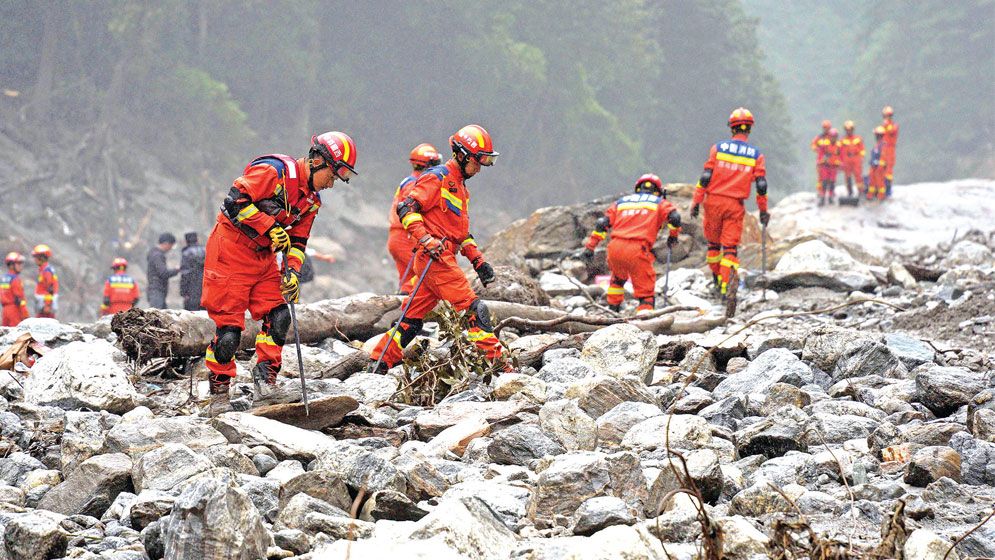
Firefighters conduct search and rescue operations along a river in Tibet’s Gyirong county bordering Nepal on Saturday. - REUTERS PHOTO
The threat of a lake formed after a glacier collapse bursting near the China-Nepal border, where a devastating flood struck earlier this week, has eased, Chinese authorities said on Saturday, as it appears to have shrunk.
Nearly 3,000 people were still missing on Saturday with 682 confirmed dead after flash floods and landslides hit the Nepal-Tibet border.
Satellite images from Thursday to Saturday morning suggest that water in the lake, which straddles the border between China's Tibet region and Nepal at the confluence of two rivers, has been slowly flowing out and gradually reducing the reservoir, state broadcaster CCTV reported, citing the Water Resources Ministry.
By Saturday afternoon, parts of the lake bed had become visible, CCTV reported.
The ministry said satellite imagery of the lake on the Purepu Tsangpo river showed it covered 99,000 square metres (1.1 million square feet) early on Saturday, roughly the size of 14 soccer pitches, having shrunk by 21,000 square metres since Thursday.
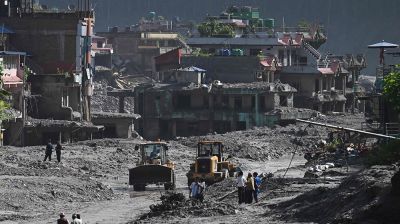
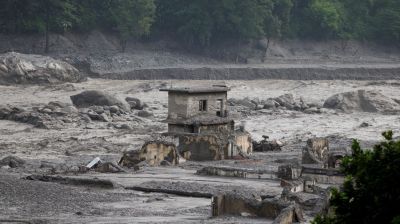
A glacier collapse on Wednesday sent a torrent of rock, ice, mud and debris through Himalayan river systems, sweeping away a border port complex linking Tibet with Nepal, killing hundreds and leaving thousands missing.
Experts and authorities have warned of an extremely high risk of secondary disasters in the valley, particularly from the lake formed by glacier debris, which could threaten rescue operations downstream.
With water draining naturally, Water Resources Ministry experts said search and rescue operations downstream could continue safely if outflows remain low or manageable and recede completely within two to three days.
Rescue workers could be notified promptly to evacuate if any abnormalities appear at the lake, with warnings issued more than 30 minutes in advance, CCTV cited the experts as saying.
State-owned engineering and rescue company China Anneng, which has been monitoring the lake since Thursday, has deployed radar and drones around the lake for 24-hour surveillance, CCTV said.
Initial overflow from the lake on Friday temporarily halted rescue work before a subsequent assessment deemed the risks manageable.
Authorities have also flagged another, larger body of water at the foot of the glacier collapse.
"We estimate its area to be over 120,000 square metres, but its depth is currently unknown," said Chen Hongqi, a senior engineer at the Ministry of Natural Resources' Geological Disaster Technical Guidance Center.
Flood risks will remain until both lakes have fully drained, an official with Nepal's Disaster Management Authority has said.
Rescuers in Nepal and China were battling on Saturday to locate thousands of people missing days after a deadly, tsunami-like wall of water and debris swept through the Himalayan region, engulfing entire villages.
Figures from both countries put the number of missing close to 3,000, with 682 bodies recovered -- and reports of some dead possibly swept downstream as far away as India.
Rescue worker Kawan Koirala, from the Nepal Scout Disaster Response Team, said they were struggling in thick, leg-sucking mud.
China's death toll rose to seven early on Saturday, with 554 people still missing.
Nearly 500 villagers and construction workers, along with 555 tourists in the area, have been evacuated, Xinhua said.
Meanwhile, India was stepping up monitoring of its Himalayan regions bordering China and Nepal, days after deadly floods apparently triggered by a glacial collapse, authorities said Saturday.
"Since we share a border with Nepal, as a neighbour, and also have a similar geographic situation... we have asked our department to monitor all the glaciers and known glacial lakes in the region," said Madan Kaushik, state disaster management minister in India's Himalayan state of Uttarakhand.
"We have asked our teams to be vigilant and monitor if a similar situation is emerging anywhere in the state," he said.