



 For all latest news, follow the Daily Sun's Google News channel.


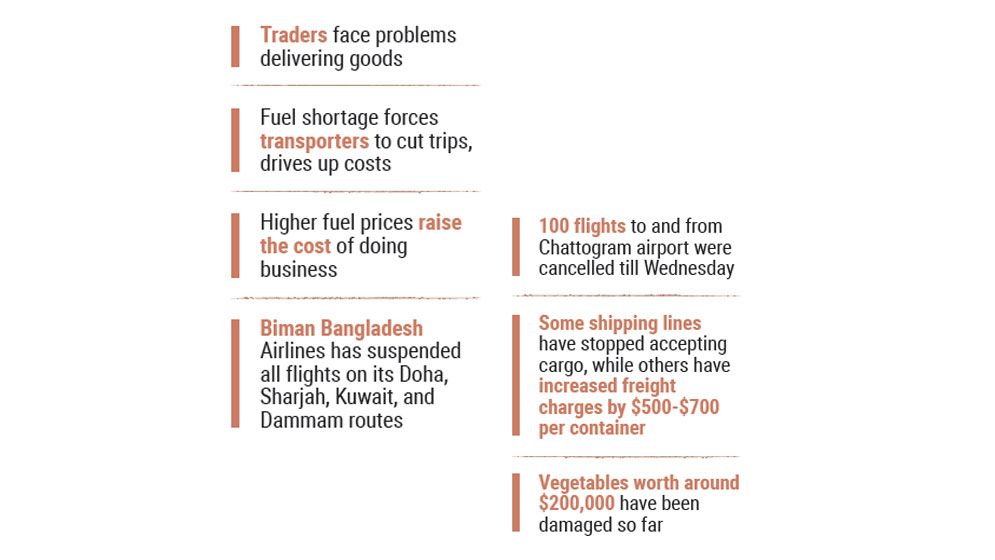
Both domestic and global supply chain disruptions triggered by the ongoing US-Israel war on Iran and the resulting energy crisis are increasing the cost of doing business and creating fresh concerns for Bangladesh’s export-oriented industries.
The conflict has severely disrupted energy shipments through the Strait of Hormuz, one of the world’s most important oil and liquefied natural gas (LNG) transit routes, triggering volatility in global energy markets and raising fuel costs for import-dependent economies like Bangladesh.
Industry insiders said that higher fuel prices are increasing electricity generation costs and factory operating expenses, forcing manufacturers to spend more on production and logistics.
This is particularly concerning for export-oriented sectors such as textiles, steel, ceramics, and light engineering, which rely heavily on stable energy supplies to maintain production schedules.
Bangladesh, which imports the majority of its energy needs, has already begun rationing fuel and purchasing LNG from the volatile spot market at significantly higher prices after disruptions in supply from the Middle East.
Business leaders say the crisis could also affect shipping and trade routes, raising freight charges and causing delays in export shipments.
Garment exporters fear that production interruptions and rising energy costs could make it harder to meet strict delivery deadlines set by international buyers.
Policy analysts warn that if the conflict persists, Bangladesh could face mounting inflationary pressures, higher import bills, and declining export competitiveness in global markets.
They have urged the government to ensure stable energy supplies and adopt contingency measures to protect export industries and sustain economic growth.
Experts have recommended diversifying energy sources and strengthening supply chain resilience to mitigate the long-term economic impact of geopolitical tensions in the Middle East.
Despite the challenges, industry stakeholders remain hopeful that diplomatic efforts to stabilise the region and global energy markets will help restore normal trade flows and ease pressure on businesses and exporters in Bangladesh.
Bangladesh Ceramic Manufacturers and Exporters Association (BCMEA) President Moynul Islam said consumer demand has recently declined due to uncertainty about the global situation.
“We are facing problems delivering products because of a shortage of transport vehicles,” he said.
Kamruzzaman Kamal, marketing director of PRAN-RFL Group, said their group operates around 3,500 trucks to transport its products. The company usually purchases fuel for these trucks from depots. However, it has not been able to obtain fuel from the depots for the past few days.
He said as a result, around 20% of its trucks remain idle, preventing the group from transporting products in line with market demand.
Kamal said, “We have been asked to collect fuel from filling stations by taking serial numbers. But once we join the line, it takes almost half a day. Moreover, fuel is unavailable at most pumps.”
He added that if the fuel supply does not return to normal soon, the situation could become serious, warning that there is even a risk of disruption in product supply.
Owing to the war, the number of passenger flights has come down. So, around 20% more cargo flights across the country have been added to send the exportable products, he said.
Perishable items such as vegetables, fish, baked foods, and other products are usually exported through air freight from Chattogram. However, the exporters are facing multiple challenges due to the ongoing crisis in the Middle East, although exports have partly resumed to some destinations.
Chattogram Shah Amanat International Airport spokesperson Engineer Ibrahim Khalil told the Daily Sun that flights operating to and from the airport typically carry some 25 tonnes of import and export cargo daily.
A total of 100 flights to and from the airport have been cancelled till Wednesday due to the war in the Middle East.
However, flights to destinations other than Doha and Abu Dhabi are gradually resuming, he said.
The cargo bookings made earlier were cancelled. Exporters are now not sending cargo without confirmed flights available, said the spokesperson.
According to him, some of the vegetables were ready for shipment while others were at processing centres awaiting export to countries including Saudi Arabia, Qatar, Oman, and Kuwait.
While some products like potatoes are exported by sea in containers, most fresh vegetables are shipped through air freight, he said.
“We practice contract farming and buy quality products at higher prices from the farmers. The disruption will affect the entire supply chain and compel everyone, including farmers, to incur losses,” feared Rana.
Bangladesh Frozen Foods Exporters Association Vice President Dodul Kumar Dutta said shipments of frozen foods, particularly fish, have become increasingly difficult as some shipping lines have stopped accepting cargo, while others have increased freight charges for destinations in Europe and America.
“In some cases charges per container have increased by $500 to $700,” said Dodul, also managing director of Pacific Sea Food Limited.
“The business setback has severe impacts and we are struggling to pay salaries and bonuses to factory workers and staff ahead of Eid,” he added.
Bangladesh Freight Forwarders Association (BAFFA) former Director Khairul Alam Suzan said exports and imports to Middle Eastern countries through sea routes are relatively small.
However, he noted that some shipping lines have imposed surcharges increasing the freight costs. It will raise both export and import costs until the war situation improves.
The global rise in fuel prices may also push up the prices of essential commodities in the country, Suzan stated.
Long queues at refuelling stations are delaying deliveries. Moreover, increased demand ahead of Eid-ul-Fitr has driven up the fare while the fuel crisis has increased it further.
The vehicles carrying 20-21 tonnes of goods are now charging Tk26,000 to Tk27,000 against the usual Tk18,000 to Tk20,000. Meanwhile, those carrying 12-13 tonnes are charging Tk20,000 to Tk21,000, up from the previous Tk12,000 to Tk13,000.
The fare will decrease to some extent if the diesel supply situation improves, he hoped.
Ruhul Amin Sikder, secretary general of Bangladesh Inland Container Depot Association (BICDA), said containerised trade with Middle Eastern countries accounts for only one to two percent of the total volume.
The disruption in container movement is not hampering the activities at the off-docks, he said.
Recommended Stories