


 For all latest news, follow the Daily Sun's Google News channel.


Dhaka seeks predictable climate finance at COP31, signs carbon market MoU with Singapore
Daily Sun Report, Antalya
Published: 15 Nov 2026, 12:00 AM
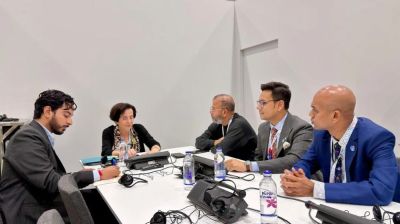
Bangladesh has called for greater international climate finance, technology transfer and capacity-building support to expand renewable energy and strengthen climate resilience, as its delegation set out its position at the COP31 summit.
Environment, Forest and Climate Change Minister Abdul Awal Mintoo presented the position at a press conference on Friday.
State Minister for Environment, Forest and Climate Change Faridul Islam, State Minister for Foreign Affairs Shama Obaed, Additional Secretary of the Environment Ministry Navid Shafiullah and MP Monsura Islam were also present.
According to the written statement, Bangladesh’s Nationally Determined Contribution (NDC) 3.0 targets a 6.39% cut in greenhouse gas emissions below the business-as-usual level by 2035, using domestic resources. The country has committed to a further 13.92% reduction, conditional on international financial and technological support.
The statement said Bangladesh accounts for less than 0.5% of global emissions but remains highly vulnerable to cyclones, floods, salinity intrusion and heatwaves. Expanding renewable energy, particularly rooftop solar, is a priority, the delegation said, adding that meeting emissions commitments and strengthening energy security would require more investment, technology transfer and predictable climate finance.
The delegation cited the World Meteorological Organization’s 2026 climate update, which estimated that global temperatures from January to September were around 1.47 degrees Celsius above pre-industrial levels. It said the first four days of formal negotiations had concluded, with talks entering a fifth day on Friday.
Progress had been made on several key issues, it said, but a number of critical matters remained unresolved and no final decisions had been reached.
$30m prospect
Bangladesh could receive up to $30 million under the first phase of a new Climate Investment Funds (CIF) programme, Accelerating Resilience Investments and Strengthening Economies (ARISE), according to information shared at the press conference.
In a message issued on Saturday, Saimum Parvez, special assistant to the prime minister on environment, forest and climate change, said the money would primarily benefit coastal communities. It would go towards strengthening coastal protection, restoring mangrove forests and improving livelihoods and adaptive capacity.
He described the prospective funding as an important step towards securing Bangladesh’s fair share of international climate finance as a climate-vulnerable country.
Just transition
Speaking on Friday at a high-level panel, “From Climate Commitments to Decent Work: Advancing a Just Transition for All”, Mintoo said developed countries must provide predictable, accessible finance without adding to the debt burdens of climate-vulnerable and least developed countries. The panel marked the official opening of the Just Transition Pavilion in the Blue Zone.
For Bangladesh, he said, a just transition meant not only moving to a low-carbon economy but also protecting the livelihoods of climate-affected people, building resilience and creating jobs through environmentally sustainable activities. “No community should be left behind in this process,” he said.
Mintoo said the NDC 3.0 Implementation Plan includes a dedicated, costed chapter on just transition, prepared with employers, workers’ representatives and the International Labour Organization (ILO).
He said the government aims to generate 20% of the country’s electricity from renewable sources by 2030, including 5,500 megawatts from rooftop solar.
He also said a five-year programme to plant 250 million trees was under way, with nearly 36 million saplings planted so far and around 350,000 green jobs expected.
The government also plans to excavate and restore 20,000 kilometres of canals to support agriculture, fisheries, rural employment and climate resilience.
The minister called for affordable finance, modern technology and technical assistance for small and medium-sized enterprises moving to cleaner production, while ensuring that the changes do not harm existing jobs or undermine industrial competitiveness.
Bangladesh supports a country-driven, request-based Just Transition Mechanism under the guidance of the CMA, he said, with particular attention to least developed and highly climate-vulnerable countries.
The event was organised by the ILO and the European Commission with the International Organisation of Employers, the International Trade Union Confederation and the UNFCCC.
Singapore agreement
On Saturday, Bangladesh and Singapore signed a memorandum of understanding on cooperation in international carbon markets at the Singapore Pavilion.
Faridul Islam signed for Bangladesh and Melvin Ong, secretary of Singapore’s Ministry of Sustainability and the Environment, for Singapore.
The agreement aims to facilitate Bangladesh’s participation in carbon markets under Article 6 of the Paris Agreement, attract sustainable investment and support the implementation of NDC 3.0. The two countries will exchange information and experience on carbon credits and explore joint emission-reduction projects.
Faridul Islam said the partnership would open new opportunities for carbon financing and help develop high-quality, transparent carbon markets. An implementation agreement is expected to be signed at COP32 in Ethiopia next year to set out the institutional framework for cooperation.
Jute showcase
On Friday, Bangladesh also hosted a side event at its pavilion, “Natural Fibres, Zero Waste and Frugal Adaptation: Jute as a Solution from Bangladesh for the COP31 Action Agenda”.
Shama Obaed Islam chaired the session, which was organised by the Ministry of Foreign Affairs, the Ministry of Textiles and Jute and the Ministry of Agriculture with the Zero Waste Foundation of Türkiye, UNOPS and the Global Center on Adaptation.
She presented jute as a renewable, biodegradable fibre and cited frugal adaptation practices such as floating gardens, early warning systems and saline-tolerant crops.
Mehmet Galip Ensarioğlu, chairman of the Environment Committee of the Grand National Assembly of Türkiye, said Bangladesh’s jute experience offered lessons for a circular economy.
Sara Austin Netzer of UNOPS said the agency would deepen its support for implementing NDC 3.0 and pointed to the International Jute Trade and Expo in Dhaka as a chance to work on nature-based solutions.
Kosovo’s Environment Minister Fitore Pacolli said Kosovo would welcome jute products.