


 For all latest news, follow the Daily Sun's Google News channel.


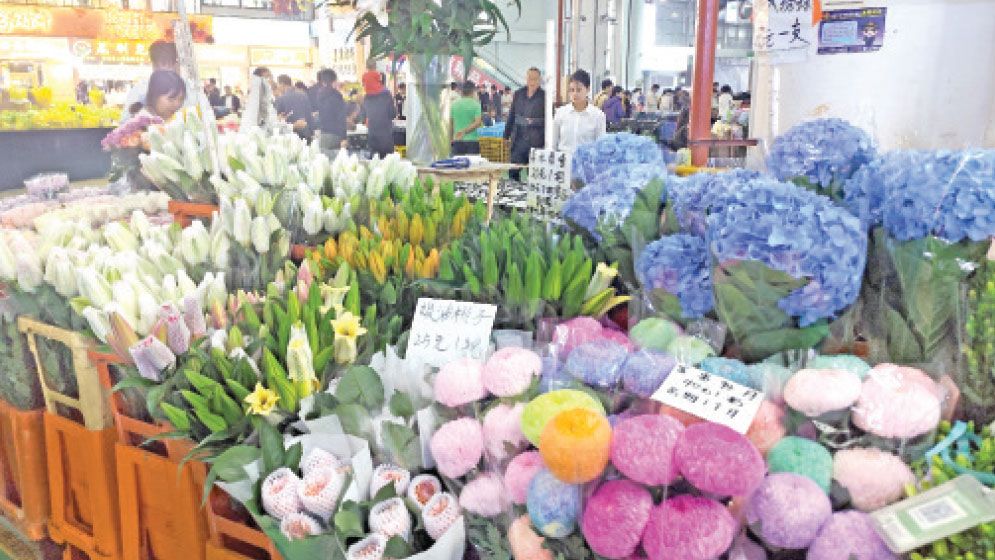
Dounan Flower Market in Kunming, China. - Md Rabiul Islam
When we reached Dounan Flower Market in Kunming at around 8:30pm, we assumed we were too late and that the action was over.
A few minutes inside proved us wrong. Workers carried bundles of fresh flowers, buyers examined blooms and traders negotiated deals, while visitors moved between rows of colour, stopping to take photographs. At Dounan, much of the wholesale business was just getting started.
Located in Dounan subdistrict of Chenggong district, in the capital of southwest China’s Yunnan province, the market is Asia’s largest flower trading hub and China’s biggest fresh-cut flower trading centre, a position it has held for 27 consecutive years.
It runs on two schedules. The daytime market, open from around 8:30am to 7pm, caters largely to retail buyers, casual visitors and tourists. The wholesale night market begins around 8pm and continues until 2am-3am.
A sea of flowers
Roses, carnations, lilies, orchids and many other varieties fill the trading halls in a vibrant mix of colours. According to market authorities, 117 types and more than 1,600 varieties are listed for trading every day.
More than 500 florist shops operate inside the complex, offering everything from familiar local varieties to exotic blooms such as moth orchids, forget-me-nots and African daisies.
Ordinary visitors can buy flowers too, often at prices well below those in conventional retail outlets elsewhere in China. A bunch of carnations, for example, can cost just two or three yuan, depending on variety and quantity. Small shops selling tea, local snacks and souvenirs add to the experience.
Dounan has two identities. To a visitor, it is a colourful marketplace with an abundance of affordable flowers. To thousands of traders and businesses, it is the centre of a vast commercial operation.
Multibillion-yuan business
The annual figures show the scale. In 2025, Dounan recorded transactions worth 13.484 billion yuan (around $2.02 billion), up from 11.57 billion yuan in 2024. It traded 15.476 billion fresh-cut flower stems. More than 70% of China’s fresh-cut flowers are distributed through the market, and exports reach more than 64 countries and regions.
Behind the trading halls lies an extensive network of growers, suppliers, brokers, transport companies and retailers. The market has more than 2,200 enterprises and business households, over 1,000 shippers, 46 logistics companies, nearly 12,000 suppliers and more than 10,000 flower brokers. Its wider supply chain involves over 80,000 associated growers and more than 350,000 flower wholesale markets and flower shops across China.
Yunnan’s geography and climate have played an important role. The province’s mild weather and suitable growing conditions support flower cultivation through much of the year, making it a major production centre.
From Kunming to the world
Flowers are perishable, so speed matters. Dounan’s transport and logistics network moves large quantities across China and overseas. Major Chinese companies buy in bulk, and millions of stems travel daily to cities such as Beijing and Shanghai. International shipments reach Japan, South Korea, Singapore, Thailand, Bangladesh and India.
Trade takes place through face-to-face transactions, auctions in the trading halls and remote channels. Auctions are central to wholesale operations, allowing buyers and sellers to trade large quantities. Those wishing to witness them are advised to arrive before 3am, when trading is in full swing and flowers are being sorted, assessed and sold for distribution.
Visitors who prefer a calmer experience can explore the daytime market, browse the flower shops and enjoy the displays.
More than a trading centre
Dounan is also a popular tourist destination. In 2025, it received 15.61 million visitors and generated more than 1.34 billion yuan in tourism revenue.
The complex includes a cut-flower trading hall, a boutique flower area, souvenir shops, hotels and other visitor facilities. What stands out is how naturally business and tourism coexist: visitors admire the blooms while, a few steps away, traders deal in thousands of stems.
Our 8:30pm arrival had seemed a missed opportunity. Instead, it gave us a glimpse of what makes Dounan so important. It is where millions of blooms begin their journeys to homes, shops and markets across China and beyond. And unlike most markets, this is a place where the night brings the business to life.