



 For all latest news, follow the Daily Sun's Google News channel.


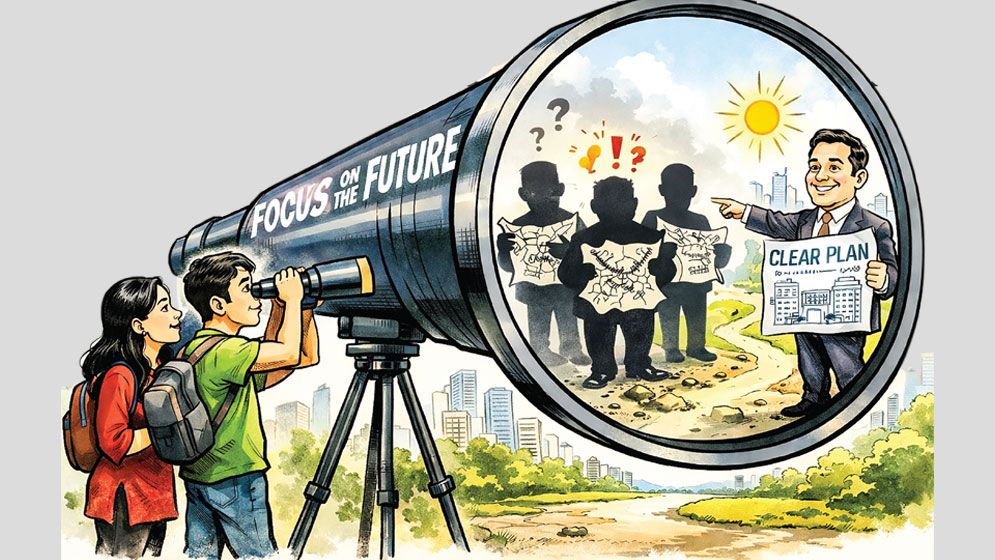
Young voters, who spearheaded the July uprising after being largely excluded from at least the last three national parliamentary elections, are set to prioritise future-oriented policies when casting their ballots in Thursday’s general election.
They told the Daily Sun that leaders committed to building a quality education system, generating employment, fostering innovation, ensuring equal opportunities, and creating a corruption-free, safe, and just society – where freedom of expression is upheld – will win their support.
Across different regions, youths expressed excitement about participating in an election long regarded as “a matter for the elders.”
While many have already decided whom they will vote for, some are still weighing their options.
“The experience of voting is new and significant for me. Of course, there are concerns, particularly regarding security, but it is an exciting moment and an opportunity to participate responsibly,” said Eliza Binte Noor, an English department student at Jahangirnagar University.
“We have spent enough time discussing the past. Now I want political leaders with realistic plans for the future and a willingness to tackle our everyday issues,” she added.
Reactions among youths have been mixed regarding the recent sweeping victories of panels backed by a right-leaning student organisation in union elections at five universities, including Dhaka University, and the emergence of a political party led by the youth icons of the July uprising.
Some noted a “controlled campus environment” under new student union leaders, while many voiced frustration over the failure of July leaders to meet expectations, citing allegations of corruption and extortion.
Election officials and analysts suggest young voters are “more aware” than before, which could drive higher turnout. “Young voters will have a significant impact on the national election. Many are first-time voters who have never cast a ballot before, so they will weigh all factors carefully,” said election analyst Abdul Alim, also a member of the Election System Reform Commission.
he added, though he expressed doubt about whether university election results would influence the national polls. Citing past examples, he noted, “It cannot be assumed that student union election winners will automatically succeed in national elections, as there are many uneducated and partially educated youths as well.”
Before the fall of the Awami League government on 5 August 2024, the three elections held over the preceding 15 years were widely criticised for being one-sided and marred by allegations of manipulation, vote rigging, ballot snatching, and overnight voting, eroding voter confidence. Large numbers of young people had taken to the streets against the Awami League, culminating in the mass uprising that toppled Sheikh Hasina’s government during the July movement.
The introduction of a voter list with photographs in December 2008 registered 81,087,000 voters. By 18 November last year, the number had risen to 127,695,183, including 43,346,421 aged 18-33.
Voters aged 18-37 now exceed 55.6 million, accounting for over 43 per cent of the total electorate. Under the National Youth Policy 2017, people aged 18-35 are considered “youth.”
Breaking this down further, some 8.53 million are 18-21, 11.9 million are 22-25, 12.1 million are 26-29, 10.6 million are 30-33, and 12.3 million fall between 34-37.
Political parties, aware of these varied demands, are sparing no effort to appeal to young voters, relying heavily on social media campaigns featuring memes, reels, music videos, and influencers.
Transparency International Bangladesh Executive Director Dr Iftekharuzzaman said, “The youth of Bangladesh have always been game-changers, and there will be no exception this time. From the colonial period through the Liberation War and in every positive post-independence achievement, young people have led the way. During the 2024 uprising, they were at the forefront, but their aspirations remain unfulfilled.” He added that young people want a new Bangladesh with good governance and an accountable, corruption-free administration. “Political parties must address youth issues seriously, as these young people will continue to play a catalytic role, guiding the country in the years ahead.’ Creating a conducive environment and opportunities for them is now an essential demand of the time.”