


 For all latest news, follow the Daily Sun's Google News channel.


Savings certificate borrowing rebounds as market yields fall
Govt nets Tk2,461cr in Jul-Dec as lower bond yields boost appeal of national savings instruments

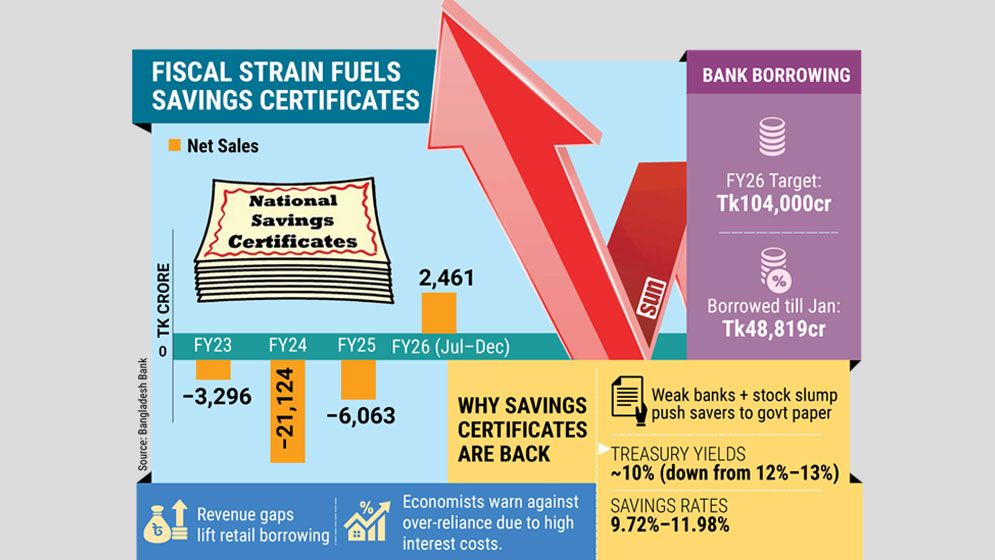
After declining for three consecutive fiscal years, government borrowing through national savings certificates has begun to rise again, driven by relatively higher returns compared with falling market yields.
In the first six months (July-December) of the current 2025-26 fiscal year, the government recorded net borrowing of Tk2,461 crore from savings certificates.
As a result, outstanding government debt under this instrument stood at Tk3.41 lakh crore at the end of December, reversing a multi-year downward trend.
Sales of savings certificates had weakened in recent years after the government repeatedly cut profit rates to rein in high-cost borrowing.
However, declining yields on treasury bills and bonds – now hovering around 10%, down from 12%-13% a year earlier – have made savings certificates comparatively more attractive to small savers.
In an effort to revive sales, the interim government raised profit rates on all types of savings certificates in January last year, with rates climbing to as high as 12.55% depending on tenure and instrument.
The higher returns proved short-lived, as rates were cut again within six months. From 1 July, the first day of FY26, the maximum profit rate was fixed at 11.98% and the minimum at 9.72%.
On 31 December, the government issued a gazette notification announcing another reduction in profit rates, effective 1 January.
However, the decision was withdrawn within four days, leaving rates unchanged. As a result, the profit rates applicable from July to December 2025 will remain in force for the first half of the current calendar year (January-June).
In fiscal accounting, net sales of savings certificates – total sales minus interest and principal repayments – are treated as government borrowing.
Dr Zahid Hussain, former lead economist of the World Bank, told the Daily Sun that lower-than-expected government revenue collection and high interest rates on bank loans have prompted the government to rely more on savings certificates to meet its obligations.
“Increasing borrowing from savings certificates reduces pressure on the government to take high-interest loans from the banking system, which is a positive development,” he said.
Pointing to broader financial stress, he added, “Everyone can see and understands the fragile condition of banks and financial institutions. The stock market has also been in a prolonged downturn. As a result, people are moving away from banks and the capital market and placing their savings in national savings certificates.”
Echoing this view, Dr Mustafa K Mujeri, former chief economist of Bangladesh Bank, said savings certificates continue to offer relatively higher returns.
“In recent months, interest rates on treasury bills and government bonds have fallen rapidly to around 10%, making them far less attractive. Considering these factors, people are choosing savings certificates,” he said.
Mujeri added that toward the end of its term, the government is borrowing from both savings certificates and banks to finance development spending, as revenue collection has fallen short of targets. Recommended Stories
However, analysts cautioned that excessive reliance on savings certificates in the long run could increase fiscal risks due to their high interest costs, urging the government to explore alternative revenue sources.
No change in source tax
Meanwhile, the National Board of Revenue (NBR) has confirmed that the withholding tax on profits from savings certificate investments of up to Tk5 lakh will remain at 5%.
The clarification came after profits were paid in January after deducting tax at a 10% rate, triggering dissatisfaction among savers.
In a letter to the Director General of the National Savings Directorate, the NBR said that if an individual’s total investment across all types of savings certificates does not exceed Tk5 lakh, the applicable withholding tax rate will be 5%.
Officials said the excess tax already deducted will be refunded, likely along with next month’s profit payment.