


 For all latest news, follow the Daily Sun's Google News channel.


Nepal eyes connectivity boost through India’s satellite link
StratNews Global
Published: 26 Nov 2026, 01:44 PM
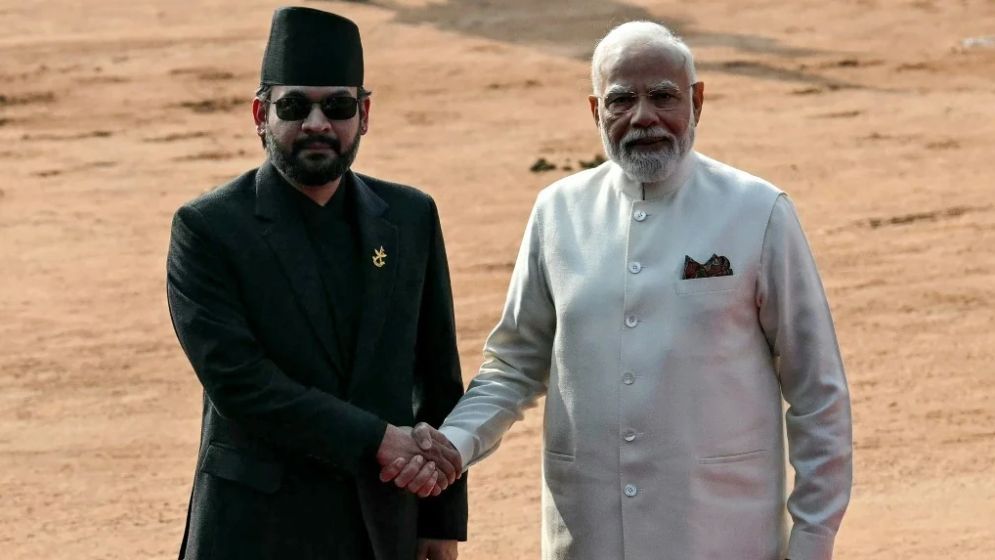
Nepal's Prime Minister Balendra Shah with Prime Minister Narendra Modi during the ceremonial welcome on 23 November, 2026, at Rashtrapatri Bhavan to mark the former's first state visit to India. Photo: Collected
India and Nepal are turning to satellite technology to address one of the Himalayan country’s persistent development challenges: connecting remote communities where difficult terrain and high infrastructure costs have limited access to reliable communication networks.
During Nepal Prime Minister Balendra Shah’s visit to New Delhi on 23 November, the two countries agreed to establish a satellite-based communication network using India’s GSAT-9, also known as the South Asia Satellite.
A memorandum of understanding, signed in the presence of the two leaders, brings the Indian Space Research Organisation (ISRO) and Nepal’s Ministry of Information and Communication together to develop the necessary infrastructure.
The proposed network will comprise a central ground station and 300 user terminals distributed across Nepal. India will provide 36 MHz of satellite bandwidth free of charge, allowing Nepal to use the communication capacity of an existing Indian space asset.
The agreement is significant because it seeks to address a practical infrastructure problem through space technology. Nepal’s settlements are spread across mountains, valleys and geographically isolated regions.
Extending conventional telecommunications networks to these locations requires substantial investment and can be technically difficult.
Satellite communication offers an alternative. Ground terminals can exchange information through a satellite link without depending entirely on terrestrial cables and mobile towers.
The proposed network is intended to support public services, particularly healthcare, education and disaster management.
Remote health facilities could use satellite connectivity to consult specialists at larger hospitals, exchange medical information and access professional advice. Schools with limited digital infrastructure could connect to online educational resources and remote teaching services.
Disaster management is another important application. Nepal is vulnerable to earthquakes, landslides and floods, which can damage roads and disrupt conventional communication networks.
Satellite links could provide an alternative means of communication, helping authorities exchange information and coordinate emergency responses when terrestrial infrastructure is affected.
The arrangement also has an important technological distinction: it does not require the development or launch of a new satellite. Nepal will use the communication capabilities of GSAT-9, launched by ISRO in May 2017, while developing the ground infrastructure needed to access its services.
This allows Nepal to benefit from an existing satellite rather than independently investing in a comparable space-based communication system. For India, it extends the practical use of its space programme through regional cooperation.
GSAT-9: The regional space cooperation model
GSAT-9 was developed by ISRO as a regional communication satellite and launched on 5 May, 2017, aboard India’s GSLV-F09 rocket from Sriharikota.
The project was initially conceived as the SAARC Satellite after Prime Minister Narendra Modi proposed the initiative at the 2014 SAARC summit. Following Pakistan’s decision not to participate, it was renamed the South Asia Satellite.
India financed the satellite as a regional development initiative, making its communication capabilities available to participating neighbouring countries.
GSAT-9 operates in geostationary orbit and carries Ku-band communication transponders designed to support television broadcasting and other communication services. It has a launch mass of approximately 2,230 kg and generates around 3,500 watts of electrical power through its solar arrays. Its designed mission life was 12 years.
The participating countries included Nepal, Bhutan, Bangladesh, Sri Lanka, the Maldives and Afghanistan. Pakistan did not join the initiative.
The satellite was intended to support communication infrastructure, distance education, healthcare, disaster-related information exchange and connectivity in geographically isolated areas.
Its underlying principle was to make India’s space capabilities available as a shared regional resource, reducing the need for neighbouring countries to independently develop similar infrastructure.
The Nepal agreement now seeks to translate that principle into a more extensive ground-level application through a dedicated network of terminals and a central station.
The satellite communication agreement is also part of a broader effort to expand bilateral engagement between New Delhi and Kathmandu.
During Shah’s visit, the two governments introduced a joint vision document titled Viksit Bharat and Samunnat Nepal.
Its 10-pillar framework identifies areas for cooperation, including connectivity, energy, water resources, climate resilience, disaster preparedness, digital services, sports, startups and technological innovation.
Foreign Secretary Vikram Misri described the document as a forward-looking framework addressing the aspirations of people in both countries, particularly younger generations.
Space cooperation is among the emerging areas of this engagement.
The proposed satellite network gives this broader partnership a concrete technological dimension. Its eventual impact, however, will depend on the deployment of the 300 terminals, the functioning of the ground station and the ability of public institutions in remote areas to use the connectivity effectively.
For Nepal, the immediate objective is to extend communication services beyond the reach of conventional infrastructure. For India, the initiative offers another application of its space capabilities in support of regional development.