



 For all latest news, follow the Daily Sun's Google News channel.


US authorises SpaceX to deploy 1 million satellites for data centers in space
Reuters, Washington
Published: 25 Nov 2026, 11:55 PM
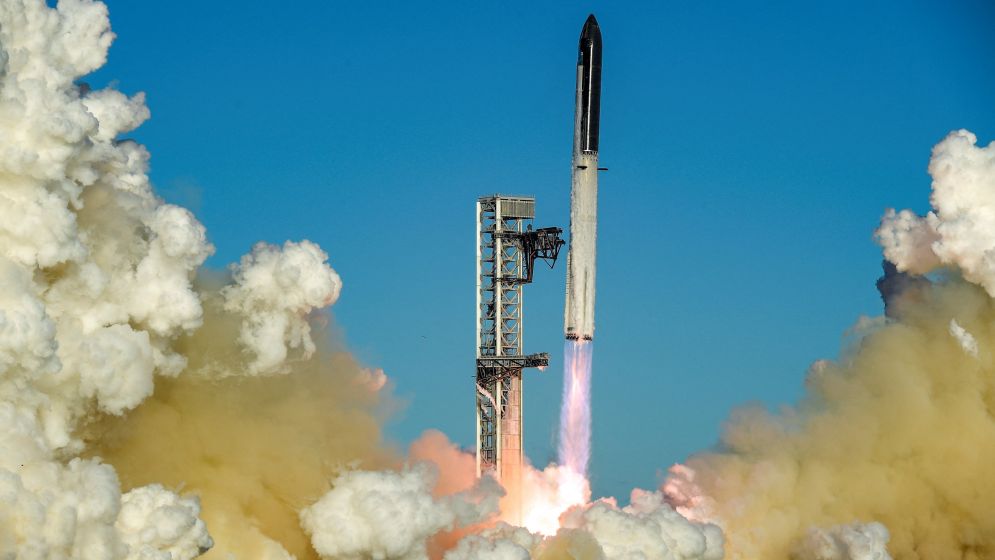
The SpaceX Starship 42 and Super Heavy v3 Booster 22 lift off on its 15th test flight from the SpaceX launch complex in Starbase, Texas, US, 13 November 2026. Photo: REUTERS
The Federal Communications Commission is authorizing Elon
Musk's SpaceX to deploy a constellation of 1 million satellites for data
centers in space, the agency said on Wednesday.
SpaceX earlier this year sought permission to deploy up to 1
million orbital compute modules to process massive amounts of data to be used
on Earth. The FCC said it was approving the SpaceX “Starmind” constellation to
help meet rapidly growing demand for AI computing.
Under the license, SpaceX must begin deployment no later
than November 2033, deploy 10% of the maximum number — or 100,000 — no later
than November 2035 and deploy 50% by November 2038, the FCC said.
Approving the application will permit SpaceX "to pioneer emergent technology that advances American leadership in space and artificial intelligence," the FCC added.
Data centers are the physical backbone of artificial
intelligence, requiring massive amounts of power.
"By directly harnessing near-constant solar power with
little operating or maintenance costs, these satellites will achieve
transformative cost and energy efficiency while significantly reducing the
environmental impact associated with terrestrial data centers," SpaceX
told the FCC.
It was unclear whether SpaceX would put 1 million satellites
in space, where only 17,000 satellites exist currently. Satellite operators
sometimes request approval for higher numbers of satellites than they intend to
deploy to buy design flexibility.
SpaceX sought approval for 42,000 Starlink satellites before
it began deployment of that system. The growing network currently has just over
11,000 satellites in space.
SpaceX's request bets heavily on reduced costs of Starship,
the company's next-generation reusable rocket under development, to help deploy
satellites.
Amazon's Orival satellite unit Leo and others have criticised
the plan, suggesting SpaceX was unlikely to deploy all the satellites and that
it could take centuries to do so. FCC Chair Brendan Carr rejected that
criticism in March.
"Amazon should focus on getting Amazon's house in order
with their own launches and their own satellite constellation, rather than
worrying about other people that are actually out there launching satellites at
the pace and cadence that SpaceX is," Carr said.
The FCC said it was also approving SpaceX's requests to back
up its optical network by approving additional communications.