



 For all latest news, follow the Daily Sun's Google News channel.


How low tech exposure turned India into a haven during Asia’s chip sell-off
India’s benchmark BSE Sensex has risen by around 6.65% since the 3 November US midterm election
Biman Mukherji, South China Morning Post
Published: 23 Nov 2026, 04:17 PM
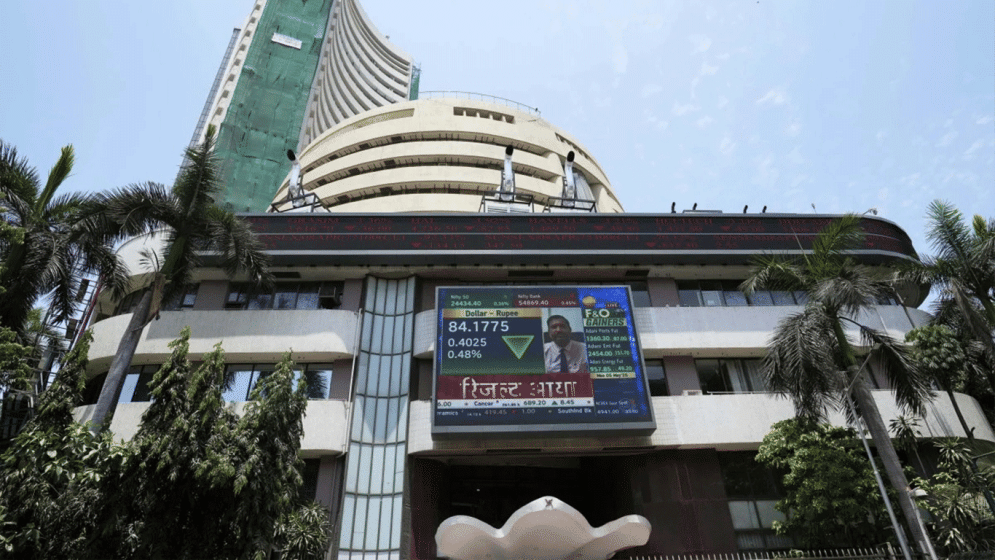
Photo: Collected
India is emerging as an unlikely winner in Asia’s artificial intelligence-driven market rout following the Nvidia fallout, as tighter US chip curbs and falling oil prices steer investors towards Indian equities – even as observers question how long the rally will last.
The boost to India’s markets comes after a two-year
hiatus, with global investors shifting capital towards non-AI sectors and crude
oil prices dipping since the US midterm elections eased fears of an escalation
in the Middle East conflict, South China Morning Post reports.
India’s benchmark BSE Sensex has risen by around
6.65% since the 3 November US midterm election, contrasting with sharp drops
across South Korea’s Kospi, Taiwan and Singapore amid concerns over stricter US
congressional scrutiny of domestic AI data centre expansion and a broader tech
sell-off.
“We expect concerns about the sustainability of
AI-related capital expenditure and earnings to prompt a rotation away from East
Asian markets such as South Korea and Taiwan, while encouraging foreign
investors to return to India after a two-year absence,” said Carlos Casanova,
senior economist for Asia at Union Bancaire Privé.
Separately, the Trump administration moved to
tighten export curbs late on Monday, with the US Department of Commerce filing
new rules targeting several routes through which Chinese firms have accessed
advanced American chips and computing power. These new restrictions will affect
data centre investment across Southeast Asia, according to a report by
UK-headquartered Capital Economics on Wednesday.
“I would expect the United States to maintain close
scrutiny of access to advanced AI chips and other strategically sensitive
technologies, particularly where national security concerns arise,” said John
Quelch, executive vice-chancellor and distinguished professor of social science
at Duke Kunshan University in China.
“However, the more immediate policy direction
appears to be tighter enforcement of existing export controls and greater
scrutiny of potential diversion through third-country intermediaries,” he added.
India’s markets – which had cooled over the past two
years as global capital chased AI and semiconductor booms in Taiwan and South
Korea – have stood out in recent days amid the broader uncertainty prevailing
across most of Asia.
“If this dynamic reverses, India could see renewed
foreign inflows,” Casanova said, noting that foreign investor sentiment towards
India had previously weakened due to high share valuations and a surge in oil
prices that weighed on the rupee against the US dollar. A decline in oil
prices, expected through next year, could provide an additional tailwind for
Indian equities, he added.
Historically, more than 80% of oil and natural gas
transiting the Strait of Hormuz via Iran and Oman has been destined for Asian
markets. Energy prices have plunged since the US election, with Brent crude
dropping roughly 16% from a high of $110 per barrel on 16 October to around $92.44
on Monday.
“We have seen a return of foreign flows into Indian
equities in the recent three weeks. Nevertheless, it is unclear how long this
rotation trade will sustain,” said Cameron Systermans, head of multi-asset for
Asia at Marsh.
He noted that earnings growth for South Korean and
Taiwanese chipmakers is likely to remain strong in the near term despite recent
market jitters, underpinned by sustained AI capacity expansion.
“Nonetheless, we are cognisant that the
diversification theme has been gaining attention recently, with the likes of
India and other emerging markets with lower tech exposure providing a good
hedge against the tail risk of the AI theme suddenly losing steam,” he added.
“Foreign investors have already started to move into
markets that are less exposed to AI. In Asia, the most obvious ones are India
and Indonesia,” said Mali Chivakul, emerging markets economist at Bank J Safra
Sarasin, referring to index provider MSCI’s October proposal to downgrade
Indonesia to stand-alone status over governance concerns.
“Indonesia has been mired with the MSCI potential
downgrade over its governance issues, so the main beneficiary so far has been
India,” he added.
Foreign investors have net purchased $9.61 billion
in Indian shares so far in November, surpassing the previous monthly record set
in November 2020, according to market data reported by Indian daily The
Economic Times.
IPO prospects
Pranav Haldea, managing director of market data firm
Prime Database, said that while long-term concerns remain over how AI adoption
will affect India’s traditional billable-hour software services firms, market
sentiment has turned positive – at least for now.
He noted that the rebound is supported by strong
corporate earnings in the July-September quarter – India Inc’s best quarterly
profit growth in four years, according to local media reports – alongside
easing geopolitical tensions and lower oil prices.
Haldea also pointed to shifting political dynamics
following the US midterm elections. “Trump’s Republican Party has been far more
supportive of the buildout of data centres and AI infrastructure, while the
Democrats not so much,” he said, referring to the Democratic pledges to rein in
AI expansion and increase scrutiny on major data centre hubs.
The rally promises to reverse an unusual disconnect
in which weak sentiment in India’s secondary markets had coincided with a slew
of mega initial public offers in September and October, including telecoms
giant Jio Platforms and the National Stock Exchange. Indian companies raised
about $4.8 billion through IPOs in October, according to data compiled by
Bloomberg.
“With the run-up we have seen in the secondary
markets, I would expect several IPO issuances to hit the market in the months
ahead,” Haldea said, noting that company promoters – controlling shareholders –
generally look to raise funds when secondary-market sentiment is positive.