


 For all latest news, follow the Daily Sun's Google News channel.


India to open military firing ranges to Japan for missile tests
The Japan Times
Published: 21 Nov 2026, 11:30 PM
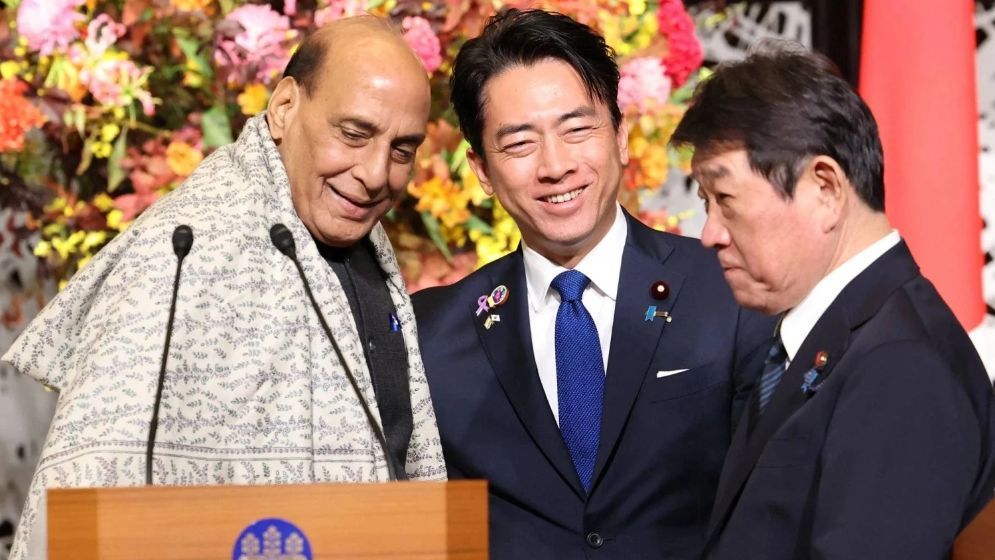
Indian defense chief Rajnath Singh, Defense Minister Shinjiro Koizumi and Foreign Minister Toshimitsu Motegi greet each other after ending a joint news conference at Iikura Guest House in Tokyo on 19 November 2026. Photo: REUTERS
The top diplomats and defense chiefs of Japan and India have agreed to boost military and arms industry cooperation, including allowing the Self-Defense Forces to use Indian ranges to conduct live-fire missile training.
Defense Minister Shinjiro Koizumi and Foreign Minister Toshimitsu Motegi joined their Indian counterparts, Rajnath Singh and S. Jaishankar, at a “two-plus-two” meeting in Tokyo on Thursday, with the two sides also expressing “grave concerns regarding economic coercion, including through arbitrary export restrictions, and non-market policies” — a thinly veiled jab at China.
Beijing has placed dozens of Japanese companies on an export blacklist, barred shipments of dual-use goods and cut off the exports of rare earths critical to Japan’s economy amid a bitter row following Prime Minister Sanae Takaichi’s remarks last November about the possibility of Japanese military intervention in a Taiwan crisis.
Leaders from the “Quad,” the grouping that brings together Japan, India, Australia and the US, voiced similar concerns about economic coercion earlier this week.
“Through our cooperation, we hope to serve as the anchor for stability in the Indo-Pacific region,” Motegi told a joint news conference after the meeting.
Also Thursday, the four Indian and Japanese ministers agreed to bolster defense equipment and technology cooperation, and to accelerate negotiations toward achieving the export of Japan’s UNICORN naval radio antenna to India.
A day earlier, Koizumi and Singh toured the Maritime Self-Defense Force’s naval base in Yokosuka, Kanagawa Prefecture, where they boarded the MSDF’s Natori Mogami-class frigate, which is equipped with the UNICORN integrated stealth mast system.
But it was the agreement to allow the SDF for the first time to use firing ranges in India to conduct live-fire training, “including those involving surface-to-ship missiles,” that was arguably the most significant development.
“This is not only significant for broadening the scope of the Self-Defense Forces’ training, it also serves as a concrete demonstration to the region and beyond of a new phase in Japan-India cooperation,” Koizumi said.
Japan said last month that it had dispatched officials to India to examine the possibility of using the South Asian nation’s missile ranges for testing long-range weapons, including its Type-25 antiship missile, as well as smaller attack drones, according to Ground Self-Defense Force Chief of Staff Gen. Masayoshi Arai.
Arai said the officials had been sent to India as part of efforts to determine how to conduct training that makes full use of the Type-25’s roughly 1,000-kilometer range — something he characterized as “a major challenge.”
Japan’s small missile-launch training grounds make in-country testing severely constrained, according to Defense Ministry officials.
But Japan is also eyeing the sites for more than just its longer-range missiles. Japanese officials have also discussed with their Indian counterparts the possibility of conducting tests of small attack drones at the ranges.
Japan is aiming to build a multilayered coastal defense system that incorporates large numbers of inexpensive unmanned aerial, surface and underwater vehicles — for both reconnaissance and attack purposes — as well as standoff missiles to attack from outside an enemy’s range.
In August, Koizumi and his Australian counterpart, Richard Marles announced that the quasi-allies were also working toward giving Japan improved access to Australia’s missile testing ranges.
This move, taken together with the discussions on India’s sites, would give Tokyo options for longer-range missile tests — a necessity as it develops powerful new missiles to deter Chinese military adventurism near Japan’s periphery and respond to North Korea’s increasingly advanced missile arsenal.
Following the four-way meeting Thursday, Koizumi and Singh held bilateral talks, with the two defense chiefs agreeing to follow up on discussions “exploring the possibility of joint development in naval shipbuilding and design.”
Japan is interested in selling its upgraded Mogami-class frigate to partners, and India has repeatedly been raised as a potential buyer after Tokyo reached a landmark agreement with Canberra to supply the vessels to the Australian Navy. The deal is the largest defense export contract in Japan’s postwar history.