


 For all latest news, follow the Daily Sun's Google News channel.


Japan, India agree to enhance military and defense industry cooperation
AP, Tokyo
Published: 20 Nov 2026, 04:22 PM
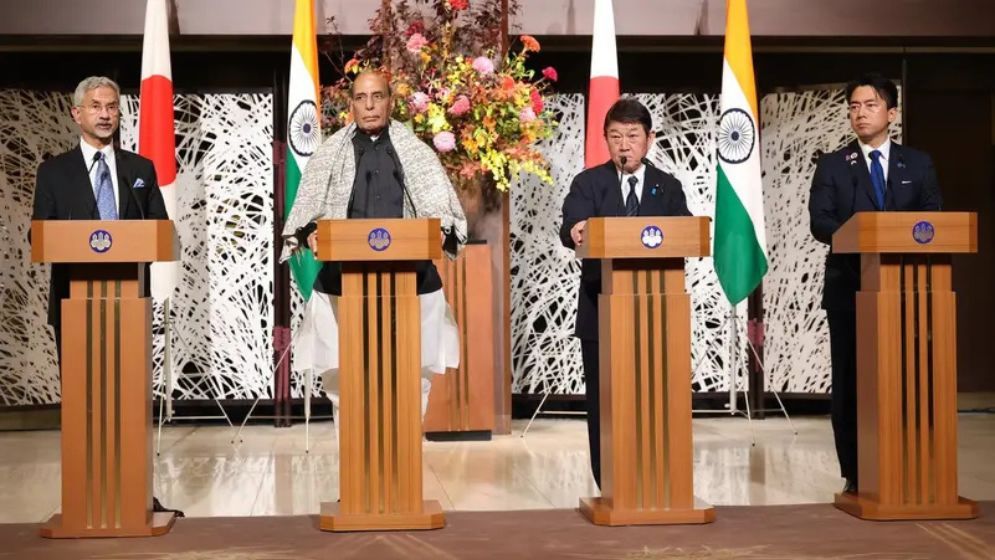
From left, Subrahmanyam Jaishankar, External Affairs Minister of India, Rajnath Singh, Defence Minister of India, Toshimitsu Motegi, Minister for Foreign Affairs of Japan and Shinjiro Koizumi, Minister of Defense of Japan, attend a joint press conference at Iikura Guest House Thursday, 19 November 2026 in Tokyo, Japan. Photo: AP
Japan and India agreed to enhance their military and arms industry cooperation, including allowing Japanese troops to conduct live-fire missile training at Indian firing ranges in future joint drills, as their defense and foreign ministers met Thursday in Tokyo.
Japanese
Defense Minister Shinjiro Koizumi and Foreign Minister Toshimitsu Motegi joined
their Indian counterparts, Rajnath Singh and S. Jaishankar, at the “two-plus-two”
meeting in Tokyo.
The
two Asian powers have been rapidly deepening security, defense and economic
ties in recent years amid growing tension and uncertainty in the region. India
and Japan also are part of the Quad grouping with the United States and
Australia that aims to counter China’s influence.
“Through
our cooperation, we hope to serve as the anchor for the Indo-Pacific region,”
Motegi told a joint news conference after the talks.
This
defense industrial cooperation will proceed under the framework of “design with
Japan, make in India,” Singh said.
As
an island nation with limited space to safely conduct missile tests and
training, Japan needs defense partners that can provide facilities for its
military to practice live-fire drills essential to improving missile
capability. Japan struck a similar arrangement with Australia this year.
Japan
has been fortifying defenses in its southwestern region to deter China’s
growing military activity and started deploying long-range missiles this year,
including Type-12 surface-to-ship missiles mobilized in Kumamoto on the
southern main island.
Japan
has also significantly relaxed its postwar pacifist principles in recent years
and lifted a ban on lethal weapons exports as part of its security, defense and
economic growth strategies.
On
Thursday, the four ministers agreed to promote cooperation in defense equipment
and technology and to accelerate negotiations toward achieving the transfer of
Japanese naval radio antenna UNICORN to India.
They
reaffirmed deepening cooperation in a range of areas including air and maritime
security, information sharing, search and rescue operations, naval shipbuilding
and artificial intelligence, according to a ministers’ joint statement after
the talks.