


 For all latest news, follow the Daily Sun's Google News channel.


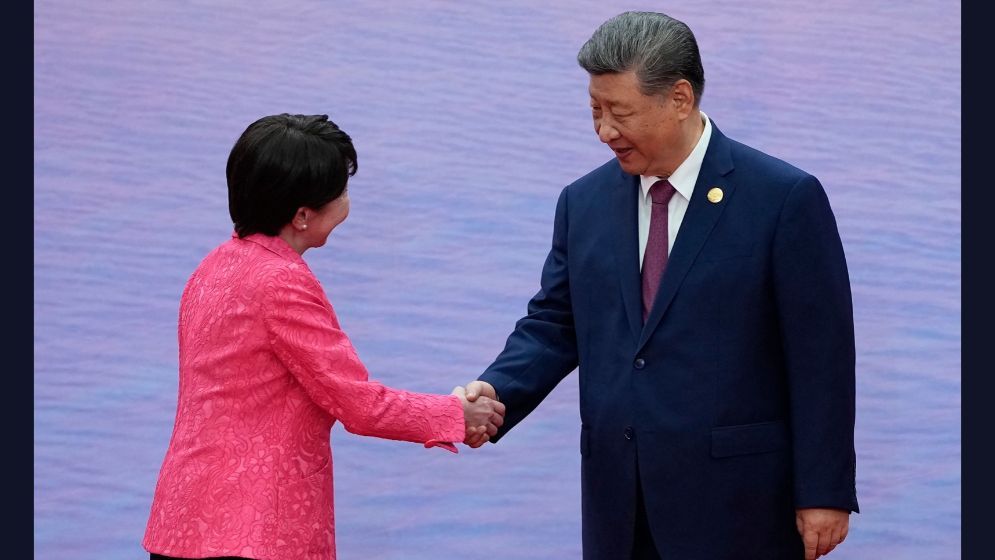
Japanese Prime Minister Sanae Takaichi (L) shakes hands with China’s President Xi Jinping before the welcome banquet at the Asia-Pacific Economic Cooperation (APEC) summit in Shenzhen, Guangdong province on 18 November 2026. Photo: AFP
Chinese leader Xi Jinping and Prime Minister Sanae Takaichi exchanged a cordial handshake at a regional summit in Shenzhen on Wednesday, offering a rare moment of respite amid their countries’ more than yearlong standoff.
Takaichi smiled as she appeared to share brief pleasantries with Xi, who was welcoming visiting leaders ahead of a banquet for the Asia-Pacific Economic Cooperation (APEC) summit in the Chinese tech hub.
The interaction — the first since Takaichi’s comments last November about possible Japanese military intervention in a Taiwan crisis — came despite Tokyo’s unsuccessful efforts to arrange formal talks with Beijing.
For Japanese officials, even a customary handshake had become a matter of diplomatic suspense. All eyes were on whether Beijing would extend even the most routine courtesy to the Japanese leader.
The seemingly warm greeting at the banquet contrasted with Takaichi’s subdued arrival at Shenzhen’s airport earlier in the day. Unlike South Korean President Lee Jae Myung and US President Donald Trump — who were welcomed by performers and festive music — the Japanese leader was met with minimal fanfare, making for a striking contrast.
The tension surrounding Wednesday’s encounter had been underscored by events in Manila earlier in the week, where Chinese Premier Li Qiang attended Monday’s China-Association of Southeast Asian Nations (ASEAN) summit but returned to Beijing that afternoon around the same time Takachi arrived in the Philippines.
Li skipped the ASEAN Plus Three meeting the next day, where China was instead represented by Agriculture and Rural Affairs Minister Zhang Zhu, a lower-level Cabinet official.
Although the busy ASEAN-related schedule would have offered limited opportunities for contact, Li’s quick departure fuelled speculation that Beijing’s leadership was keen to avoid any awkward brush with the Japanese leader.
Takaichi, for her part, approached Zhang at his seat during the ASEAN Plus Three meeting. The two smiled, shook hands and exchanged a few words, though the substance of their conversation was not immediately known.
The brief encounter between Takaichi and Xi offered a rare occasion of direct contact amid a diplomatic freeze that began a year ago, when Takaichi suggested that Chinese military actions around Taiwan could draw the Self-Defense Forces into a conflict.
Beijing reacted furiously, demanding that she retract her remarks and subsequently stepping up economic and diplomatic pressure on its neighbour. Tokyo has maintained that its position on Taiwan has not changed.
Even as the Takaichi administration has repeatedly expressed its willingness to engage in dialogue with China, the Japanese leader has shown little inclination to soften her stance ahead of her APEC visit.
At a Tuesday’s “Quad” gathering in Manila, she joined the leaders of the US, Australia and India in expressing “grave concerns about economic coercion, including through arbitrary export restrictions,” in a thinly veiled rebuke of Beijing.
Ahead of Wednesday’s encounter, there were concerns that Xi could repeat another now-famous encounter between Japanese and Chinese leaders, when relations were deeply strained over territorial and historical issues.
At the 2014 APEC summit in Beijing, Xi greeted then-Prime Minister Shinzo Abe with a notably stony expression and barely acknowledged his presence, a situation that produced a frosty handshake that would become an enduring image of the neighbors’ deteriorated ties.
That exchange nevertheless preceded formal bilateral talks, which helped begin a cautious diplomatic rapprochement. This time, however, no such meeting has been announced, leaving Tokyo with little hope of a resolution to their row in the near future.