


 For all latest news, follow the Daily Sun's Google News channel.


China’s Halloween crackdown: When costumes become a threat to authority
Daily Mirror
Published: 16 Nov 2026, 07:11 PM
File Photo: Reuters
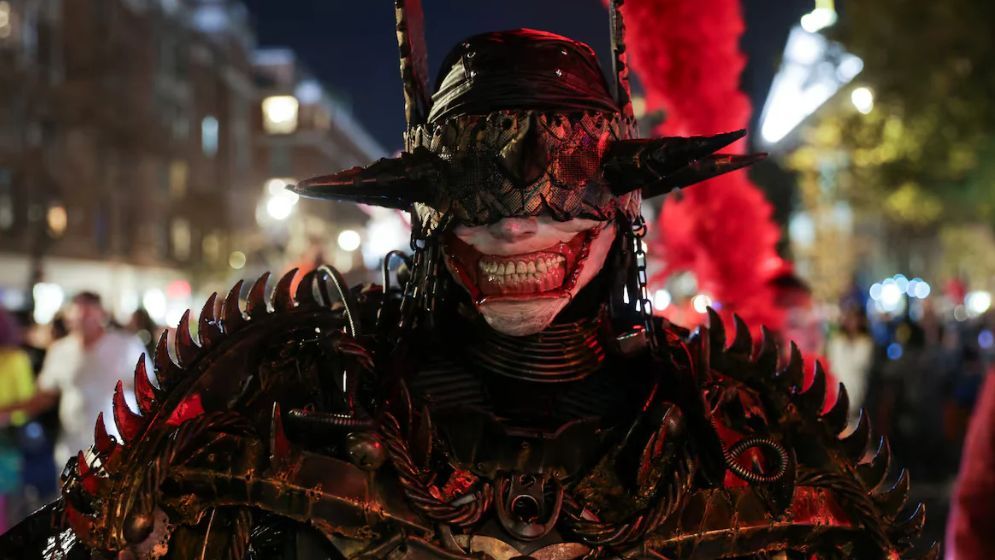
The streets were meant to be filled with ghosts, superheroes and people escaping the monotony of everyday life. Instead, in several Chinese cities this Halloween, uniformed police officers, barricades, and restrictions on what people could wear were the most conspicuous presence.
For many young Chinese, October 31 offered a chance to gather, experiment with costumes, and turn everyday frustrations into satire. For the authorities, however, the celebrations carried a more sensitive dimension: the possibility that humour could become an expression of public discontent.
Security was tightened across Beijing, Shanghai and Hangzhou as crowds gathered on October 31, 2026. Police were deployed around popular meeting places, some entertainment venues restricted themed clothing and reports circulated of costumed participants being taken away for questioning.
The measures came amid growing evidence that Halloween has acquired a significance beyond entertainment in China, where young people have increasingly used costumes to comment on unemployment, economic pressures, government policies and the legacy of pandemic restrictions.
The recurring security response has turned an imported festival into an increasingly revealing test of the limits of public expression.
A festival under close surveillance
In Shanghai, Changle Road, Yuyuan Road and South Shaanxi Road once again attracted large numbers of people in costumes. Yet the gatherings took place against a backdrop of heightened policing.
Residents reported increased patrols, while photographs and videos circulating on Chinese social media showed police vehicles, metal crowd-control barriers and officers stationed around popular areas.
Fuxing Park had announced that some nighttime attractions would remain closed from October 30 to November 3, citing maintenance work on lighting equipment, according to reports carried by The Paper.
The timing drew attention because the park and nearby streets have been associated with previous Halloween gatherings.
A Shanghai resident who spoke to The Epoch Times anonymously said restrictions had been imposed in parts of the city, although the celebrations remained lively.
Her account suggested that the authorities had not prevented every gathering but had maintained a visible security presence around locations where crowds were expected.
Beijing witnessed a different atmosphere. Security measures had already been heightened around the Chinese Communist Party's Fifth Plenum, which concluded on October 29.
A Beijing-based journalist told The Epoch Times that the security arrangements had effectively prevented public Halloween gatherings around the capital.
He said police were stationed in the embassy district and that restrictions remained in place until midnight on November 1. Although he later visited a nightclub where the atmosphere was lively, he described a markedly different situation on the streets.
The journalist also alleged that police interfered with a Reuters reporter attempting to conduct street interviews, telling potential interviewees that they could not speak to foreign media and driving the reporter away.
The account, attributed to the journalist, points to the wider sensitivity surrounding independent reporting during a period of heightened security.
Nightclubs impose costume restrictions
The restrictions were not confined to public streets. Two Beijing nightclubs announced limits on Halloween clothing shortly before the celebrations.
On October 30, PILLBOX informed customers that themed costumes, cosplay outfits, associated makeup, masks and head coverings would not be permitted during the week. The venue cited "on-site safety and comprehensive technical reasons".
Another nightclub, DADA, advised customers not to arrive wearing Halloween-related costumes over the weekend.
Such restrictions illustrate how security concerns can extend beyond the direct management of large crowds.
Costumes are central to Halloween, but they also allow participants to communicate ideas without speeches, banners or organised demonstrations.
In a political environment where public gatherings and dissent are closely monitored, even an informal street celebration can attract official attention when its content becomes unpredictable.
Hangzhou incident fuels online criticism
In Hangzhou, videos circulating online appeared to show police officers escorting away a person dressed as Ultraman Tiga, a Japanese superhero character.
The footage prompted criticism and ridicule on Chinese social media, with users questioning why someone wearing a fictional character's costume had attracted police attention.
A Hangzhou-based individual told The Epoch Times that a shopping complex and surrounding streets had been overwhelmed by crowds, with large numbers of regular and special police officers deployed in the area.
The Beijing journalist also said he had seen people dressed as Guanyin, the Buddhist figure associated with compassion, and Caishen, the traditional Chinese god of wealth, being turned away by police.
These incidents, based on accounts and videos reported by The Epoch Times, have not all been independently verified.
Nevertheless, their circulation has become part of the wider debate over how far authorities are prepared to go in regulating spontaneous public celebrations.
Costumes carry the weight of economic frustration
The significance of this year's gatherings lies partly in the messages carried by participants. Some costumes reportedly mocked employment practices, corporate communication and the pressures facing young people in an uncertain economic climate.
One participant used a mock exchange involving Claude, the artificial intelligence chatbot developed by US company Anthropic, to satirise restrictions affecting Chinese users.
The exchange read: "Are you a Chinese user?" The response was: "Yes." The chatbot then replied: "Sorry, you can't use this."
The joke was brief, but its meaning was readily understood: access to technology, the internet and global digital services remains shaped by political and regulatory boundaries.
A Beijing-based journalist told The Epoch Times that young people were using Halloween to release frustrations that had accumulated over time.
He described the costumes as reflections of pressures surrounding employment, corporate culture and the broader economic situation.
The use of humour is significant. Rather than assembling around a political slogan, participants can convey dissatisfaction through an exaggerated character, a familiar image or a short joke.
The message may be indirect, but it can resonate widely because it draws on experiences shared by people facing similar anxieties.
A recent report by Lianhe Zaobao also documented how economic concerns shaped Halloween costumes in several Chinese cities.
In Hangzhou, a participant reportedly wore a representation of a falling Shanghai Composite Index chart, while another used the popular expression about retail investors being repeatedly 'harvested' by the stock market.
In Shenzhen, costumes and props similarly mocked falling market indices and the experience of investors.
The trend reflects the way ordinary economic concerns have entered popular cultural expression. Stock market losses, competition for jobs and pressure to meet family expectations are not abstract policy issues for young people. They are part of everyday life, making them natural subjects for satire.
2023 celebrations changed everything
The roots of the current sensitivity can be traced to Shanghai in October 2023, when Halloween gatherings became an unexpected outlet for public expression after the lifting of China's stringent zero-Covid restrictions.
Young people appeared in elaborate costumes, some of which carried unmistakable references to recent political and social experiences. Participants dressed as pandemic enforcement workers in white protective suits, complete with oversized testing swabs.
Others appeared as surveillance cameras or used costumes to mock the stock market and youth unemployment. Some displayed blank sheets of paper, recalling the demonstrations against Covid restrictions in November 2022.
The gatherings attracted widespread attention online because they allowed people to communicate criticism without organising a conventional protest.
The consequences soon became apparent. Radio Free Asia reported in November 2023 that Shanghai police had detained several young people identified through photographs and videos of the celebrations.
Some had dressed as COVID enforcement personnel or Winnie the Pooh, a character whose online representation has been censored in China because of comparisons with President Xi Jinping.
The report also said internet regulators had contacted major platforms over Halloween-related content.
The episode established a pattern: costumes that appeared playful to participants could be interpreted by authorities as political expression.
Previous crackdowns set the precedent
The security response intensified again in 2024.
Reuters reported that police patrolled central Shanghai ahead of Halloween, apparently seeking to prevent a repeat of the previous year's gatherings. At least six costumed people were seen being led away by police near Zhongshan Park.
One participant dressed as a skeleton said officers detained him and ordered him to remove his makeup.
Reuters also reported that local officials had encouraged businesses to promote family-friendly celebrations and discourage adult costume activities.
A bar and restaurant owner in the Jing'an nightlife district was asked to sign an agreement promising not to organise costume contests, with the stated aim of maintaining social order and the city's public image.
Radio Free Asia separately reported that dozens of people turned out in costumes despite the restrictions. Some were taken away, while others were reportedly asked to remove makeup and provide personal identification details.
The 2024 incidents demonstrated that the authorities' concern extended beyond explicitly political costumes. Even ordinary cosplay could become subject to scrutiny when it formed part of an unpredictable street gathering.
Politics behind an ordinary celebration
China's authorities have not publicly presented a detailed explanation for every restriction imposed during the 2026 celebrations. Crowd management, traffic disruption and public safety are legitimate considerations when large numbers of people gather in urban streets.
The recent incident in Wuhan, where a private-hire driver was reportedly trapped and harassed by Halloween revellers, also demonstrated that disorderly behaviour can occur during such events.
Wuhan police subsequently said one man had received an administrative penalty and three others had been reprimanded.
However, the repeated deployment of police, restrictions on costumes and reported intervention against participants raise questions that go beyond crowd control.
The pattern has emerged over several years, particularly after young people began using Halloween to make indirect comments about government policies and economic conditions.
The distinction between entertainment and dissent becomes especially blurred when satire draws on subjects that are politically sensitive.
A costume representing a surveillance camera, a joke about unemployment or a falling stock market chart may not constitute an organised political protest. Yet such expressions can expose frustrations that are difficult to measure through official statements or controlled public discussions.
For young people confronting employment uncertainty, economic pressure and restrictions on expression, Halloween has become a brief opportunity to communicate through humour.
The growing security presence suggests that even this limited space for spontaneous expression is viewed with caution.
The most revealing feature of China's Halloween celebrations is not the costumes themselves, but the attention they attract. When a superhero outfit, a satirical chatbot exchange or a falling stock market chart becomes a matter of security concern, an ordinary festival begins to reflect a much deeper unease over what citizens are permitted to say, display and share in public.