



 For all latest news, follow the Daily Sun's Google News channel.


China's drive to boost consumer spending struggles to gain ground
Daily Sun Report, Dhaka
Published: 14 Nov 2026, 01:55 PM
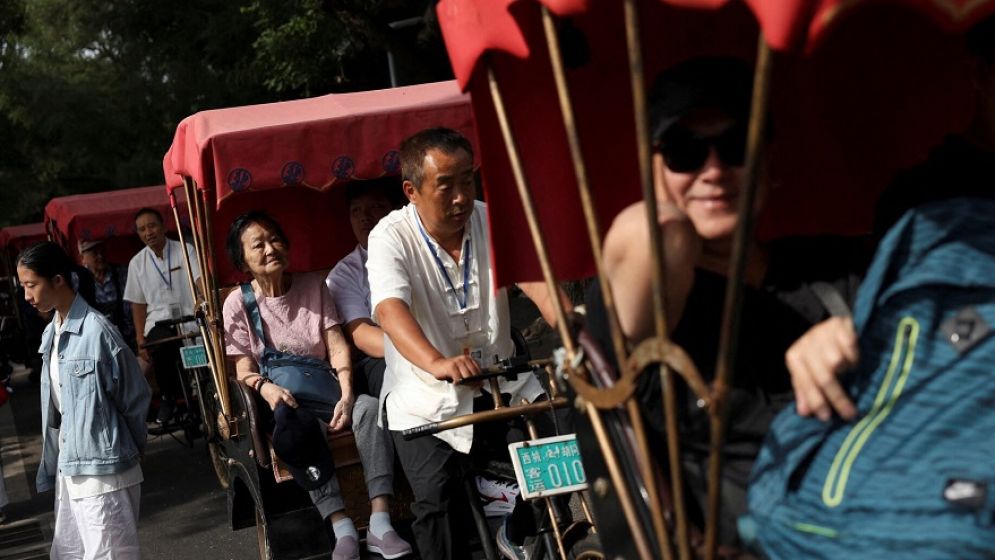
File Photo: Tourists ride rickshaws in the Shichahai area on National Day, the first day of China's eight-day Golden Week holiday, in Beijing, China October 1, 2025. REUTERS
Despite a series of measures by the central and provincial governments, China is struggling to revive household spending, as falling property values, weak consumer confidence and concerns over future financial security continue to keep families cautious about spending.
The challenge has become a major concern for Beijing as it seeks to make domestic demand a stronger driver of economic growth. While the Chinese Communist Party (CCP) has increasingly emphasised consumption in its economic policies, the latest figures suggest that the shift is yet to produce significant results.
Between late October and early November, the world's two largest economies experienced defining political moments. In Beijing, the Chinese Communist Party's Fifth Plenum highlighted loyalty, discipline and “self-revolution”. In the United States, Democrats regained majority control of Congress in the midterm elections, leaving President Donald Trump in a weakened political position.
Economic opportunities and public concerns shaped the political landscape in both countries, but their economic challenges are very different. The United States is dealing with renewed inflation, partly driven by the crisis in the Middle East, while China is struggling with persistent deflationary pressure and weak household spending.
For three decades, China's party-state treated household consumption largely as a result of economic growth rather than one of its main drivers. That approach is now changing.
At last December's Central Economic Work Conference, domestic demand was identified as a fundamental driving force of the economy. “Letting domestic demand lead” was placed at the top of the eight key tasks for 2026.
The 15th Five-Year Plan Recommendations also made a “marked rise” in the household consumption rate a headline goal for the first time. In July 2026, the State Council approved a dedicated plan to boost consumption, setting a target of around 60 trillion yuan ($8.4 trillion) in retail sales by 2030.
The importance attached to consumption is also reflected in official policy documents. The Chinese word for consumption, xiāofèi, appeared 20 times in the Five-Year Plan Recommendations and around 30 times in the 2026 Government Work Report.
However, household spending remains weak. World Bank data show that Chinese households saved about 42.7 per cent of GDP in 2024, compared with the global average of 26 per cent. Gross capital formation accounted for 40.5 per cent of GDP, while household consumption stood at just 40 per cent, well below the global average of 56.6 per cent.
The scale of household savings is also striking. Chinese households held a record 167 trillion yuan ($25.01 trillion) in bank deposits at the end of 2025, up 9.7 per cent from the previous year.
A major reason for this reluctance to spend is the property market downturn. For years, home ownership was the main investment choice for China's first-generation middle class. But the property market collapse has severely affected household wealth and confidence.
In 2025, investment in real estate development fell by 17.2 per cent, while new home sales declined by 8.7 per cent.
Consumer confidence remains fragile. In the People's Bank of China's latest published survey of urban depositors, 62.3 per cent of respondents said they preferred to save more. Only 19.2 per cent wanted to spend more, while 18.5 per cent preferred to invest.
Over the past 25 years, China's economy has changed considerably on the production side, but household demand has not kept pace.
In 2000, agriculture accounted for 14.5 per cent of GDP, industry and construction for 45.1 per cent, and services for 40.4 per cent. By 2025, according to the National Bureau of Statistics, the primary sector's contribution had fallen to 6.7 per cent, while the secondary sector, covering manufacturing and construction, accounted for 35.6 per cent. Services made up 57.7 per cent.
The shift has continued this year. During the first three quarters, services accounted for 58.7 per cent of GDP and contributed 66.3 per cent of economic growth.
The spending figures, however, tell a different story. Household consumption accounted for 46.8 per cent of GDP in 2000 before falling to a low of 34.6 per cent in 2010, when investment peaked at 46.1 per cent.
By 2024, consumption's share had recovered to 40 per cent, while investment accounted for 40.5 per cent. This indicates that household spending has yet to become a stronger engine of growth. In 2025, final consumption contributed 2.6 percentage points to China's 5 per cent economic growth.
These figures help explain why Beijing is now placing greater emphasis on services consumption, particularly in elderly care, childcare, healthcare, tourism, culture and sports.
Services already make up the largest part of China's economy and are the main source of new jobs. Expanding the sector could also absorb workers no longer needed in manufacturing and construction.
Unlike manufactured goods, services cannot simply be sold in foreign markets on a large scale. A stronger services-driven economy could therefore help China avoid adding to the industrial overcapacity and trade tensions that have strained its relations with trading partners.
An ageing population and a shrinking workforce will also increase demand for healthcare and elderly care services. Rather than relying solely on incentives such as trade-in coupons to encourage purchases of goods, the CCP hopes to stimulate demand for services that households increasingly need.
But achieving this will require greater investment in people, something the existing system has been reluctant to prioritise.
Regional figures show that consumption patterns vary considerably across China. Last year, Jiangsu overtook Guangdong for the first time to become the country's largest consumer market, with retail sales of 4.64 trillion yuan. Zhejiang followed with 3.92 trillion yuan.
Among cities, Chongqing replaced Shanghai as the largest consumer market, recording retail sales of 1.67 trillion yuan against Shanghai's 1.66 trillion yuan. Beijing ranked third with 1.37 trillion yuan, followed by Chengdu with 1.14 trillion yuan, Guangzhou with 1.10 trillion yuan and Shenzhen with 1.03 trillion yuan.
In per capita spending, Shanghai topped the list at 54,765 yuan, followed by Beijing at 50,667 yuan and Zhejiang at 47,551 yuan. The national average was 29,476 yuan.
Interestingly, the wealthiest regions spend a smaller share of their disposable income than less-developed areas. Households in Beijing spend just 56.9 per cent of their disposable income, while the figure in Shanghai is 59.5 per cent. In Tibet, it stands at 72.6 per cent.
The figures suggest that households in poorer or less-developed regions contribute more to consumption as a share of their income than those in wealthier areas.
Local governments are also stepping up efforts to attract consumers. In July 2026, Chongqing introduced measures to accelerate its development as an international consumption centre, including upgrading commercial districts and promoting the night-time economy.
The city has also offered a five-year transition period for converting old factories into elderly care and healthcare facilities.
Guangdong, meanwhile, has attributed more than 130 billion yuan in sales to its subsidies and the “Buy Guangdong Quality” campaign. However, across 20 provinces, retail sales grew by just 4.7 per cent in the first half of 2026.
Despite the policy push at both national and provincial levels, the broader economic figures show little improvement.
For most Chinese families, their home remains their biggest asset, but property values continue to fall. Real estate development investment dropped by 17.2 per cent in 2025, while resale prices in third-tier cities fell 5.4 per cent year-on-year in September 2026.
Household lending has also weakened. In the first eight months of 2026, household loans contracted by 1.03 trillion yuan, while deposits increased by 6.99 trillion yuan.
Another weakness is the government's reliance on one-off subsidies to encourage spending. Families, however, tend to save for risks that such incentives cannot address, including old age, illness, unemployment and their children's education.
The minimum basic pension for rural and urban residents remains below 200 yuan a month, adding to concerns about financial security.
So far, Beijing's efforts to encourage household spending have been relatively modest. But changing consumption habits will require more than temporary subsidies and promotional campaigns.
Broader reforms to social security, income distribution and employment opportunities are needed to give households greater confidence in their financial future. Increasing young people's incomes, creating more jobs and allowing market-driven demand and supply to play a stronger role will also be crucial if China wants to build an economy driven more by domestic consumption.
Source: The Diplomat