


 For all latest news, follow the Daily Sun's Google News channel.


Global media urged to advance BRI achievements
Rezaul Karim, back from China
Published: 13 Nov 2026, 06:15 PM
Belt and Road cooperation has evolved into a well-received global public good, and international media outlets should jointly tell the stories of the Silk Road to enhance people-to-people bonds, media representatives from various countries said at a forum.
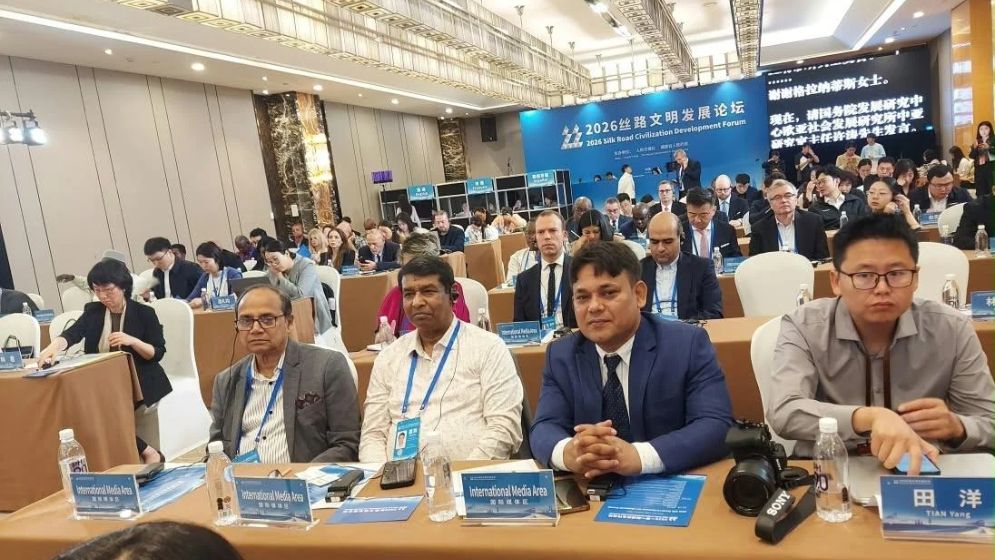
Participants at the forum’s opening session, held in the presence of senior representatives of the Chinese government, the Communist Party of China, and People’s Daily, including Yu Shaoliang, President of People’s Daily, emphasised the importance and necessity of strengthening cooperation among media organizations in different countries to better tell the stories of the Belt and Road Initiative.
Such cooperation, they noted, would contribute to enhancing policy communication and fostering closer ties among peoples.
The keynote speeches focused on three strategic pillars shaping the future of media and economic cooperation. The first was strengthening “Partnership” through the exchange of content and technical expertise to sustain the project’s positive momentum.
The second was promoting the concept of “Connectivity” as a bridge bringing cultures and markets closer together, while emphasizing the importance of local expression and a global perspective in overcoming perceptual barriers and narrowing the psychological distances between peoples.
Co-hosted by People's Daily and the People's Government of Fujian province, the 2026 Media Cooperation Forum on Belt and Road held recently in Fuzhou, the capital of Fujian province, drawing more than 200 foreign delegates from 182 media outlets and institutions across 100 countries and international organizations.
At the opening of the 2026 Media Cooperation Forum on Belt and Road, Chinese officials and business leaders cited the need for global action in what they called “the world’s largest international platform for economic cooperation in terms of scale, reach and impact.”
Xian Hui, vice chairman of the National Communist of the Chinese People’s Political Consultative Conference (CPPC), said the BRI, which President Xi Jinping started in 2013, was no longer just focused on development and investment initiatives originally intended to link East Asia and Europe through physical infrastructure.
He said it has evolved into “modernist socialization,” which called for a “deeper alignment of development strategies, improving connectivity networks and balancing development with security by providing an environment that would bring peace, prosperity, openness and civilization.”
Hu Heping, the executive deputy head of publicity for the department of the CPC Central Committee, said that amid the “rise of conflicts, unilateralism and challenges of copyright infringements,” there was a need to “build a consensus for development, tell stories that benefit people and deepen exchanges of cooperation by building bridges of communication.”
Zhang Tao, president of the China National Nuclear Corp.; Wang Jihang, president of the Agricultural Bank of China; Oleg Kopylov, deputy secretary general, Shanghai Cooperation Organization; Miao Jiianmin, chairman, China Merchants Group; Zhao Fei, board member and general manager, China Changan Automobile Group; Xu Siwei, chairman, China Reform Holdings Corp.; and Zhang Wenwu, vice chairman and president, CITIC Group Corp., were among the business leaders who pushed for greater “connectivity” through the media to help boost international cooperation by sharing “people-to-people experiences, cultural and financial integration.”
Hu Heping, executive deputy head of the Publicity Department of the Communist Party of China Central Committee, said the Silk Road spirit has driven fruitful achievements despite rising global instability, injecting new momentum into world peace and development.
-6af7012ae391a.jpg)
Since the Belt and Road Initiative was proposed in 2013, it has transitioned from a Chinese proposal into global action, welcoming a family of 150 countries and 30 international organizations, and yielding more than 4,000 cooperation projects worldwide, Hu said.
He emphasized that these results proved that the BRI aligns with global trends and commands public support, and that global media outlets should continue to spread the Silk Road spirit and actively promote the BRI's contributions to global development.
Yu Shaoliang, president of People's Daily, said that given the diverse development stages and cultures of partner nations, BRI reporting must adopt localized perspectives, empathetic expressions and a global vocabulary to dismantle misconceptions and forge closer emotional bonds.
Facing international distractions, the media must maintain an objective stance, delivering truthful coverage to convey a shared desire for prosperity, and leveraging the power of the media to build a global consensus for development synergy.
Pavel Negoitsa, general director of Russia's Rossiyskaya Gazeta, said that over the past 13 years, the BRI has grown into an unparalleled global endeavor in terms of participation, project scope, investment scale and the hope it inspires across continents. He said that navigating complex challenges such as trade frictions, the BRI stands as an ambitious, long-term vision that drives the free flow of goods, capital, personnel and ideas based on peace, openness and mutual benefit.
Saadia Shariff, chief marketing officer of Pakistan's Jang Media Group, said the BRI is not merely about trade figures, but a vision connecting people, which manifests in Pakistan as the China-Pakistan Economic Corridor that has brought tangible results.
Abbas Sayed, an Egyptian tour guide who gave an on-site explanation for the leaders of China and Egypt and their spouses at the Grand Egyptian Museum in September, said, "Chinese media are genuinely strengthening the emotional bonds between China and different nations, and similarly, as an Egyptian guide, I see myself as an ambassador for cultural exchange between our two peoples."
"I hope to connect with diverse individuals in China so I can convey the real China to the Egyptian people," he said.
On the sidelines of the forum, the "Fuzhou Initiative" for media cooperation among "Belt and Road" countries was officially launched. This initiative aims to establish a permanent institutional mechanism to coordinate media efforts, facilitate the exchange of news and information, and support joint projects that foster a positive public perception of the initiative globally, thereby ensuring sustained cooperation among the participating media organizations.
The emphasied the need to unite "forces" to address global media challenges through a rational and objective stance, conveying the aspirations of societies for shared prosperity and a more stable, integrated future for the benefit of all humanity.
The forum featured the fourth meeting of the Council of the "Belt and Road" News and Media Cooperation Network, held in Fuzhou, Fujian Province. The meeting brought together representatives from 38 media organizations across 23 countries.
In its capacity as the Council’s chair, the People’s Daily presented a report on the activities of the third term, highlighting the Council’s success—since its renewal in August 2024—in fostering media cooperation and innovation, as well as broadening consensus regarding the "Belt and Road" Initiative. The number of member organizations in the network has grown to 327, representing 120 countries—an increase of 19 percent compared to 2024—further solidifying its position as a platform for international media cooperation.
The participants agreed to continue developing the Forum’s initiatives and adopted the "Joint Declaration of the Fourth Meeting," which called for promoting development, peace, stability, and cultural exchange, as well as leveraging smart technologies and intensifying media cooperation.
Furthermore, the formation of the Council’s fourth term was announced, with the inclusion of 42 media organizations from 26 countries. Representatives of the member organizations also discussed ways to strengthen the network’s role, further develop the "Silk Road Award" for international media, and foster closer ties between peoples.
The participants reaffirmed their commitment to the spirit of the Silk Road, pledging to continue playing their part in promoting the "Belt and Road" Initiative and fostering mutual understanding and friendly exchanges among peoples—thereby contributing to the building of a community with a shared future for mankind and supporting global peace, prosperity, and development.