


 For all latest news, follow the Daily Sun's Google News channel.


Pakistan’s solar boom exposes deep flaws in the country’s power system
Daily Sun Report, Dhaka
Published: 10 Nov 2026, 10:01 PM
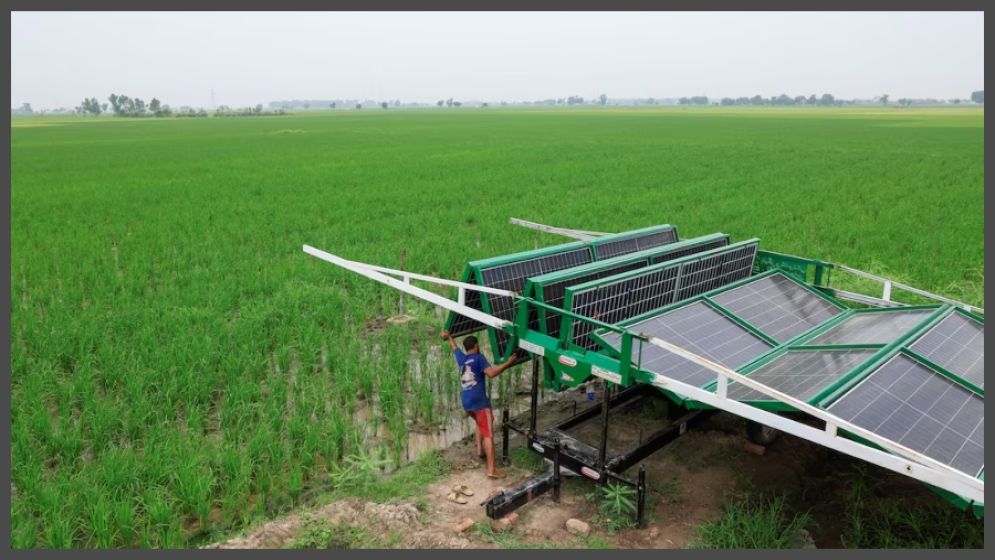
A worker installs a folding solar panel unit, to run a tube well, the motorised pump that taps groundwater, in a rice field in Muridke, Sheikhupura District in Punjab province, Pakistan August 12, 2025. REUTERS
Pakistan continues to face power shortages despite a rapid shift to solar energy, exposing deep-rooted weaknesses in its electricity system, including mounting financial liabilities, inadequate transmission infrastructure and unreliable fuel supplies.
The solar boom has helped households, businesses and farmers cut electricity bills and reduce their dependence on the national grid. However, the growing use of solar power has yet to resolve the country's wider energy crisis.
The contradiction became clear on 5 October, when ARY News reported that electricity generation had fallen at several power plants, pushing the national supply shortfall beyond 4,000 megawatts (MW). The shortage led to longer and more frequent power cuts in several regions, with consumers in Lahore and other parts of Punjab reportedly facing two to three hours of load-shedding.
For a country already grappling with heavy debt, inflation and rising household expenses, the latest shortages have added further pressure on the economy.
Yet Pakistan's energy story has another side. Over the past two years, millions of households, farmers and businesses have embraced rooftop solar panels and battery storage to escape expensive electricity tariffs and an unreliable power supply.
So why is Pakistan still struggling to keep the lights on despite generating more solar power than ever before?
Pakistan's solar revolution in just two years
The scale of Pakistan's solar expansion has been remarkable.
According to energy think tank Ember, electricity demand in Pakistan rose by 21 per cent, or 33 terawatt-hours (TWh), between FY23 and FY25. During the same period, electricity generation from distributed solar systems more than tripled, increasing from 15 TWh to 51 TWh.
This means solar power accounted for the entire increase in electricity demand over those two years. Meanwhile, electricity generation from the conventional grid fell by 3 per cent.
The share of distributed solar in Pakistan's electricity mix nearly tripled, climbing from 10 per cent to 28 per cent, the report said.
Pakistan added 27 gigawatts (GW) of distributed solar capacity in just two years. That is roughly equivalent to the combined capacity of all the coal-, gas- and oil-fired power plants the country has ever built.
What drove this sudden shift?
Expensive grid electricity, frequent power cuts, a weakening currency and falling solar panel prices have made solar an increasingly attractive alternative. Pakistan has consequently become one of the world's largest importers of solar panels as consumers look for ways to reduce their dependence on the conventional electricity network.
The financial benefits are significant. A residential solar system with a medium-sized battery is estimated to generate electricity at around PKR 20 per unit, compared with approximately PKR 40 per unit for grid electricity.
The transition is also changing energy consumption across different sectors.
Farmers are switching to solar-powered pumps for irrigation instead of relying on diesel or grid electricity. Industries are adopting solar to reduce their dependence on expensive gas and coal, while households are installing rooftop panels to lower their bills and avoid load-shedding.
Commercial establishments are also meeting an increasing share of their electricity needs through solar rather than relying entirely on the national grid.
Why cheaper solar has not ended Pakistan's power crisis
This is where Pakistan's energy transition becomes complicated.
As more households and businesses generate their own electricity, they purchase less power from the national grid. However, the cost of maintaining the conventional power system does not automatically fall when grid consumption declines.
The government has long-term agreements with power producers that require payments for the generation capacity made available to the system. These are known as capacity payments.
Such payments often continue even when thermal power plants are operating below their full capacity. As more consumers turn to solar, fewer grid users are left to share the financial burden of maintaining the conventional electricity system.
The Institute for Energy Economics and Financial Analysis (IEEFA) has warned that the growing use of solar panels and batteries could leave conventional power plants underutilised, increasing the financial burden on consumers who remain dependent on grid electricity.
The problem is further complicated by Pakistan's long-running circular debt crisis.
In simple terms, circular debt is the accumulation of unpaid bills across the electricity supply chain. It occurs when power distribution companies fail to collect enough money from consumers to meet their payments to power producers and other suppliers.
According to the National Electric Power Regulatory Authority's State of Industry Report 2024, Pakistan's circular debt stood at PKR 2.4 trillion, or around $8.6 billion, in June 2024.
This has created an increasingly unequal energy system. Consumers who can afford solar panels and battery storage are reducing their reliance on expensive grid electricity, while those unable to make the initial investment remain exposed to high tariffs and the costs of maintaining the conventional power network.
The electricity grid is another major problem
Pakistan's electricity crisis is not simply a question of how much power the country can generate. It is also about whether that electricity can reach homes and businesses reliably.
A 2025 World Bank assessment highlighted a significant mismatch between Pakistan's electricity generation capacity and its transmission infrastructure.
Between 2014 and 2023, the country's surplus conventional generation capacity, excluding intermittent renewable sources, ranged from 36 per cent to 70 per cent. This means Pakistan frequently had more conventional generation capacity than it could fully utilise.
The assessment also found that the capacity of the grid's substations was substantially lower than the country's installed power generation capacity.
This distinction is crucial. Having enough power plants does not necessarily mean electricity can be delivered to consumers. Without sufficient transmission lines and substations, available electricity may remain stranded instead of reaching homes and businesses.
The government is taking steps to address some of these shortcomings.
In July 2026, the World Bank approved $375.9 million for Pakistan's Grid Stability Enhancement Project. The programme includes installing grid-stabilisation equipment at three 500-kilovolt substations and upgrading another 26 substations.
According to the World Bank, the project could help bring 640 MW of currently curtailed wind power onto the grid, allowing Pakistan to make better use of its 1,840 MW of wind capacity in the south. It will also support around 491 MW of planned renewable energy projects in the private sector.
Solar is saving Pakistan billions in fuel imports
Pakistan's solar expansion has another major advantage: it is reducing the country's dependence on imported fossil fuels.
In an analysis published in April 2026, the Centre for Research on Energy and Clean Air (CREA) estimated that Pakistan had avoided more than $12 billion in oil and gas imports between 2021 and February 2026 because of solar adoption.
The report estimated that the country could save a further $6.3 billion by the end of 2026, depending on global energy prices.
As households, farms and factories increasingly generate their own electricity, demand for imported liquefied natural gas (LNG) has also declined. Some contracted LNG shipments have consequently been diverted to international markets.
Pakistan's State Bank reported that the country's energy import bill fell by 5.8 per cent in FY25, while LNG import volumes dropped sharply. It attributed the lower LNG demand to reduced consumption by the power sector and industry.
However, petroleum import volumes remained broadly unchanged. Lower international oil prices also contributed to the decline in the overall import bill.
Despite these savings, electricity shortages have persisted.
In mid-April 2026, the Ministry of Energy's Power Division said a sharp decline in hydropower generation had created an estimated electricity shortfall of around 4,500 MW during peak hours.
A ministry spokesperson said hydropower output had fallen by nearly 1,991 MW overnight, forcing distribution companies to extend power cuts.
Gas-fired power generation has also faced difficulties. Several media reports suggested that LNG-based power plants with a combined capacity of 6,000 MW remained largely idle amid disruptions to LNG imports linked to the Middle East war.
These developments underline why installing more solar panels alone cannot guarantee an uninterrupted electricity supply. Pakistan still needs reliable backup generation, adequate fuel supplies and a grid capable of delivering electricity when and where it is needed.
Can Pakistan fix its power system?
Pakistan's experience offers an important lesson: generating more electricity and fixing an electricity system are two different challenges.
Solar power has allowed households and businesses to escape some of the costs of expensive grid electricity. It has also reduced the country's reliance on imported fuels and met the entire increase in electricity demand between FY23 and FY25.
However, the financial obligations to conventional power producers remain. So do transmission bottlenecks, fuel supply disruptions and the growing costs of maintaining an ageing electricity network.
According to the World Bank, Pakistan has committed to increasing the share of renewable energy in its electricity mix to 60 per cent by 2030.
The country's solar revolution is already transforming its energy economy. The next challenge is to ensure that the conventional power system can adapt to this rapid transition without placing an even heavier burden on consumers.
Ultimately, Pakistan cannot solve its electricity crisis simply by generating more power. It needs a system capable of delivering electricity reliably and affordably to everyone.
Source: CNBCTV18