


 For all latest news, follow the Daily Sun's Google News channel.


Malaysia attorney general intervenes to halt ex-PM Najib's house arrest transfer
Attorney general disregarding royal order, Najib's lawyers say
Reuters, Kuala Lumpur
Published: 06 Nov 2026, 08:51 PM
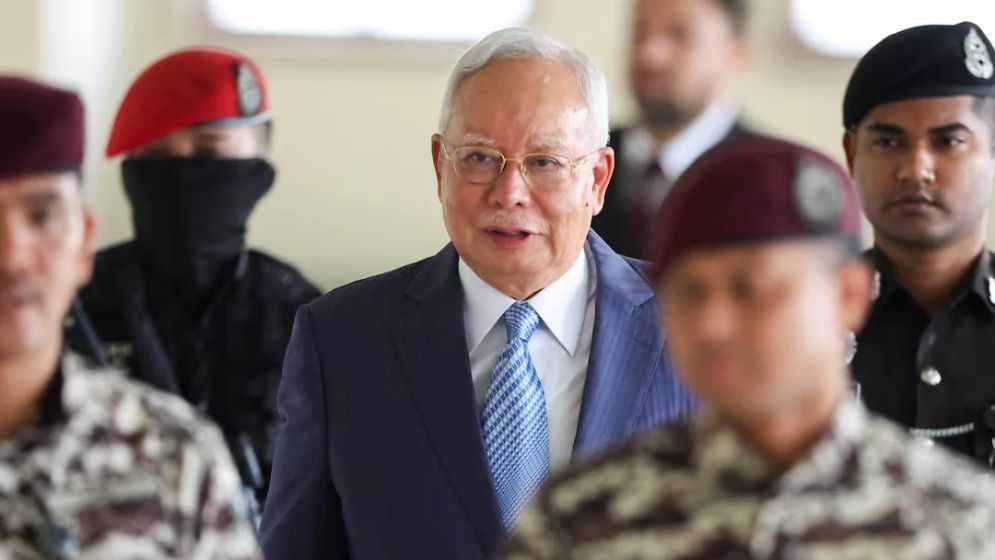
Malaysia's former Prime Minister Najib Razak arrives at the Kuala Lumpur High Court at Kuala Lumpur, Malaysia, on 14 October 2026. Photo: Reuters
Malaysia's attorney general on Friday postponed jailed former premier Najib Razak's transfer to house arrest to review his royal pardon, in a last-minute intervention after a court cleared him to leave prison four years into his sentence.
Najib, prime minister from 2009 to 2018, was jailed in relation to a multi-billion-dollar scandal at state investment fund 1Malaysia Development Berhad and was granted approval in a September royal pardon to serve his remaining two years at home.
A court gave Najib the green light earlier on Friday to start his house arrest and he left prison briefly to undergo a scheduled dental checkup, Transport Minister Anthony Loke said.
Police and throngs of media had gathered for most of the day outside Najib's cordoned-off Kuala Lumpur residence in anticipation of his arrival.
But the Attorney-General's Chambers late on Friday said questions had arisen over the legal interpretation of King Sultan Ibrahim's pardon and the court order allowing Najib to leave jail.
"In this regard, the implementation of house arrest... should be temporarily suspended until further investigation and clarification," it said in a three-page statement.
'EXECUTIVE OVERREACH'
Najib's legal team said there was no lawful reason to keep him in jail in disregard of a royal order, adding the attorney general had been present at a meeting that advised the king on the pardon and had raised no concerns.
"To claim the power to suspend His Majesty’s order by media statement is, in our view, executive overreach," it said.
One of Malaysia's most influential and divisive politicians, Najib has repeatedly denied wrongdoing in the 1MDB case and insists he was made the scapegoat for the complex, globe-spanning scheme that siphoned away as much as $4.5 billion, according to US investigators.
More than $1 billion allegedly ended up in accounts linked to Najib, 1MDB's co-founder, prosecutors have said.
He was also convicted of abuse of power and money laundering in a separate 1MDB-related case in December and sentenced to 15 years in prison with fines of $2.8 billion. He has appealed that verdict.
Najib was given a boost earlier on Friday when his party, the United Malays National Organisation, paid a 50 million ringgit ($12.32 million) fine on his behalf, raised through crowdfunding, to allow him to leave prison, which was a condition of his pardon.
In a statement under a headline that said "do not commit treason", UMNO's secretary-general Asyraf Wajdi Dusuki said the pardon must be respected.
"What justification is there for further delaying the implementation of house arrest?" he said.
'MALAYSIA'S BIGGEST CROOK'
Najib was for years a towering figure in Malaysian politics and still commands influence in UMNO, which is part of Prime Minister Anwar Ibrahim's multi-party government.
Anwar's Pakatan Harapan alliance has strongly opposed leniency towards Najib, putting it at odds with the once dominant UMNO, and his transfer to house arrest could create more political tension.
It is also likely to fuel criticism over the government's handling of corruption cases and further erode support for Anwar after setbacks in two state elections this year, which went the way of UMNO.
Though the next general election is not due until early 2028, Anwar has said he could call a snap poll if rifts deepen.
Transport Minister Loke, leader of the Democratic Action Party, the largest member of Anwar's ruling bloc, on Friday said he would resign from the cabinet as soon as Najib begins house arrest.
Former DAP lawmaker Tony Pua, who played a key role in uncovering the 1MDB scandal, said Najib was "Malaysia's biggest crook" and chided UMNO for fundraising to get him out of prison.
"Instead of using such a large sum of money to help ordinary Malaysians, they chose to 'free' Malaysia's most corrupt," he said on Facebook.