


 For all latest news, follow the Daily Sun's Google News channel.


No diesel, no overhead wires – How India’s hydrogen train actually works
The Print
Published: 04 Nov 2026, 10:17 PM
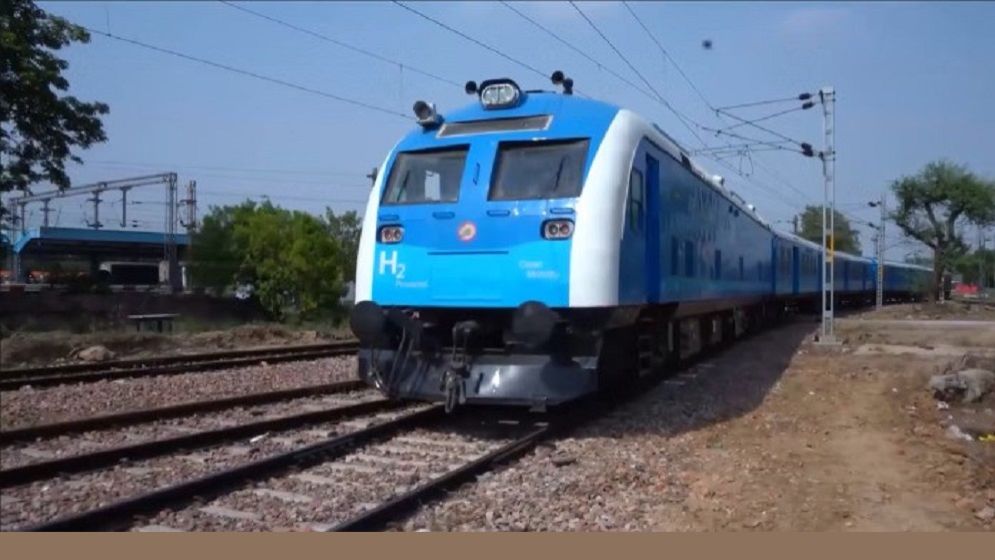
A train pulls into a station without the familiar rumble of
a diesel engine or a cloud of exhaust. Instead of burning fuel to move, it
carries a system that produces electricity inside the train itself. The fuel is
hydrogen, and the only direct by-products of the process are water and heat.
India has already taken this technology out of the drawing
board. Its first hydrogen-powered passenger train named “Namo Green Rail” was
flagged off on 17 July 2026, on the Jind-Sonipat section in Haryana. The
10-coach train has two hydrogen-powered driving units, eight passenger coaches
and a combined power output of 2,400 kilowatts.
But hydrogen does not directly turn the train’s wheels. It
first has to be converted into electricity through a device called a fuel cell.
Understanding that process also explains why hydrogen trains are being explored
as an alternative to diesel locomotives, and why they are not necessarily the
answer for every railway route.
It is an electric train, but it carries its own power
station.
The easiest way to understand a hydrogen train is to think
of it as an electric train that does not need overhead wires to draw
electricity.
A conventional electric locomotive receives power from
overhead lines or, in some systems, a third rail. A hydrogen train generates
electricity onboard. It does this using a fuel cell, which combines hydrogen
stored in tanks with oxygen drawn from the surrounding air.
Inside the fuel cell, hydrogen molecules are split into
protons and electrons. The protons pass through a special membrane, while the
electrons travel through an external circuit. That movement of electrons
creates an electric current.
The electricity is then used to power traction motors, which
turn the wheels and move the train. Water and heat are produced during the
reaction.
The process can be represented simply as:
Hydrogen + Oxygen => Electricity + Water + Heat
There is no burning of hydrogen in an engine. Instead, the
fuel cell converts its chemical energy directly into electrical energy.
This is why a hydrogen train is technically an electric
train, even though it does not rely on an overhead power supply.
Why does it also need a battery?
If the fuel cell produces electricity, why does the train
need batteries as well?
The answer lies in the way trains use power. They do not
require the same amount of electricity at every moment. Starting from a
station, accelerating, climbing a gradient and travelling at speed can all
place different demands on the propulsion system.
A fuel cell is well suited to supplying a relatively steady
stream of electricity. A battery, meanwhile, can provide additional power when
demand rises sharply.
India’s train uses lithium iron phosphate batteries
alongside its hydrogen fuel cells. The two systems work together: the fuel
cells provide electricity, while the batteries help meet sudden increases in
power demand and store surplus energy when available.
The batteries can also capture energy during braking through
regenerative braking, converting some of the train’s motion back into
electricity rather than losing all of it as heat.
In India’s train, the propulsion equipment is housed in two
driving power cars, one at either end of the eight passenger coaches. Each has
a rated output of 1,200 kW, taking the combined output to 2,400 kW.
The train is approved to operate at up to 75 kmph on the Jind–Sonipat
route, although its design speed is 110 kmph.
Where does the hydrogen come from?
A hydrogen train cannot simply collect hydrogen from the
air. It needs a dedicated production, storage and refuelling system.
At Jind, Indian Railways has established a facility to
supply hydrogen to the train. The hydrogen is produced through electrolysis, a
process in which electricity is used to split water into hydrogen and oxygen.
The hydrogen is then compressed and stored in specialised
tanks. This is necessary because hydrogen is a very light gas and occupies a
large volume unless compressed.
At the Jind facility, the storage system can hold around
3,000 kg of hydrogen. The gas is stored at pressures of up to 500 bar and
dispensed to the train at 350 bar through dedicated refuelling equipment.
The arrangement is similar in principle to refuelling a
conventional vehicle, but the pressures, storage equipment and safety
procedures are very different.
The train’s onboard cylinders carry the hydrogen to the fuel
cells, where it is converted into electricity during the journey.
If hydrogen is flammable, how safe is the train?
Hydrogen is highly flammable. It can ignite when mixed with
air in the right proportions, and storing it under high pressure introduces
additional engineering challenges.
That does not automatically make hydrogen transport unsafe,
but it means the entire system has to be designed around preventing leaks,
detecting them quickly and controlling the supply if something goes wrong.
Indian Railways has installed sensors to detect hydrogen
leaks, heat, flames and smoke. The train also has ventilation systems,
automatic shut-off arrangements and monitoring equipment. The refuelling
facility is subject to safety procedures and has received approval from the Petroleum
and Explosives Safety Organisation.
The gas is stored in specialised cylinders, while the supply
system is designed to isolate the hydrogen flow if abnormal conditions are
detected. These safeguards are important because hydrogen is difficult to contain:
its small molecules can escape through gaps that would not necessarily leak
other gases.
The safety challenge is therefore not just about preventing
a fire. It is about ensuring that a leak is detected before hydrogen can
accumulate in a dangerous concentration.
Is a hydrogen train really emission-free?
At the point where the train operates, a hydrogen fuel cell
produces no carbon dioxide from the propulsion process. Its direct by-product
is water, rather than the exhaust associated with diesel combustion.
But there is an important distinction between what comes out
of the train and the emissions involved in producing its fuel.
Hydrogen is not naturally available as a ready-to-use energy
source in the same way that sunlight or wind is. It has to be produced using
another source of energy. If the electricity used for electrolysis comes from
renewable sources such as solar or wind, the resulting hydrogen can be
classified as green hydrogen.
If hydrogen is produced using fossil fuels, however, its
production can generate substantial greenhouse gas emissions. The environmental
benefit of a hydrogen train therefore depends partly on how the hydrogen is
made, how it is transported and how much energy is used along the way.
In other words, a train that emits only water vapour while
moving is not automatically carbon-free across its entire energy supply chain.
Why not replace every diesel train with hydrogen?
Hydrogen trains are not necessarily a better option than
conventional electric trains. Where overhead electrification already exists,
using electricity directly is generally more energy-efficient than converting
it into hydrogen, compressing and storing it, and then converting it back into
electricity onboard.
That is one reason the technology is particularly relevant
to routes where installing overhead wires is difficult or expensive, including
some regional and less heavily used railway lines.
Indian Railways has electrified more than 99 per cent of its
broad-gauge network, according to the Railways. This means hydrogen is not
being introduced to replace the entire electric railway system. Its potential
role is more specialised: providing an alternative to diesel on sections where
full electrification may not be practical.
There are also questions around the cost of producing green
hydrogen, the expense of specialised trains, the construction of refuelling
stations and the availability of a reliable supply. These factors will
determine whether the technology can be expanded beyond a pilot route.
What happens next?
India’s first hydrogen train is intended to demonstrate that
the technology can work under Indian railway conditions. The project also
establishes infrastructure for producing, storing, compressing and dispensing
hydrogen, rather than testing only the train itself.
In July 2026, the Railways said the train had travelled more
than 1,200 km since its launch, saving over 3,200 litres of diesel. It has also
indicated that experience from the project could help assess hydrogen-powered
trains for other routes, including heritage sections such as Kalka–Shimla.
The technology is still developing, and its wider use will
depend on operational reliability, fuel costs, safety and the availability of genuinely
low-carbon hydrogen.
The bigger shift is in how a train gets its power. For more
than a century, railway propulsion has relied on burning fuel onboard or
drawing electricity from an external supply. A hydrogen train offers a third
arrangement: carrying a fuel that can be converted into electricity as the
train moves.
Whether it becomes a common sight on Indian tracks will depend not just on how well the train runs, but on whether the country can produce enough affordable, low-emission hydrogen to keep it moving.