


 For all latest news, follow the Daily Sun's Google News channel.


After losing majority, Netanyahu claims elections were ‘stolen’
Agencies
Published: 03 Nov 2026, 11:30 PM
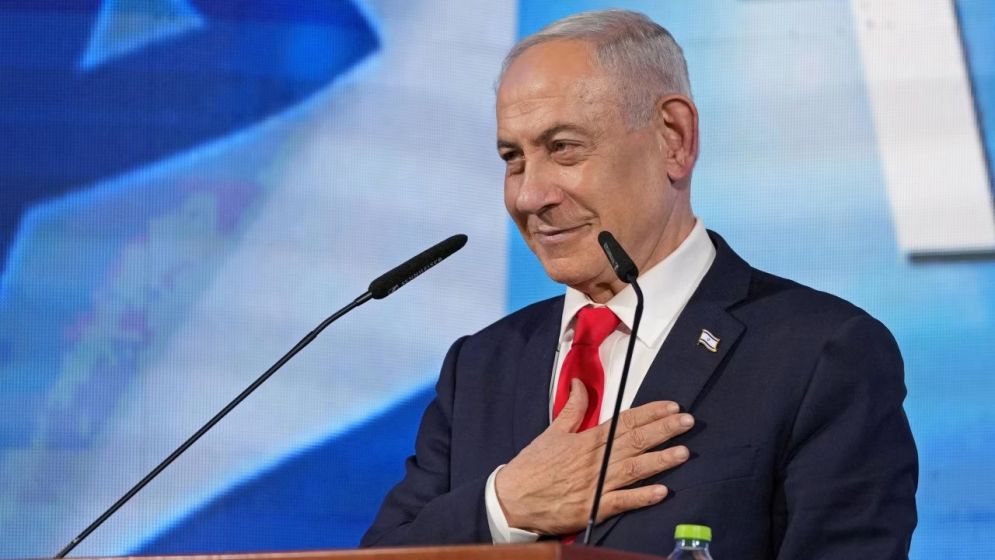
Israeli Prime Minister Benjamin Netanyahu has failed to
secure a majority in the 27 October general elections, which was expected thanks
to the corruption allegations against him and his failure to deliver on
security pledges.
But he has not lost either, in the conventional sense of the
term, his political group was still elected the biggest party. This has allowed
him enough room and maneuvers to resort to the last available option needed to
form the government -- challenge the election results.
And his target is obvious, the Arab coalition, which has won
the highest number of seats, thereby, denying simple majority to both Netanyahu
and his opponent.
Repetition?
On election day in March 2015, Benjamin Netanyahu filmed a
controversial 28-second video, warning right-wing voters that Arab citizens
were heading to the polls “in droves.” A week later, after he had won against
prevailing expectations, he apologized, saying he did not intend to offend the
Arab sector as a whole.
Eleven years and six elections later, Netanyahu is playing
the same game, only on a much grander scale.
Since losing his majority in the 27 October vote, Netanyahu
and his allies have been pressing a serious accusation: the election was
“stolen” by Arab parties through bribery, foreign funding and fraud. They are
demanding investigations, arrests and, in the most extreme version, even
canceling the vote and going to another round of elections.
They have yet to present any evidence, but the political
goal is clear: to cast a veil of illegitimacy on the Joint List and Raam, the
two Arab parties that saw record turnout and are likely to be a crucial part of
any effort to oust Israel’s longest-serving leader.
“They are doing this because they lost”, Gadi Eisenkot,
Netanyahu’s main challenger, said in a Thursday video statement.
Netanyahu did not lose the election outright, nor did he win
it. The same is true for Eisenkot. Both fell short of the required 61-seat
majority in the 120-seat parliament needed for a clear victory.
Netanyahu cannot form the government or pass laws at will.
But he will still remain the chief of caretaker government until Israel sorts
out the political stalemate and uncertainty, which could last weeks – perhaps
months.
Netanyahu knows the math. His coalition dropped to 53 seats
and has no clear way of securing a majority. The Eisenkot-led bloc has 48 seats
on its own. But with the support of 19 seats from the Arab parties, it has a
clear majority of 67 seats.
The only government to have ousted Netanyahu – the
Bennett-Lapid government in 2021 – included Raam, and it collapsed after
roughly a year. Now, Netanyahu’s primary goal after the elections, according to
a source close to him, is to delegitimize and prevent any Jewish-Arab political
cooperation that could weaken his grip on power.
Early preparation
Netanyahu knew, like most others, that winning a simple
majority this election would be the toughest ever feat for him, and that the
largest share of seats would be more than he could wish for.
So, he and his comrades started preparing their plot early
-- weeks before election day.
In mid-October, Netanyahu and Religious Zionist party chair
Bezalel Smotrich announced plans to deploy about 2,000 observers at polling
stations in Arab communities, framing the Arab voting stations as sites of
potential fraud.
Early on election morning, police arrested three Raam
activists over an alleged cash-for-votes scheme, in a widely publicized
incident. The original tip about the arrests, Israel’s Channel 12 News later
reported, came from Netanyahu’s chief of staff, who bypassed standard channels
to personally reach the police commissioner. Courts rejected most of the police
requests for tough restrictions, and some of the suspects have been released.
But Netanyahu’s campaign machine seized on the story, amplifying the arrests
and claiming it was an effort to “steal the elections.”
As the ballots were counted, the campaign continued and
intensified. On Wednesday, Netanyahu’s Likud party said it had submitted
hundreds of testimonies alleging bribery, threats, violence and forgery from
Raam and the Joint List, while the pro-Netanyahu Channel 14 reported suspicions
of millions of shekels from a foreign source.
Then, a letter leaked.
The Central Elections Committee chair, Supreme Court Deputy
Chief Justice Noam Solberg, had written to David Zini, the director of the Shin
Bet security service, requesting an inquiry into “serious suspicions” of
foreign funding. Israeli media later reported that Zini himself had asked for
the letter, after reportedly meeting with Netanyahu earlier. Solberg wrote that
he could not verify the seriousness of the evidence. But for Likud and other
right-wing politicians it hardly mattered: the letter was treated as
confirmation and proof.
Netanyahu’s far-right allies Smotrich and Itamar Ben Gvir
called to arrest the Arab party leaders, with Ben Gvir alleging a Qatari-funded
effort to boost Arab voter turnout, which Qatar categorically denied as
“ridiculous and dangerous.”
On Channel 14, the story was dubbed “The Ballot Terror.”
Likud lawmaker Boaz Bismuth wrote on X that the results of the “terrorist
parties” should not be recognized until “every stone” was turned. On Sunday,
Netanyahu himself shared a video of a right-wing activist claiming of massive
forgeries and calling to “simply invalidate the elections.”
The episodes elicited sharp criticism of Israel’s police
commissioner and Shin Bet chief – both Netanyahu appointees.
“There is a common denominator between the two affairs,”
Amos Harel, Haaretz’s senior defense analyst, wrote. “In both cases the Prime
Minister’s Office is stirring things behind the scenes with the Shin Bet and
the police, and Likud immediately leverages the reports into a massive
propaganda campaign” designed to delegitimize the Arab parties and reduce the
opposition’s freedom of actions.
'Feeble proofs' officially rejected
Election authorities, however, rejected Netanyahu’s narrative.
The Central Elections Committee officially dismissed claims of widespread fraud
as baseless and said there is no evidentiary basis for alleging a systematic
compromise of the vote.
On Sunday, the committee chairman appeared alongside the
head of the Shin Bet and the attorney-general in a special statement in which
they said the elections were conducted properly. Even if the foreign funding
suspicions are substantiated, they said it won’t overturn the result or
undermine the integrity of the process. “Your decision at the ballot box will
be honored,” Solberg said.
Likud was unmoved, insisting in a statement a “black cloud”
hangs over the results.
The opposition has broadly backed the investigation but has
framed Netanyahu’s allegations as an effort to undermine the outcome. Eisenkot
called it a “despicable and malicious influence operation” meant to delay the
publication of the results and delegitimize the 26th Knesset. Yair Golan, the
leader of the left-wing Democrats party, said that is how “a dictator who
refuses to accept defeat at the ballot box” behaves.
The Joint List, which is the target of the delegitimization
campaign, fired back in its own statement.
“No smear campaign will erase the achievement of the Arab public, and no attempt to cast doubt on the legitimacy of our vote will change the will of the voters,” the party said in a statement last week. “You wanted us small and weak, and you got us big and strong.”