



 For all latest news, follow the Daily Sun's Google News channel.


From New Delhi to Manila to Atlanta, the Quad finds its rhythm in 2026
Despite the stir over an impending Quad Leaders’ summit, the grouping has had a productive year with multiple outcome-oriented convenings
The Diplomat
Published: 03 Nov 2026, 06:37 PM
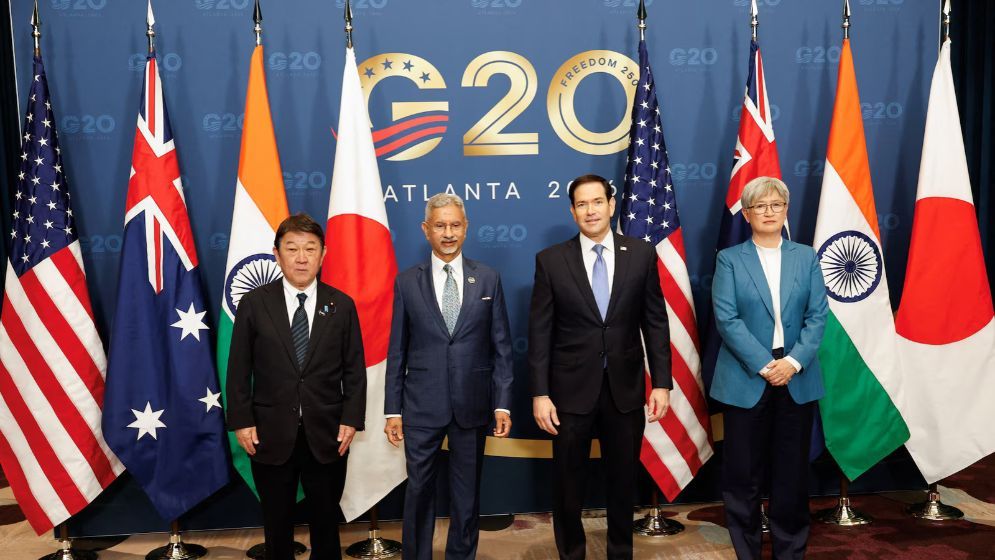
Japan's Foreign Minister Toshimitsu Motegi, India's External Affairs Minister S Jaishankar, US Secretary of State Marco Rubio and Australia's Foreign Minister Penny Wong pose for photographs at the Quad Foreign Ministers’ Meeting on the sidelines of the G20 foreign ministers' meeting in Atlanta, Georgia, US on 31 October 2026. Photo: Reuters
Over the weekend, foreign ministers of the Quad nations convened on the sidelines of the G20 Foreign Ministers’ Meeting in Atlanta.
This was the third meeting between Quad foreign ministers
this year, following their convenings in New Delhi (in May) and Manila (in
July).
Yet much of the commentary and analysis continues to focus
on the long-impending Quad Leaders’ Summit, which is now expected to be held in
Manila later this month.
The summit has been the focus of much debate since the 2025
Quad Leaders’ summit, which was scheduled to be hosted by New Delhi, fell
through. The leaders’ convening is understandably much awaited since it would
be the first since US President Donald Trump’s return to the White House.
Moreover, it could put to rest some of the ever-growing
speculation on the Quad’s future amid cascading geopolitical conflicts, energy
and tech supply constraints, and conjecture over an emergent G3 model (China,
Russia, and the US) of managing “spheres of influence.”
However, even without a leaders’ summit, 2026 has been
significant for the Quad. Three foreign minister-level convenings resulted in
the finalisation of joint priorities, announcements being put into action, and
the broadening of engagement touch-points.
To begin with, much of the headlines on the Quad convening
in Atlanta on 31 October have pertained to the grouping’s “intent to provide
over $85 million of technical and financial assistance” for supporting access
to trusted AI across the Indo-Pacific, and the US commitment to “provide $10
million to promote infrastructure and facilities” in India and ASEAN that
recover critical minerals from waste.
These are notable developments in joint mobilisation for capacity-building, particularly given the Quad nations’ increasingly convergent views on “economic coercion.” In the joint statement following the Atlanta convening, the Quad nations notably expressed their concerns on “arbitrary export restrictions, as well as non-market policies and practices that result in overcapacity to disrupt global supply chains in critical industries.”
With this clarity in joint priorities and concerns, it is
important to note that the latest takeaway on critical minerals also builds on
the Quad’s May 2026 announcement of the “Quad Critical Minerals Framework”
after the meeting in New Delhi.
In supporting the recovery of critical minerals during waste
disposal, the Quad has taken a key step toward realising the framework’s
central aim to leverage economic tools and cooperation in this key domain.
For India, such a joint effort also aligns well with New
Delhi’s push to bolster domestic capacities on production and refinement of
critical minerals through tech partnerships with like-minded nations, incentive
schemes, and streamlining of its policy directives.
In addition, 2026 has also yielded greater clarity on the
Quad’s place in the Indo-Pacific. Much like the clearer stance against
“economic coercion,” the Quad nations’ identification of themselves as “ASEAN
Comprehensive Strategic Partners” has been a significant development.
In July 2026, at their meeting in Manila, the Quad nations
declared their support for the “practical implementation of the ASEAN Outlook
on the Indo-Pacific (AOIP)” through shared priorities of maritime and
transnational security, economic prosperity and security, critical and emerging
technologies, and humanitarian assistance and emergency response.
Analysts were quick to note that “ASEAN Centrality” has been
part of various Quad statements over the years. But the outright support for
AOIP has now put to rest longstanding ambiguity on how the Quad’s agenda would
undercut or duplicate ASEAN-led institutions and agenda-setting in the region.
Addressing this ambiguity was an apparent intention.
Japanese Foreign Minister Motegi Toshimitsu noted that the Quad meeting in
Manila, which was held on the sidelines of ASEAN-related Foreign Ministers’
Meetings, sent “a strong message that the Quad supports ASEAN Centrality and
unity.”
Beyond policy alignment, the Quad convening in Atlanta last
week also led to the announcement of the first-ever “Quad Business Leaders’
Forum,” which will convene industry leaders, government, and policy experts
from Quad nations.
This addresses the longstanding absence of a dedicated
private-sector channel to support the Quad’s vision and encourage
cross-pollination between Indian, American, Japanese, and Australian private
sectors.
Meanwhile, the Quad nations’ export credit agencies are
scheduled to convene in Tokyo on 18 November to identify opportunities for
cooperation on mobilisation of public finance.
Another significant outcome of the Atlanta convening
pertained to the “Quad Initiative on Indo-Pacific Energy Security,” which was
announced at the Quad convening in May 2026. As per the joint statement
released following last week’s convening, the Quad in September 2026 organised
the first-ever “Quad Fuel Security Forum” for advancing fuel security in the
Indo-Pacific by strengthening strategic petroleum reserves and stockholdings.
This is a pertinent area for Quad cooperation given the
prolonged nature of implications stemming from the Hormuz crisis. For instance,
even as Asia’s imports of crude recovered in October 2026 to match levels prior
to the Iran conflict, the real stress in energy markets now pertains to refined
products and downstream derivatives (like diesel) due to refining operations
being constrained in the Middle East and Russia.
Finally, the joint statement released following the Quad
meeting in Atlanta also included updates on several nascent initiatives covered
during the May 2026 meeting in New Delhi. This includes the second
“Quad-at-Sea” Ship Observer mission in September 2026 and the second
Indo-Pacific Logistics Network (IPLN) Tabletop Exercise (TTX) hosted by Japan’s
Ministry of Defense in September 2026.
Hence, even as many continue to question the relevance of
the Quad, the grouping’s 2026 record demonstrates substance and increased
clarity on its place in the Indo-Pacific.
Over the course of three separate meetings in New Delhi,
Manila, and Atlanta, the Quad’s foreign ministers have fine-tuned joint
priorities, moved announcements into action, and widened the ways in which the
grouping engages.
Ahead of the much-anticipated Quad Leaders’ Summit, the Quad
found its rhythm in 2026. Going forward the task is to now give that rhythm
scale.