


 For all latest news, follow the Daily Sun's Google News channel.


War-torn Europe propels resurgent Indian defense industry
Bloomberg
Published: 31 Oct 2026, 01:54 AM
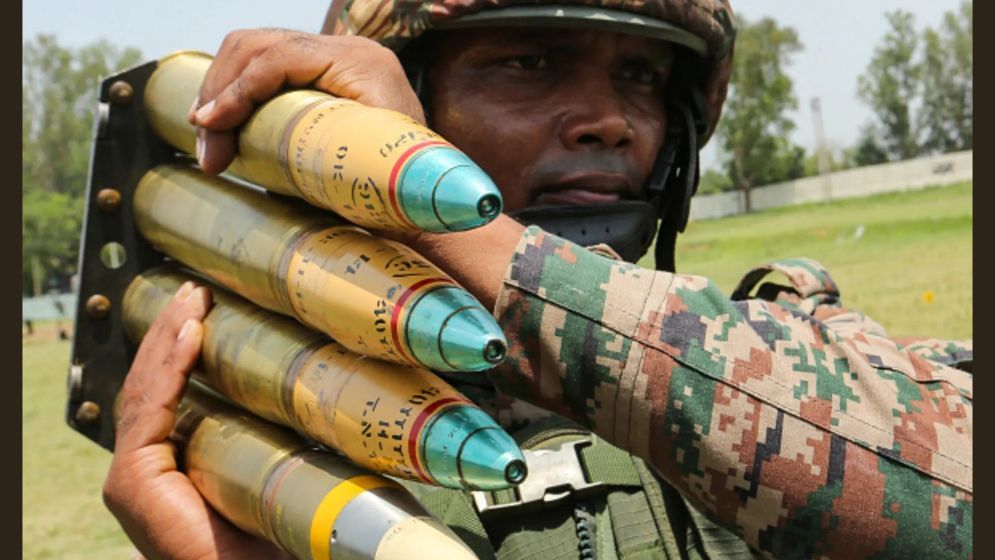
An Indian Army soldier carries ammunition near the Line of Control in the Jammu region in May 2025. Photo: AFP
Europe’s rearming efforts are fueling an explosive increase in Indian defense exports, boosting a key industry in a way that could disrupt New Delhi’s longstanding relationship with Moscow.
Indian arms makers have sent at least $872 million worth of ammunition — including artillery shells, mortar shells, propellant and explosives — to European countries since Russia’s invasion of Ukraine four years ago, according to data sourced by Trade Data Monitor from the Ministry of Commerce and Industry of India.
While still modest compared with the US and other leading exporters, for India it represents a more than 1,600% increase from the $49.2 million in arms exported to Europe in the four-year period before the war, according to trade data.
Three-quarters of those shipments have gone to nations within a 13-country bloc in Eastern and Central Europe that’s been a major arms supplier to Ukraine, and where demand surged after Russia’s full-scale invasion. India is now the overall second-biggest supplier of arms including shells, mortars, propellants and explosives to these countries, behind South Korea, up from 28th four years ago, according to Trade Data Monitor.
India doesn’t disclose which defense products are exported or who buys them. But an analysis of bill of lading documents provided by Trade Data Monitor and Big Trade Data — which capture physical exports that have crossed customs — shed light on India’s growing role in the global arms trade, as well as the geopolitical complications that entails.
The increased demand comes in the midst of a years-long push by Prime Minister Narendra Modi to bolster domestic arms manufacturing and reduce the military’s reliance on imports. But the sales to US allies in Europe also undercut its longtime partner Russia, which has been India’s primary supplier of weapons since the Cold War. Modi and Putin have already met twice in 2026; more than 50% of India’s combat aircraft are of Russian origin, and it has also been one of the single largest buyers of Russian oil since 2022.
In April the government said total overseas arms sales soared 63% to $4 billion during the fiscal year ending in March, more than doubling since 2023 and about 25 times higher than a decade earlier. The figure includes contracted and authorized exports not yet delivered, in addition to actual exported weapons.
A gauge of defense stocks on the National Stock Exchange of India Ltd. has jumped nearly 15% this year, beating a Bloomberg index of global peers.
New Delhi has long embraced a policy of non-alignment in major conflicts, a posture that Indian leaders say provides “strategic autonomy.” Indian officials in both the government and industry stressed that the motivation behind the growing transactions was purely commercial.
“Russia’s invasion of Ukraine has created a voracious demand for shells and munitions, and Indian firms are taking advantage of that,” said Walter Ladwig, a political scientist with a specialty in South Asian defense policy at King’s College London.
Ladwig added that selling arms not to Ukraine directly, but to other European countries provides a degree of cover.
“There’s a certain degree of plausible deniability that states accept from each other in international politics,” he said. “Russia has created the market demand that Indian defense companies are responding to. In some respects it’s a business decision — the dollars and cents make sense.”
Although each transaction is ultimately cleared by the Ministry of Defence, all buyers of Indian weapons are bound by end-user agreements that restrict their ultimate destination and use, and any outcome in which Indian arms ultimately land in an unauthorized location is the fault of the buyer, the Indian officials added, speaking on condition of anonymity because of the sensitivity of the matter.
The data show how the country is steadily climbing into the booming global arms trade. Although Indian officials have publicized high-tech weapons sales, including new deals for its BrahMos supersonic cruise missile, the data show that the driving force behind the growth in New Delhi’s arms exports has been more basic battlefield supplies manufactured by state-run firms.
Such bread-and-butter munitions are in high demand globally, particularly in Europe. They are also sought after in Israel, where India shipped $76 million worth of shells, mortar rounds, propellants and explosives over the two years through March 2026, nearly equal to its combined exports from the prior six.
The data show Israel has also expanded its use of Indian aircraft parts. Through March this year, New Delhi was the third-largest foreign supplier of such components to Israel, up from ninth in 2023, before Israel’s war against Hamas, which the US has designated a terrorist group.
India is “a rising power and a crucial partner for Israel in force build-up — spanning procurement, exports, joint manufacturing,” said Tamir Hayman, head of the INSS research institute in Tel Aviv and former head of the Israel Defense Forces military intelligence, adding that “the overarching trend is unmistakable.”
Customs records only cover commercial sales, leaving out direct government-to-government deals and tech transfers. Indian officials have repeatedly touted the country’s expanding defense exports, boasting that Indian-made arms are in growing demand worldwide.
“Today our defence exports have increased by almost 50 times,” Modi said during his annual Independence Day address to the nation in August. “Our weapons are reaching about 100 countries. India’s reputation is gradually increasing on the global stage.”
India’s Ministry of External Affairs and Ministry of Defence did not respond to requests for comment. Russia’s Ministry of Foreign Affairs, Ukraine’s Foreign Ministry and Defense Ministry, and Israel’s Defense Ministry did not respond to requests for comment.
India’s growth in overseas weapons flows from a broader effort to turn India into an export powerhouse, part of Modi’s signature “Make In India” policy, which has already turned the South Asian nation into China’s chief rival in smartphone manufacturing.
At the heart of India’s scale-up in weapons exports are companies known as Defence Public Sector Undertakings, state-run weapons firms that accounted for more than half of India’s defense exports in the last fiscal year. Among them is Munitions India Ltd., India’s largest producer of ammunition, which accounted for more than half of all export earnings by Indian public defense companies in the two years through fiscal 2025.
The Pune-based company was one of a handful of such state-run firms formed in the wake of a sweeping reform of India’s weapons industry in 2021. Aimed at shaking up an inefficient system and boosting competition, the reform’s hallmark was the breakup of the Ordnance Factory Board, a sprawling, bureaucratic collection of 41 arms factories — some dating to the colonial era — spread across India.
Munitions India absorbed roughly one-third of those plants. Ravi Kant, Munitions India’s managing director, said competition from private weapons companies at home was a key reason behind the company’s search for new markets overseas.
“For us to sustain as a company, we needed to look for a customer beyond the domestic market,” Kant said in 2023. “There are customers here, there are countries here and there are companies here whom we can support in supply of various kinds of ammunition.”
The weapons the newly formed Defence Public Sector Undertakings sell, though, are largely not of domestic design. Representatives from the companies told an Indian parliamentary committee in November 2024 that most still used Russian technology, and that it would take time to change that.
Arming Ukraine
It’s difficult to know exactly how many Indian-made arms have made it to Ukraine. Unlike big-ticket weapons like fighter jets and missile platforms, shells and other ordnance move in industrial-scale quantities across multiple borders, and customs records document individual transactions, not the full path from manufacturer to final recipient, making them difficult to trace.
In one instance, however, Ukrainian customs records compiled by Big Trade Data show Indian-origin ammunition entering Ukraine in February 2024. The records show at least 78 shipments valued at $62.8 million of 155-millimeter artillery shells, along with their propellants and fuzes.
In these transactions, Regulus Global LLC, a Virginia-based defense and logistics company, was recorded as the exporter, according to the filings from Big Trade Data. The company has spoken publicly about its support for Ukraine and supplying arms for its war effort.
The importer was recorded as SpetsTechnoExport, the state-owned arms procurement firm headquartered in Kyiv. The records don’t show what happened after the weapons were imported or how Regulus acquired them.
A spokesman for Regulus declined to comment. SpetsTechnoExport did not respond to requests for comment.
Customs records also show multiple Eastern European buyers importing defense goods from India in the same periods they were exporting similar products from other countries to Ukraine.
According to Indian customs documents compiled by Big Trade Data, Munitions India exported nearly 72,000 rounds of 120-millimeter mortar shells between 2024 and 2025, with CN Romtehnica SA, the official procurement arm of the Romanian Ministry of National Defence, listed as an importer of these shells. Ukrainian customs records, meanwhile, show that in early 2024 Romtehnica was recorded as the exporter of nearly 6,000 rounds of the same caliber, with Ukraine’s state-owned foreign-trade defense enterprise Ukrspecexport named as the importer and Bulgaria listed as the country of origin.
Similarly, Indian customs records compiled by Big Trade Data show that between 2023 and 2025, Solar Industries India Limited sent at least 229,000 kilograms of RDX — a high explosive — with the Polish state-owned explosives manufacturer Nitro-Chem SA, which describes itself as “an export leader in the Polish arms industry,” listed as an importer of these explosives.
Ukrainian customs records, meanwhile, show two shipments of RDX in 2024 on which Nitro-Chem was recorded as the exporter, with Ukrainian Advanced Microtechnologies named as the importer and the European Union listed as the country of origin.
The Ukrainian buyer, according to its website, uses RDX to make reactive-armour elements for tanks — an end use recorded on the Ukrainian customs paperwork too, which describes the material as “a high explosive… used for the production of elements of dynamic protection of tanks” supplied “under a state contract under a state defence order for the needs of the National Guard of Ukraine.”
The transactions show that India could be helping Ukraine’s allies restore stockpiles depleted from years of selling to Ukraine, allowing such support to continue, said Siemon Wezeman, senior researcher in the Arms Transfers Programme at the Stockholm International Peace Research Institute, which researches conflict and arms control.
The Czechoslovak Group, a leading European arms company whose subsidiaries have bought millions of dollars worth of Indian munitions since Russia invaded Ukraine in 2022, declined to comment on specific transactions. But it noted that Indian companies were well-positioned to supply Europe.
“India has a well-developed defense and chemical industry and is currently one of the possible suppliers of energetic materials and other inputs used in ammunition production,” the group said in a statement. “This is particularly important at a time when European production capacity in this area still falls short of the level needed to fully meet demand.”
Indian defense manufacturers are increasingly aware of the risk of hardware exported from India finding its way to unintended battlefields, and New Delhi will likely have to introduce clearer guidelines and safeguards, senior industry executives said, speaking on condition of anonymity because of the sensitivity of the issue. Companies could face sanctions, while India itself could come under heightened international scrutiny, they added.
“There is a lack of ammunition production in Europe to deal with both what Ukraine needs and with what Europe needs,” Wezeman said. “Therefore you import, in this case from India.”