



 For all latest news, follow the Daily Sun's Google News channel.


Netanyahu, at risk of losing power, steps up attacks on Israel's Arab parties
Reuters, Jerusalem
Published: 29 Oct 2026, 11:21 PM
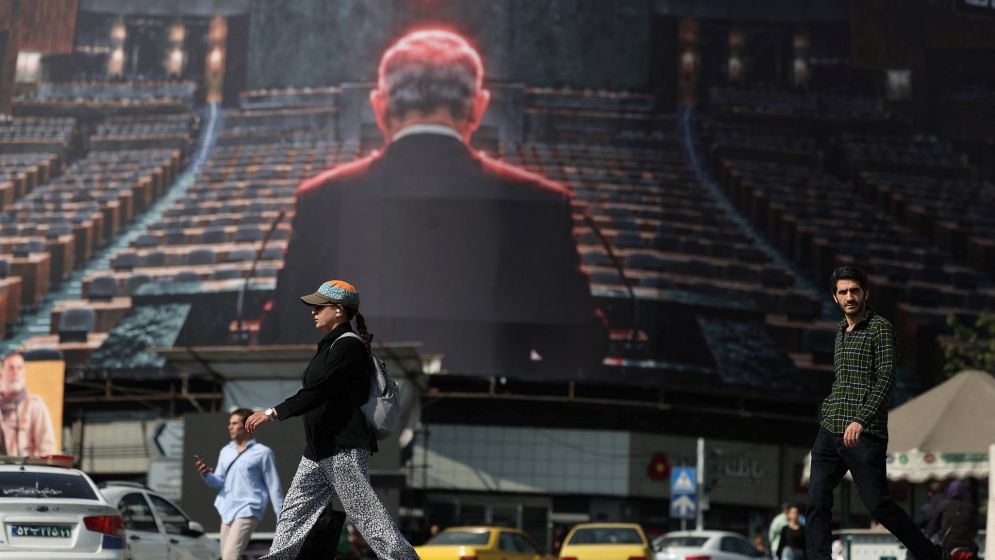
People walk past a billboard depicting Israeli Prime Minister Benjamin Netanyahu in the empty hall of the United Nations, on a building in Tehran, Iran, 28 October 2026. Photo: Reuters
Israeli Prime Minister Benjamin Netanyahu alleged on
Thursday, without providing evidence, that Arab parties' record gains in an
election this week were driven in part by voter fraud, a charge rejected by
Arab leaders who accused the premier of incitement.
The allegation represents an escalation of rhetoric against
Arab parties by Netanyahu and his far-right partners after high Arab turnout in
a national ballot on Tuesday effectively blocked a smooth path to power for
either him or his main rivals.
Israeli officials said on Thursday that the authorities were probing fraud allegations, though the election's integrity was not systematically compromised.
Analysts and critics say that by stepping up attacks on Arab
parties, Netanyahu may be trying to ensure his main rival, Gadi Eisenkot, feels
unable to even consider forming a minority government with Arab help that could
oust him from power.
Netanyahu's goal is "delegitimising any Arab-Jewish
cooperation", said Eytan Gilboa, professor of politics at Reichman
University.
Tuesday's tightly fought election has produced no clear
winner and is likely to be followed by weeks of protracted negotiations over a
new government.
With nearly 99% of votes counted, Netanyahu's
nationalist-religious bloc held a modest lead in seats over a bloc of
right-wing and centre-left parties led by Eisenkot, with both men's coalitions
short of the 61 seats needed for a majority in parliament.
Parties representing Israel's 21% Arab minority were
projected to win an unprecedented 19 seats, leaving Eisenkot's bloc, which has
48 seats against Netanyahu's camp of 53, with no path to power without broad
Arab backing.
Eisenkot has so far ruled out including the parties in
government but his camp could try to form a minority government with Arab
support from the outside.
Election integrity not systematically compromised, officials
say
Ahmad Tibi, one of the leaders of the Arab Joint List party,
said Netanyahu has launched a "toxic campaign" meant to undermine the
election results.
"This entire campaign is directed against Eisenkot, to
prevent him, intimidate and scare him off forming a government that relies on
external support from the Joint List or Ra'am," Tibi told Reuters.
During and after Tuesday's election, Netanyahu and his
allies warned against rising Arab turnout and his right-wing Likud party issued
statements accusing the Arab parties of "stealing the vote."
It demanded police and the Shin Bet domestic intelligence
service investigate incidents of suspected election bribery and intimidation at
ballot stations in Arab towns. It said it possessed evidence of such activity
but has not presented it to the public.
The police say they have arrested at least seven people
since Tuesday in Israel's south, where many Arabs live, on suspicion of voter
fraud.
On Thursday, the head of Israel's Central Election
Committee, Supreme Court jurist Noam Sohlberg, said he had asked the Shin Bet
to investigate suspicions that unidentified foreign players had tried to
intervene in the election.
Likud seized on Sohlberg's request, alleging an attack on
Israel's democracy, "an Islamisation of Israel and the toppling of the
right-wing in order to bring about IDF withdrawal and defeat on all fronts,
foremost Iran."
Likud said Qatar was behind the alleged election
intervention, which Qatar denied.
Ra'am head Mansour Abbas said his party was not involved and
urged a full investigation.
"We have one message in response to the campaign of
incitement and delegitimization he (Netanyahu) is waging against Arab citizens:
Nothing will come of it, because there is nothing there," Abbas said in a
statement.
In a letter sent to a parliamentarian and published by the
Central Election Committee, the committee said that there was "no base for
claims that there was systematic harm to the election's integrity."
Shin Bet said that its investigation was focused only on
those involved and should not cast aspersions on "an entire sector that
went out to vote democratically and legally."
Israeli president: 'We must not tarnish an entire community'
The coalition that last toppled Netanyahu, in 2021, for the
first time in Israel's history relied on an Arab party — Ra'am, which has
Islamist roots. But Eisenkot's camp would need backing from the Arab-dominated
Joint List, which includes an explicitly anti-Zionist party.
Eisenkot said in a statement that the investigation into
possible election meddling must be carried out without politicians intervening.
"Likud and Netanyahu have set out on an orchestrated
organised campaign to delegitimise the election results," Eisenkot said.
After vote tallying is completed, President Isaac Herzog
will consult with party chairs and choose a candidate who he thinks has the
best chance to form a government.
On Thursday, he said the allegations must be investigated.
"But even at a moment like this, we must not tarnish an entire community that sought to exercise its right to vote and take an active part in democracy," Herzog said.