


 For all latest news, follow the Daily Sun's Google News channel.


European, Mideast foreign ministers push peace and diplomacy at Istanbul talks
AFP, Istanbul
Published: 24 Oct 2026, 10:32 PM
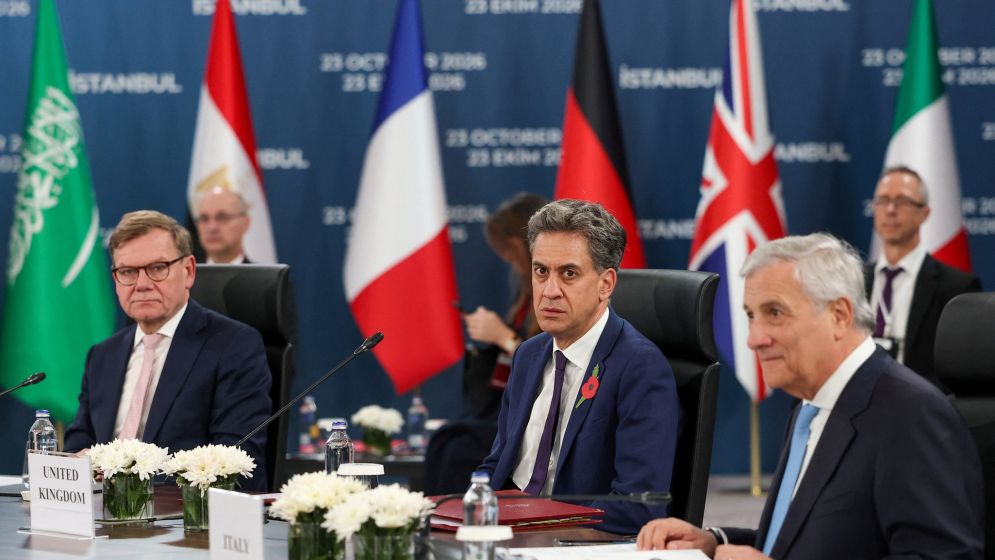
German Foreign Minister Johann Wadephul, British Foreign Secretary Ed Miliband and Italian Minister of Foreign Affairs International Cooperation Antonio Tajani are pictured during a meeting in Istanbul, Turkey, 23 October 2026. Photo: REUTERS
Foreign ministers from eight European and Middle Eastern
countries met in Istanbul on Friday in an unprecedented format, urging
diplomacy and peaceful solutions to prevail across the Middle East as well as
the reopening of the Strait of Hormuz.
Ministers from Britain, France, Germany and Italy met
counterparts from Turkey, Saudi Arabia, Pakistan and Egypt to discuss Hormuz --
a crucial trade route blocked in the Iran war -- Yemen and ways to end the
Russia-Ukraine conflict.
The talks happened at an Istanbul hotel overlooking the
Bosphorus, after separate meetings of top European diplomats and others from
regional countries.
At the heart of the talks was the situation in the Straits
of Hormuz and Bab el-Mandeb -- which is paralysing global trade and driving up
energy prices as well as the attacks on Saudi Arabia by Houthis from Yemen,
allies of Tehran.
French Foreign Minister Jean-Noel Barrot said a new
escalation between Iran and the United States "would create nothing but
losers and would undoubtedly have very serious consequences for hydrocarbon
prices".
"The first thing this group of eight countries ... will
do is call on both sides to exercise the utmost restraint, because we cannot
afford another escalation in the region," he told journalists.
Italy's Antonio Tajani said the regional problem cannot be
solved "from a purely military standpoint".
"If we want to reopen Hormuz, which is vital for our
economies, we must promote dialogue and make Iran understand that this attitude
cannot continue."
Egyptian backing for Saudi
Turkish Foreign Minister Hakan Fidan hosted the meeting as
Turkey stepped up efforts to strengthen its regional role, including through
the Mecca Defence Alliance, a defence pact launched with Pakistan and Saudi
Arabia in August.
Turkey has said the pact is not aimed at any specific
country and remains open to others, including Egypt although Cairo has yet to
decide whether to join the alliance.
On Wednesday, President Abdel Fattah al-Sisi said however
Egypt would "defend Saudi territory" but would not take part in any
attack on Yemen.
Iran-backed Houthis are battling Yemen's Saudi-backed
government and have launched attacks on Saudi Arabia.
Intensifying attacks by the Houthis have forced Saudi Arabia
to close its main airport and postpone a major investment conference, while a
maritime blockade has threatened oil exports from the world's largest crude
exporter.
Riyadh has since secured backing from its allies.
During a surprise visit on Wednesday, President Emmanuel
Macron said French forces would help protect the Red Sea oil terminal of Yanbu.
Britain announced a day earlier that it would deploy fighter
jets to help Saudi Arabia defend against the growing threat of Houthi attacks.
'Diplomacy the only way’
Ankara also intended to give more substance to the very
young Mecca pact, which brings together NATO's second-largest army Turkey,
Saudi Arabia the greatest power in the Gulf and Pakistan, the only state
equipped with nuclear weapons in the Muslim world.
At the closure, Fidan praised Friday's talks.
"The most important feature of our platform is that
it's informal, flexible, allows for the free expression of our ideas, the
creation of policies around these ideas, and the determination of concrete
action steps if necessary," he told a news conference.
The eight countries "decided, after very constructive
discussions, to continue the work by meeting at regular intervals", Barrot
said.
Fidan said all countries around the table "do not want
the war to spread further" both in the Gulf and in Ukraine. "All
countries believe that diplomacy and dialogue are the only way forward,"
he said.
"There is a huge room for diplomacy, but also a huge room for war. It depends especially on the stance that the relevant actors, the states in the region, and some global actors will take".