


 For all latest news, follow the Daily Sun's Google News channel.


From India's first IITs to digital health: Seven decades of the India-UNDP partnership
UNDP
Published: 24 Oct 2026, 05:27 PM
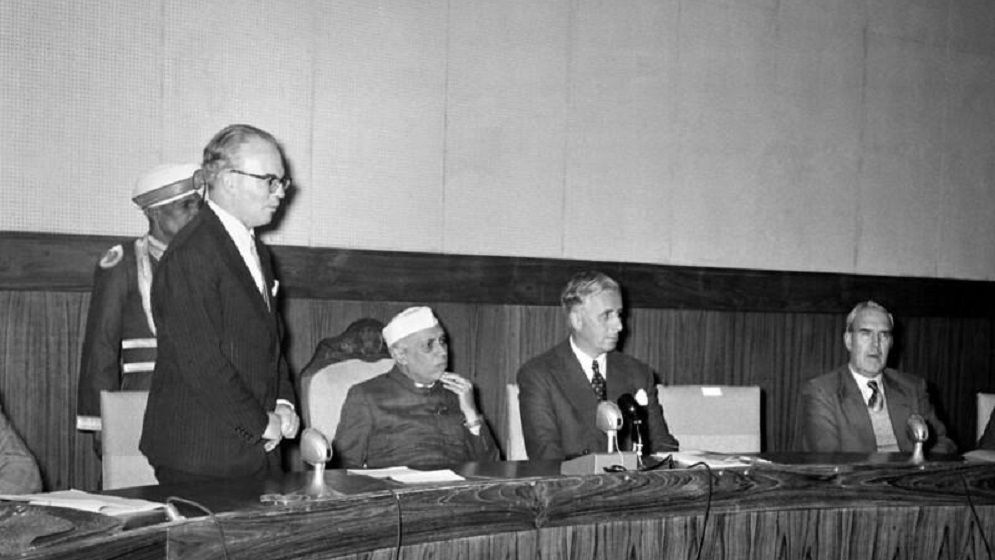
Indian Prime Minister Jawaharlal Nehru with James Keene, resident representative, UN Technical Assistance Board, New Delhi, 1958. Photo: UNDP
In the 1950s, India was a young nation investing in its
future. New institutions were taking shape, scientific research was expanding,
and the country was building the skills and infrastructure needed for
development.
The United Nations was part of that journey.
Years before the United Nations Development Programme (UNDP)
was formally established in 1965, UN technical cooperation was already
supporting India's efforts to strengthen its scientific and engineering
capabilities.
From the establishment of the country's early Indian
Institutes of Technology to the development of satellite communications,
digital governance and public health systems, the partnership has evolved
alongside India's changing priorities.
On United Nations Day, we revisit some of the milestones
that have shaped this journey.
1950s: Building the foundations of scientific India
India's early development priorities included building
institutions capable of producing world-class scientists, engineers and
researchers.
UN technical assistance contributed to the establishment of
IIT Kharagpur in 1950 and IIT Bombay in 1958, supporting the development of
institutions that would help shape India's scientific and technological future.
These early investments in education and research laid the
groundwork for decades of innovation.
1960s: From oil exploration to satellite communications
As India expanded its industrial and technological
capabilities, cooperation focused on strengthening expertise in energy and
communications.
In 1966, training and research support to the Oil and
Natural Gas Corporation's Institute of Petroleum Exploration helped strengthen
domestic oil exploration capabilities.
A year later, technical expertise supported India's first
Experimental Satellite Communication Earth Station in Ahmedabad.
This was an important step in developing India's
capabilities in satellite-based communication, technologies that would
eventually support applications ranging from environmental monitoring to
disaster warnings.
1970s: Transforming dairy, broadcasting and public
administration
The 1970s brought a new focus on modernising systems that
touched everyday life.
Through technical cooperation with the National Dairy
Development Board, UNDP supported Operation Flood, the programme that helped
transform India's dairy sector and strengthen milk supply chains across the
country.
In media and communications, UNDP helped develop the Film
and Television Institute of India in Pune and establish a dedicated television
training division, strengthening professional broadcasting skills.
Meanwhile, support to the National Informatics Centre helped
introduce mainframe computing into public administration, an early milestone in
India's journey towards digital governance.
1980s: Protecting wildlife and connecting researchers
By the 1980s, environmental conservation and scientific
connectivity were becoming increasingly important.
UNDP's collaboration with the Wildlife Institute of India
strengthened research and training capacities for wildlife conservation.
In 1986, cooperation with the Department of Electronics
contributed to the development of ERNET, India's pioneering education and
research network, helping connect scientific institutions through emerging
networking technologies.
UNDP also supported the strengthening of plant quarantine
stations to protect agriculture against pests and pathogens as India expanded
access to imported seeds.
1990s: Putting people at the centre of development
The 1990s marked an important shift towards understanding
development beyond economic growth alone.
Working with India's Planning Commission, UNDP helped
strengthen the use of the human development approach in policymaking,
supporting national and state-level systems for measuring progress in people's
lives.
At the community level, the South Asia Poverty Alleviation
Programme supported women's self-help groups in Andhra Pradesh, strengthening
local institutions that would become important to rural financial and social
systems.
Cooperation also extended to clean energy strategies for
Himalayan states, research and diversification in the jute sector, conservation
of medicinal plants and efforts to understand the migratory routes of Olive
Ridley sea turtles.
The common thread was a growing emphasis on people, livelihoods
and environmental sustainability.
2000s: Strengthening rights, local governance and disaster
resilience
The new millennium brought greater attention to citizen
rights, accountable institutions and community participation.
Following the introduction of the Right to Information Act
in 2005, UNDP supported capacity building for public information officers and
government officials to help operationalise the legislation.
From 2006, technical assistance to the Ministry of Rural
Development helped strengthen systems for implementing the Mahatma Gandhi
National Rural Employment Guarantee Act (MGNREGA).
UNDP also worked to build the capacities of elected women
representatives in Panchayati Raj institutions and collaborated with the
Government of India to institutionalise gender budgeting.
In disaster management, the partnership supported stronger
state-level capacities and community-led recovery approaches, placing affected
communities at the centre of reconstruction.
Other areas of cooperation included biodiversity planning,
sustainable rural tourism, HIV-sensitive social protection and State Action
Plans on Climate Change.
2010s: Digital health, inclusion and climate finance
During the 2010s, the partnership increasingly brought
together technology, social inclusion and environmental sustainability.
One major milestone was the Electronic Vaccine Intelligence
Network (eVIN), designed and implemented by UNDP to digitise vaccine stocks and
cold-chain temperature monitoring.
By improving visibility across vaccine supply chains, eVIN
helped strengthen immunisation logistics and later provided an important
foundation for COVID-19 vaccine management.
UNDP also supported efforts to advance transgender rights,
improve access to justice for women and marginalised communities, and expand
women's opportunities through the Disha programme, which tested approaches to
skills development and entrepreneurship.
On the environmental front, the Biodiversity Finance
Initiative (BIOFIN), launched in India in 2015, helped assess financing needs
and inform national biodiversity financing plans.
Work on energy efficiency in industries and Indian Railways
demonstrated how environmental sustainability could be integrated into major
economic sectors.
2020s: Responding to crises and accelerating sustainable
development
When COVID-19 placed extraordinary pressure on health
systems, UNDP supported India's response through digital vaccine logistics and
assistance to oxygen systems in hospitals across the Northeast.
The partnership supported the rollout of CoWIN for COVID-19
vaccination and subsequently the nationwide rollout of U-WIN, strengthening
digital systems for routine immunisation for pregnant women and children.
Beyond the pandemic, cooperation has focused on translating
the Sustainable Development Goals into measurable progress at state and
district levels.
UNDP-supported SDG monitoring and coordination models have
helped strengthen data-driven planning and local action.
The partnership also continues to support India's
environmental commitments, including action on climate change, biodiversity,
desertification and ozone layer protection.
At the community level, work with government partners
focuses on strengthening rights and livelihoods for tribal communities,
supporting smallholder farmers through crop insurance, and improving
protections for sanitation workers.
From public health to climate resilience, the emphasis
remains on building systems that can reach people at scale.